
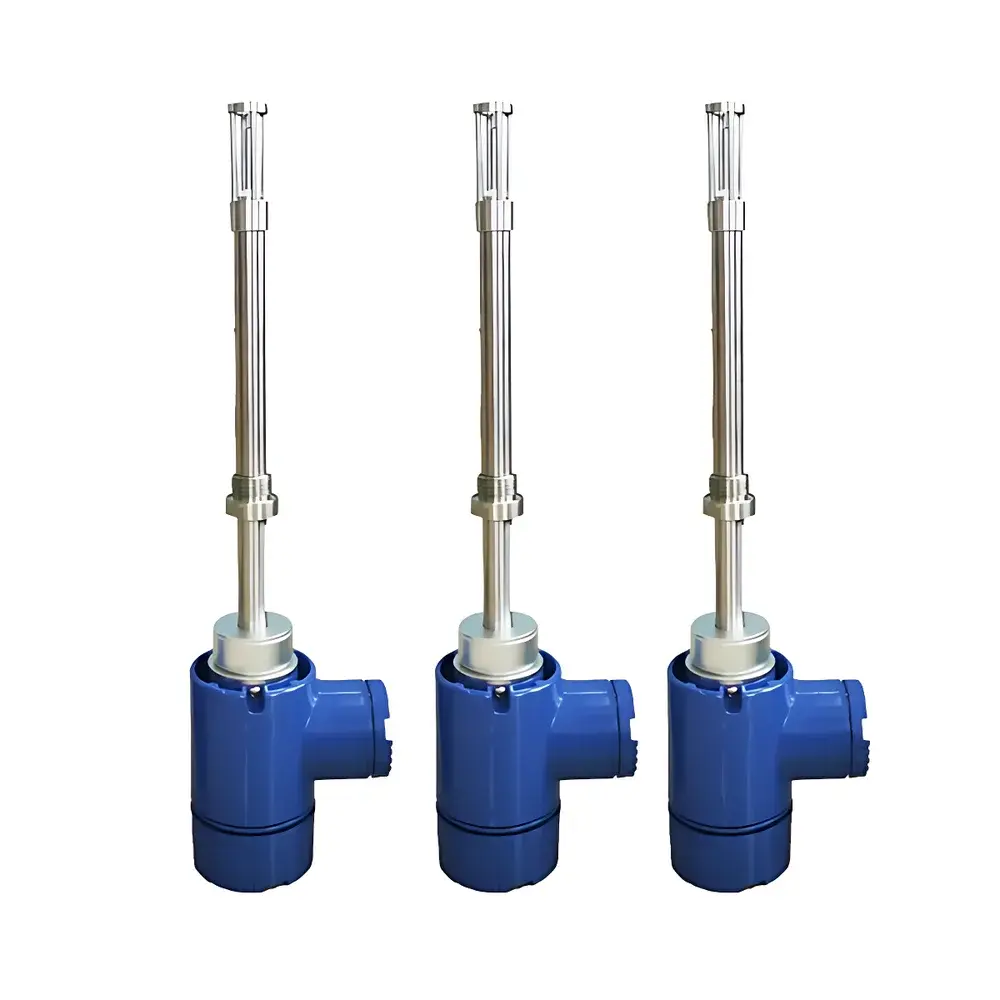
Bigdipper T-BD5 MS1204p Microwave Attenuation-Based Crude Oil Water Content Analyzer
| Brand | Bigdipper |
|---|---|
| Origin | Beijing, China |
| Manufacturer | Bigdipper Instruments Co., Ltd. |
| Model | T-BD5 MS1204p |
| Measurement Principle | Microwave attenuation (MS1204 sensor technology) |
| Operating Temperature | 100–350 °C |
| Pressure Rating | 1.6–4.0 MPa |
| Water Content Range | 0.02–101% w/w |
| Resolution | 0.02–0.1% |
| Repeatability | ±0.05% to ±1.0% FS |
| Output | 4–20 mA analog, RS232/RS485, Modbus RTU, IEEE 1451.2 STIM |
| Enclosure Rating | NEMA 7/8/9 |
| Intrinsic Safety | Ex ia IICT6 |
| Flameproof Protection | Ex d ia IIC T5 |
| Wetted Materials | 1Cr18Ni9Ti stainless steel, polyimide |
| Installation Options | Threaded (ZG1", NPT), flanged, clamp-type, bypass |
| Flow Orientation | Counter-flow (frontal insertion) |
| Sensor Geometry | Insertion-type probe with optimized electromagnetic field distribution |
| Compliance | ASTM D4006, ISO 9001, GB/T 11141-2014, ATEX Directive 2014/34/EU (via third-party certification), IEC 60079-0/-11/-14, FDA 21 CFR Part 11 (data integrity support via audit trail in BD5xCMD firmware) |
Overview
The Bigdipper T-BD5 MS1204p is a high-reliability, in-line microwave attenuation-based analyzer engineered for continuous, real-time water-in-crude oil measurement across upstream, midstream, and downstream hydrocarbon processing environments. Unlike conventional capacitance or dielectric sensors—whose accuracy degrades significantly with temperature, salinity, emulsion stability, or flow turbulence—the MS1204 sensing platform employs frequency-modulated microwave transmission through the flowing medium, measuring amplitude attenuation proportional to water concentration independent of conductivity, viscosity, or phase separation kinetics. This physics-based approach enables stable calibration over extended operational intervals without recalibration drift, even under dynamic process conditions involving variable water-cut (0.02–101%), high temperature (up to 350 °C), and elevated pressure (up to 4.0 MPa). The instrument was originally developed under the Beijing Torch Program (1996) following three decades of comparative research into international moisture detection methodologies by Chinese Academy of Sciences engineers, resulting in a robust architecture validated across over 1,200 field installations worldwide.
Key Features
- True microwave attenuation sensing—immune to electrical conductivity variations, eliminating errors from brine content, corrosion inhibitors, or demulsifier residues
- Insertion-style probe design with optimized electromagnetic field geometry for uniform sensitivity across full water-cut range (0.02–101% w/w)
- Intrinsically safe (Ex ia IICT6) and flameproof (Ex d ia IIC T5) dual-certified housing for Zone 0/1 and Class I Div 1 hazardous locations
- High-temperature probe materials: 1Cr18Ni9Ti austenitic stainless steel and thermally stable polyimide insulation rated to 350 °C
- No moving parts, no optical windows, no consumables—designed for zero-maintenance operation in abrasive, fouling-prone crude streams
- Configurable analog output (4–20 mA) with user-defined span; digital interfaces include RS485 (Modbus RTU), RS232, and IEEE 1451.2 STIM for smart transmitter integration
- Onboard data logging with time-stamped audit trail compliant with GLP/GMP traceability requirements (BD5xCMD variant)
Sample Compatibility & Compliance
The T-BD5 MS1204p is validated for homogeneous, single-phase or stable emulsion crude oils and condensates with dielectric contrast between hydrocarbon and aqueous phases. It is not intended for highly aerated, foaming, or intermittently segregated flows—consistent laminar or turbulent flow with minimal entrained gas is required for metrological validity. The sensor complies with international standards governing petroleum product analysis (ASTM D4006 for water determination in crude oil), quality management systems (ISO 9001), and explosion protection (IEC 60079-0, -11, -14; EN 60079-0:2018). Firmware versions BD5xCMD and BD5ICM support electronic record integrity per FDA 21 CFR Part 11, including operator authentication, change history, and tamper-evident audit logs. Third-party ATEX certification documentation is available upon request for EU market deployment.
Software & Data Management
The BD5xCMD and BD5ICM transmitter variants integrate embedded firmware supporting configuration via local keypad or remote HART-compatible handhelds. All models log timestamped measurement records with configurable sampling intervals (1–60 seconds). Data export is supported via ASCII CSV over serial or Modbus register polling. For enterprise-level integration, the IEEE 1451.2 STIM interface provides standardized transducer electronic data sheet (TEDS) metadata, enabling plug-and-play recognition within distributed control systems (DCS) and SCADA platforms. Optional cloud telemetry modules support MQTT/HTTPS upload for centralized analytics, predictive maintenance alerts, and historical trend correlation with separator performance or custody transfer events.
Applications
- Real-time water-cut monitoring at wellheads, manifold headers, and gathering station inlets
- Custody transfer verification pre- and post-treatment (dehydration, desalting, electrostatic coalescence)
- Optimization of chemical injection rates (demulsifiers, corrosion inhibitors) based on dynamic water-phase feedback
- Process safety interlocks for high-water alarms in storage tanks or pipeline pigging operations
- Concentration tracking of polar contaminants in refined products (e.g., methanol in LPG, glycol in natural gas liquids)
- Research-grade quantification of water-in-oil emulsion stability under thermal or shear stress in pilot-scale facilities
FAQ
What physical principle does the MS1204 sensor rely on?
Microwave attenuation at fixed carrier frequencies (typically 1–3 GHz), where signal loss correlates directly with volumetric water fraction due to water’s high dielectric loss tangent relative to hydrocarbons.
Can the T-BD5 MS1204p measure water in heavy crudes or bitumen?
Yes—provided the sample remains pumpable and thermally homogenized; viscosity independence is inherent to microwave propagation physics, though extreme non-Newtonian behavior may require empirical calibration validation.
Is field calibration possible without laboratory reference standards?
Yes—the instrument supports two-point field calibration using certified reference oils (e.g., ASTM D4006-compliant spiked samples); no disassembly or sensor removal is required.
How does the system handle emulsion inversion or water-in-oil/oil-in-water transitions?
The microwave method responds to total water volume regardless of dispersion state; however, rapid phase inversion may cause transient measurement lag until flow stabilization—process engineering controls are recommended to minimize such transients.
What cybersecurity protocols are implemented for remote access?
Firmware v3.2+ includes TLS 1.2 encryption for HTTPS API endpoints, role-based access control (RBAC), and secure boot verification; Modbus communication requires network-level segmentation per ISA/IEC 62443-3-3 guidelines.






