
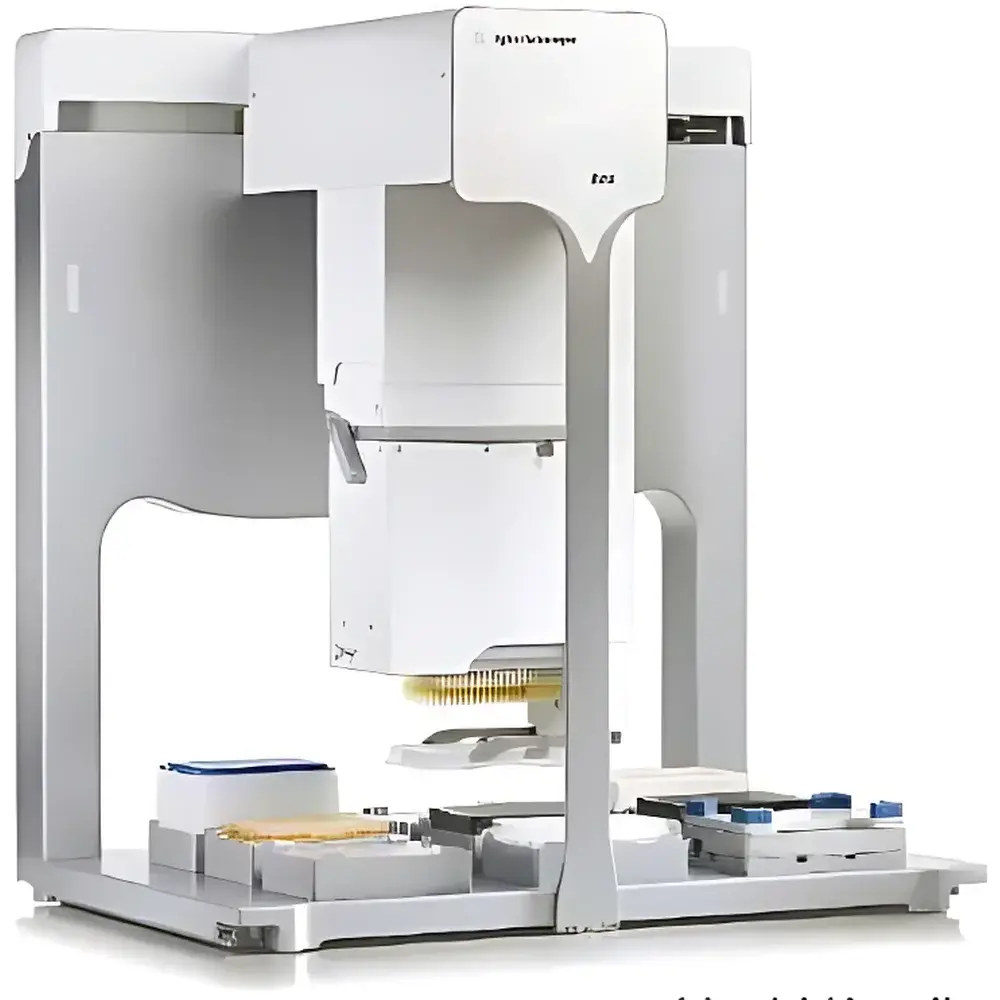
Agilent Bravo Automated Liquid Handling Platform
| Brand | Agilent Technologies |
|---|---|
| Origin | Singapore |
| Manufacturer | Agilent Technologies |
| Origin Category | Imported |
| Model | Bravo |
| Pricing | Available Upon Request |
Overview
The Agilent Bravo Automated Liquid Handling Platform is a modular, benchtop liquid handling workstation engineered for precision, reproducibility, and flexibility in sample preparation workflows across drug discovery, genomics, cell biology, and quality control laboratories. Built on a robust, open-architecture platform, the Bravo system employs air-displacement pipetting technology with positive displacement options available via compatible accessories. Its core design philosophy centers on minimizing manual intervention while maintaining traceability, compliance readiness, and seamless integration into regulated environments. The system supports end-to-end automation of liquid transfer, dilution, plate replication, reformatting, and assay setup — all within a footprint small enough to fit inside laminar flow hoods or standard biosafety cabinets (BSCs), enabling sterile and contamination-controlled operations.
Key Features
- Compact 9-microwell plate deck layout: Optimized for space-constrained environments; fully compatible with Class II laminar flow hoods and biosafety cabinets without compromising accessibility or ergonomics.
- Modular pipetting heads: Interchangeable 96-channel and 384-channel pipetting modules with disposable tips; supports accurate liquid dispensing from 300 nL to 250 µL per channel across 96-, 384-, and 1536-well microplates.
- Flexible tip pickup modes: Single-tip, row-wise, column-wise, or arbitrary pattern selection enables precise adaptation to diverse plate layouts and protocol requirements.
- Open-system architecture: Front-, side-, and rear-accessible design facilitates integration with third-party instruments (e.g., plate readers, centrifuges, thermal cyclers) and supports custom robotic arm interfacing.
- Optical safety curtain: Integrated light curtain meets IEC 61508 and ISO 13857 safety standards, automatically halting motion when interrupted — ensuring operator protection during routine operation.
- Optional On-Deck Thermal Cycler (ODTC): A compact, Peltier-based thermal cycler mounted directly on the Bravo deck eliminates manual plate transfers, reduces hands-on time by up to 70% in PCR setup workflows, and improves thermal consistency across replicates.
Sample Compatibility & Compliance
The Bravo platform handles a wide range of sample types including aqueous buffers, cell suspensions, genomic DNA/RNA extracts, protein solutions, and viscous reagents (e.g., glycerol-containing stocks). Tip compatibility extends to low-retention, filtered, and conductive tips for sensitive applications such as qPCR and single-cell analysis. From a regulatory standpoint, the system supports Good Laboratory Practice (GLP) and Good Manufacturing Practice (GMP) workflows through Agilent Instrument Qualification (AIQ), which delivers documented Installation Qualification (IQ) and Operational Qualification (OQ) protocols aligned with ISO/IEC 17025 and ASTM E2500 guidelines. Full audit trail capabilities, electronic signatures, and user access controls are enabled via VWorks software configuration compliant with FDA 21 CFR Part 11 requirements.
Software & Data Management
VWorks Automation Control Software serves as the central interface for method development, execution, and monitoring. Its drag-and-drop workflow builder allows users to construct complex multi-step protocols without coding — including conditional logic, plate mapping, error handling, and real-time status visualization. All method files, run logs, and instrument events are stored in a structured SQLite database with timestamped entries, supporting retrospective analysis and data integrity verification. VWorks also provides export functionality in CSV, XML, and LIMS-compatible formats (e.g., ANSI X12, HL7), facilitating integration with enterprise laboratory information management systems (LIMS) and electronic lab notebooks (ELN).
Applications
- Compound library normalization and cherry-picking for high-throughput screening (HTS)
- Automated nucleic acid library preparation for next-generation sequencing (NGS)
- Cell-based assay setup including transfection, viability assays, and dose-response profiling
- qRT-PCR and digital PCR (dPCR) plate setup with thermal cycling integration
- QC sample preparation for biopharmaceutical release testing (e.g., residual host cell DNA quantification)
- Standard curve generation and serial dilution across multiple concentration ranges
FAQ
Is the Bravo platform compatible with third-party consumables?
Yes — the system accepts industry-standard tips, plates, and tubes from major suppliers, provided dimensional specifications comply with ANSI/SBS microplate standards.
Does the Bravo support barcode scanning for sample tracking?
Yes — optional integrated 2D barcode reader module enables automated plate identification, traceability, and error-proofing during protocol execution.
Can VWorks be validated for use in regulated environments?
Yes — Agilent provides VWorks Validation Support Packages including IQ/OQ documentation templates, test scripts, and change control records aligned with GAMP 5 principles.
What maintenance is required for long-term reliability?
Routine maintenance includes tip ejection calibration, pipette axis alignment verification, and optical sensor cleaning — all supported by guided procedures in the onboard service menu and Agilent’s remote diagnostics portal.
Is remote monitoring or cloud-based data backup available?
While VWorks operates locally for security and latency reasons, encrypted log exports can be scheduled to network drives or secure cloud storage via IT-managed file transfer protocols (e.g., SFTP, SMB).
Related Products



