
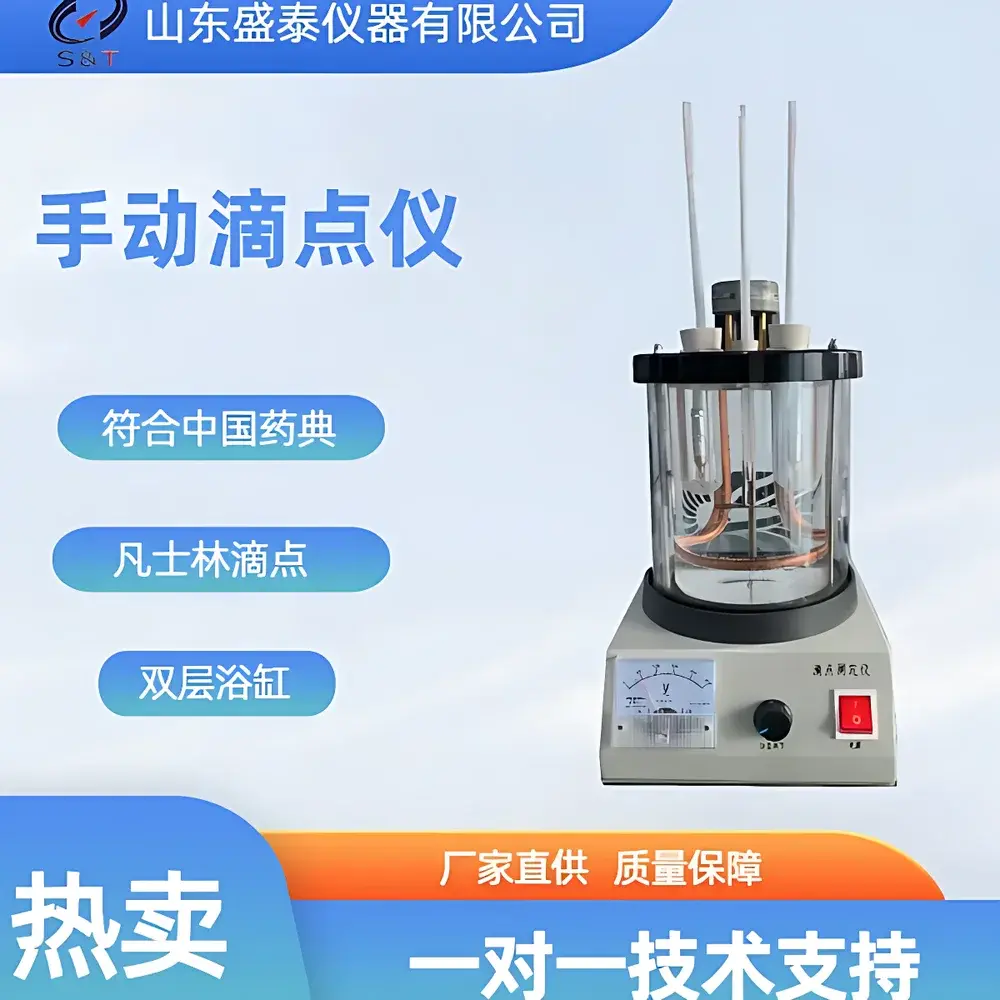
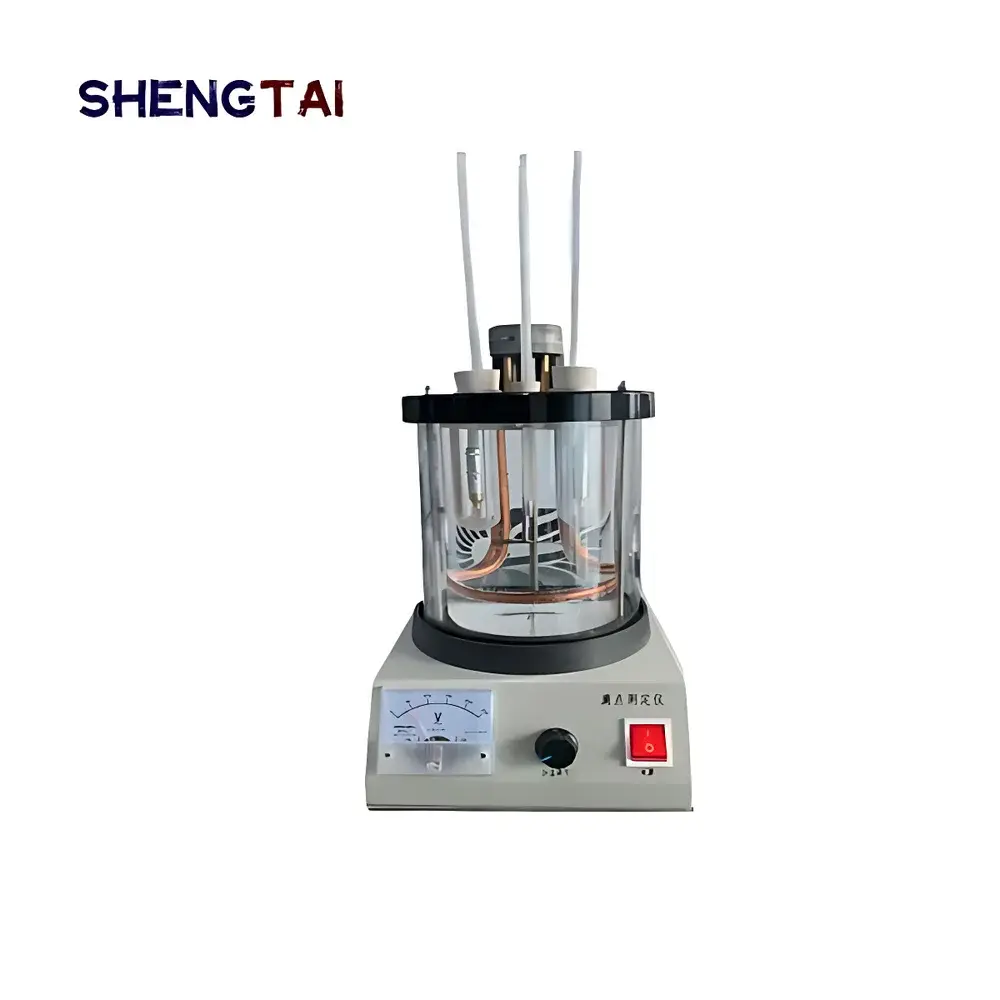
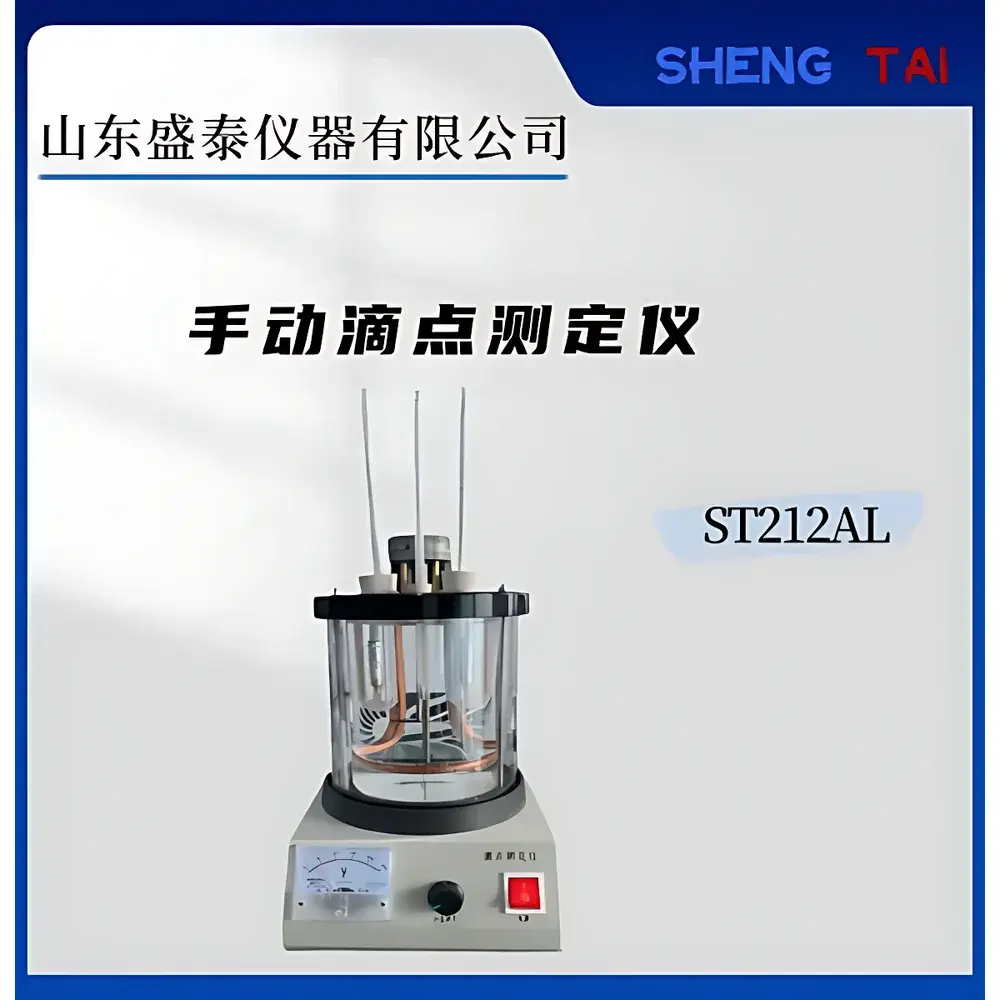
Shengtai Instruments ST212AL Manual Dropping Point Apparatus
| Brand | Shengtai Instruments |
|---|---|
| Origin | Shandong, China |
| Manufacturer | Yes |
| Country of Origin | China |
| Model | ST212AL |
| Pricing | Upon Request |
| Power Supply | AC 220 V ±10%, 50 Hz |
| Bath | Double-walled insulated bath |
| Grease Cup | Brass-plated chromium |
| Test Tube | Borosilicate glass, 110 mm total length, 25 mm inner diameter |
| Thermometer | Metal-sheathed, –5 to 105 °C |
| Heater | Tubular, 400 W |
| Stirring Motor | 250 rpm |
| Ambient Operating Temperature | –10 to +40 °C |
| Relative Humidity | ≤85% RH |
| Max. Power Consumption | ≤500 W |
Overview
The Shengtai Instruments ST212AL Manual Dropping Point Apparatus is a precision-engineered instrument designed for the standardized determination of dropping point — the temperature at which a semi-solid substance (e.g., petroleum greases, pharmaceutical ointments, or vaseline) begins to flow under defined thermal and gravitational conditions. It operates on the classical capillary-melting principle: as the sample in a standardized grease cup is uniformly heated within a thermostatically controlled oil bath, the onset of continuous droplet formation through the cup’s calibrated orifice marks the dropping point. This method aligns with pharmacopoeial and industrial test protocols requiring reproducible, operator-controlled thermal transition assessment without automated ramping or digital feedback loops.
Key Features
- Compliance-ready design validated against Chinese Pharmacopoeia (2020 Edition), British Pharmacopoeia, and SH/T 0678—Standard Test Method for Dropping Point of Petrolatum.
- Double-walled insulated bath ensures stable thermal gradient development and minimizes external heat loss during prolonged heating cycles.
- Precision-machined brass-plated chromium grease cups conform strictly to dimensional tolerances specified in pharmacopoeial standards (wide-end ID: 7.35–7.65 mm; narrow-end ID: 3.1–3.2 mm), ensuring consistent sample geometry and flow dynamics.
- Dedicated metal-sheathed thermometer (–5 to 105 °C) with fine-scale graduation enables direct visual reading with ±0.5 °C readability — suitable for manual endpoint detection per USP & EP guidelines.
- 250 rpm magnetic stirring motor maintains uniform temperature distribution throughout the bath medium, reducing convection-induced stratification and improving inter-laboratory reproducibility.
- 400 W tubular heater delivers controlled thermal input, supporting gradual ramp rates required for accurate identification of the first discernible droplet fall — critical for GMP-aligned QC workflows.
- Robust mechanical architecture with no embedded microprocessors or firmware, facilitating straightforward validation, calibration traceability, and long-term serviceability in regulated environments.
Sample Compatibility & Compliance
The ST212AL is optimized for semi-solid thermoplastic materials exhibiting defined softening transitions, including but not limited to: white petrolatum (USP/NF grade), yellow ointment base (BP), hydrocarbon-based greases, and certain polymer dispersions. Its physical configuration satisfies the geometric and procedural constraints outlined in ISO 4625, ASTM D566, and EP 2.2.17. While not electronically compliant with FDA 21 CFR Part 11, its fully manual operation supports ALCOA+ data integrity principles when used with contemporaneous handwritten records, witnessed observations, and calibrated reference thermometers — making it suitable for GLP-compliant stability studies and routine QC release testing where audit trails are maintained via laboratory notebook documentation.
Software & Data Management
This apparatus does not incorporate embedded software, firmware, or digital data output interfaces. All measurements are recorded manually by the operator using calibrated analog instrumentation. Temperature readings are documented directly from the metal-sheathed thermometer at the moment of first droplet detachment. This analog workflow eliminates risks associated with electronic data manipulation, software validation burden, or cybersecurity vulnerabilities. Laboratories implementing this instrument may integrate it into broader quality management systems via standardized SOPs governing observation timing, recording frequency, and secondary verification procedures — consistent with Annex 11 (EU GMP) expectations for non-automated equipment.
Applications
- Quality control release testing of petrolatum and ointment bases in pharmaceutical manufacturing facilities.
- Batch-to-batch consistency evaluation of topical formulations prior to packaging.
- Stability-indicating testing under accelerated storage conditions (e.g., ICH Q1A).
- Raw material qualification of hydrophobic excipients supplied to contract development and manufacturing organizations (CDMOs).
- Educational use in university-level pharmaceutics and analytical chemistry laboratories for teaching fundamental thermal transition behavior.
- Regulatory submission support for ANDA or DMF dossiers where dropping point serves as a critical quality attribute (CQA).
FAQ
What pharmacopoeial standards does the ST212AL explicitly support?
It is configured and validated for Chinese Pharmacopoeia (2020), British Pharmacopoeia, and SH/T 0678 — all of which define identical cup geometry, bath configuration, and endpoint criteria.
Is the grease cup interchangeable with ASTM D566-compliant cups?
Yes — its dimensional specifications (including narrow-end orifice and cup height) meet the tolerance limits specified in ASTM D566 for standard grease cups.
Can this instrument be used for samples other than petrolatum?
It is applicable to any semi-solid material that exhibits a discrete, gravity-driven flow onset within the –5 to 105 °C range and conforms to cup loading requirements (e.g., certain waxes, bituminous materials, and synthetic ointment bases).
Does the unit include calibration certification?
Each shipment includes a factory calibration certificate for the metal-sheathed thermometer, traceable to national metrological standards; users are responsible for periodic recalibration per internal SOPs.
What maintenance is required for long-term reliability?
Routine cleaning of the bath chamber and grease cup after each use, periodic inspection of heater terminals and stirrer coupling integrity, and annual verification of thermometer accuracy using ice-point and boiling-water references.





