
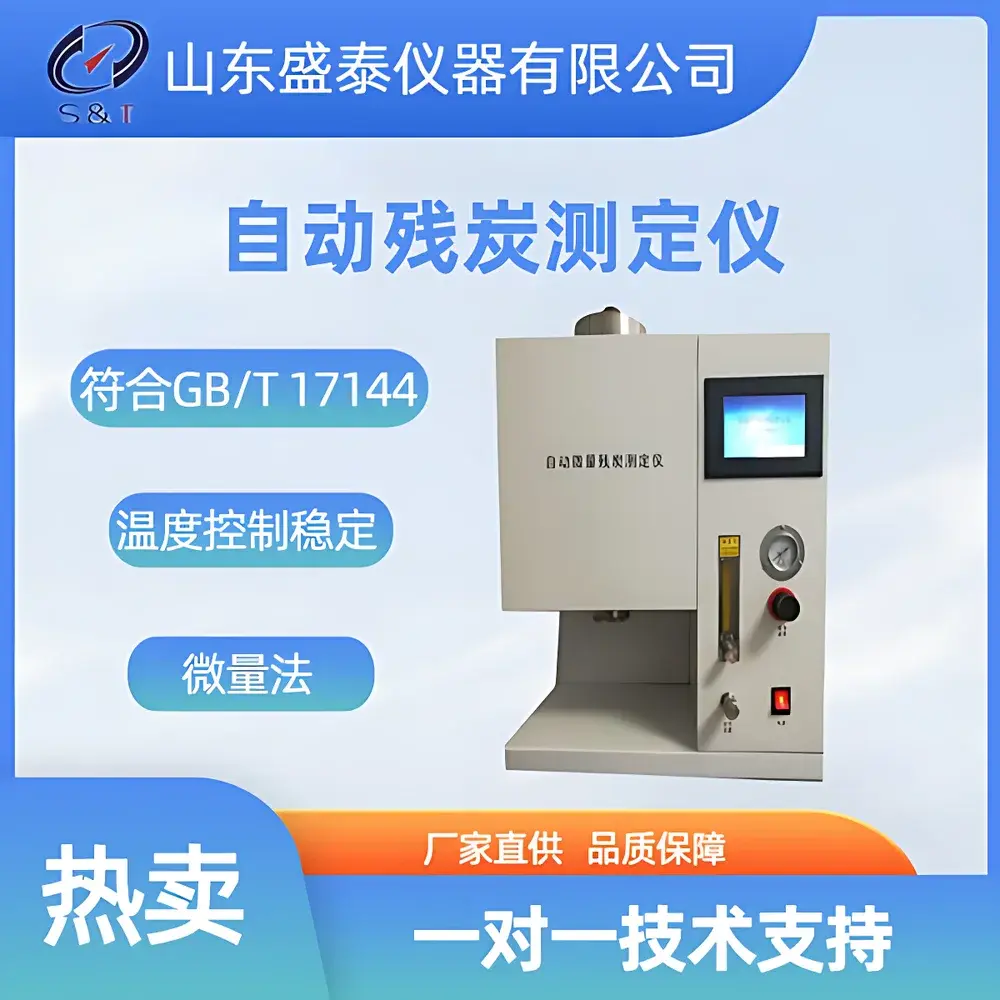
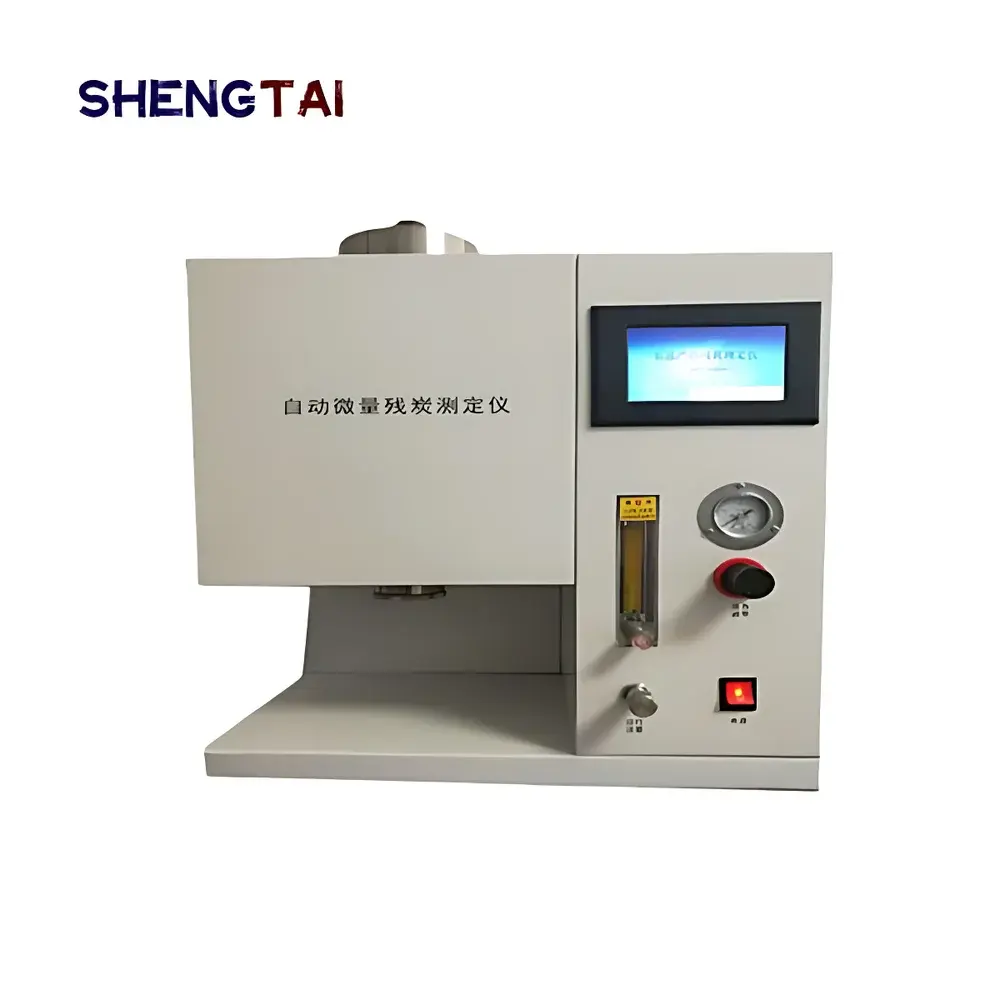
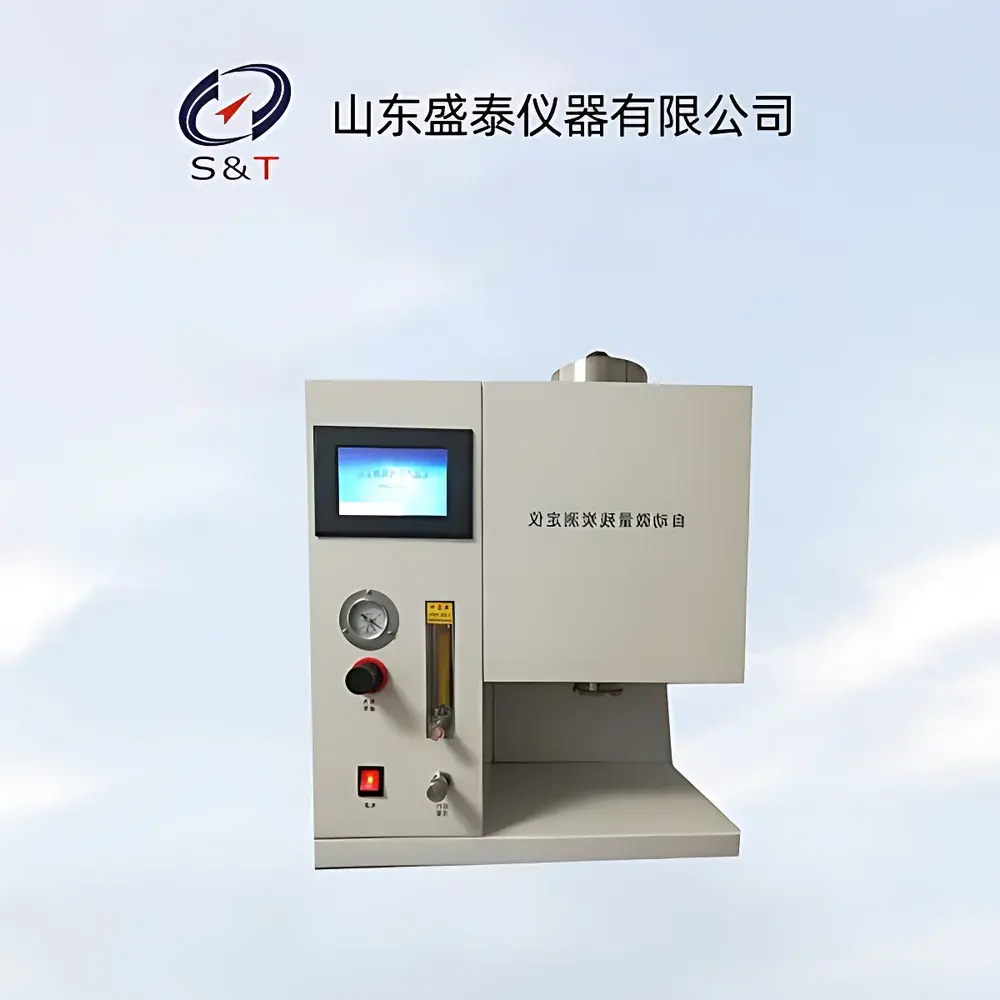
Shengtai Instruments SH109 Micro Carbon Residue Tester
| Brand | Shengtai Instruments |
|---|---|
| Origin | Shandong, China |
| Manufacturer Type | Direct Manufacturer |
| Country of Origin | China |
| Model | SH109 |
| Price Range | USD 7,000 – 14,000 |
| Standard Compliance | GB/T 17144-2021, ASTM D4530, ISO 10370:1993 |
| Measurement Range | 0.10–30.0 % (m/m) |
| Temperature Range | Ambient to 500 °C |
| Isothermal Accuracy | 500 °C ±2.0 °C (15 min hold) |
| Nitrogen Supply Pressure | 0–392 kPa (adjustable) |
| Gas Flow Control | 100–1000 mL/min, with auto-switching between 150 mL/min and 600 mL/min |
| Furnace Chamber Dimensions | Φ85 mm × 105 mm |
| Waste Collection Bottle Capacity | 200 mL |
| Heating Power | 1000 W |
| Power Supply | AC 220 V ±10%, 50 Hz |
| External Dimensions | 230 × 320 × 425 mm |
| Time Setting Resolution | <0.1 s |
| Display & Control | Color LCD touchscreen interface with real-time status indicators (Purge / Ramp / Soak) |
| Data Output | Optional thermal printer support |
Overview
The Shengtai Instruments SH109 Micro Carbon Residue Tester is a precision laboratory instrument engineered for the quantitative determination of carbon residue in petroleum products via the micro-method—specifically aligned with the gravimetric principle defined in GB/T 17144-2021, ASTM D4530, and ISO 10370:1993. Unlike the traditional Conradson carbon residue (CCR) method (GB/T 268), the micro-method employs a small, precisely weighed sample (typically 0.7–1.0 g) placed in a standardized crucible, subjected to controlled pyrolysis under inert nitrogen atmosphere. The residual carbonaceous material remaining after volatilization and thermal decomposition is quantified as mass percent (m/m). This technique delivers improved repeatability, reduced operator variability, and enhanced safety due to smaller sample volumes and enclosed furnace operation. The SH109 is optimized for routine quality control in refineries, lubricant formulation labs, and third-party testing facilities where trace-level carbon residue assessment—particularly for distillate fuels, diesel blends, and base oils with residues below 0.10 % (m/m)—is required for compliance with engine deposit prediction models and refinery process monitoring protocols.
Key Features
- Full-programmable thermal profile control: Precise ramp rate definition, multi-stage temperature setpoints, and automated soak duration execution ensure strict adherence to standard-defined heating schedules (e.g., 10 °C/min to 500 °C, followed by 15-minute isothermal hold).
- Integrated nitrogen flow management system: Dual-range mass-flow regulation (100–1000 mL/min) with automatic switching between low-flow (150 mL/min) during initial purge and high-flow (600 mL/min) during pyrolysis ensures optimal inert gas blanket integrity and reproducible oxidation suppression.
- High-stability furnace architecture: Ceramic-insulated heating chamber with PID-controlled 1000 W resistive elements maintains ±2.0 °C isothermal accuracy at 500 °C over 15 minutes—critical for inter-laboratory comparability.
- Real-time operational status visualization: Color LCD touchscreen displays dynamic phase indicators (“Purge”, “Ramp”, “Soak”) alongside actual vs. setpoint temperature, elapsed time, and gas pressure—enabling immediate procedural verification without manual logging.
- Modular sample handling design: Accommodates both standard micro-crucibles (for 0.10–3.0 % range) and extended-capacity crucibles (for up to 30.0 % residue), with dedicated racks and calibrated 200 mL waste collection bottle for condensate containment.
Sample Compatibility & Compliance
The SH109 is validated for use with liquid hydrocarbon samples including middle distillates (diesel, jet fuel), residual fuel oils, lubricating base stocks, and cracked feedstocks. It meets all instrumental requirements specified in GB/T 17144-2021 (China), ASTM D4530 (U.S.), and ISO 10370:1993 (International), ensuring data acceptability in regulatory submissions, contract testing reports, and internal QC documentation. Its measurement range of 0.10–30.0 % (m/m) supports both low-residue specification verification (e.g., ultra-low-sulfur diesel) and high-residue process stream characterization. Instrument design incorporates fail-safes against overpressure, overheating, and uncontrolled gas flow—aligning with general laboratory safety best practices per ISO/IEC 17025:2017 clause 5.3. All electronic components comply with CE electromagnetic compatibility (EMC) directives, and mechanical construction adheres to IP20 environmental protection rating for indoor laboratory use.
Software & Data Management
While the SH109 operates as a standalone benchtop unit with embedded firmware, its RS232 and USB interfaces enable seamless integration into laboratory information management systems (LIMS) or custom data acquisition platforms. Time-stamped test records—including start time, final mass, calculated residue %, temperature profile log, and operator ID—can be exported in CSV format for audit trail generation. Optional thermal printer output provides hard-copy documentation compliant with GLP principles. Firmware supports user-defined method templates, password-protected parameter modification, and event-driven logging (e.g., door open, pressure deviation >5 kPa), facilitating FDA 21 CFR Part 11 readiness when deployed with validated software layers. Audit trail functionality—including who changed what parameter and when—is configurable via external host applications.
Applications
- Refinery process control: Monitoring carbon-forming tendency of vacuum gas oils and coker feedstocks to optimize cracking severity and minimize fouling in downstream units.
- Fuel certification: Verifying conformance of diesel and marine distillate fuels to ISO 8217, EN 590, or ASTM D975 specifications requiring ≤0.10 % (m/m) carbon residue.
- Lubricant R&D: Evaluating thermal stability of synthetic esters and polyalphaolefins under simulated high-temperature service conditions.
- Contract testing laboratories: Supporting accredited testing per ISO/IEC 17025 for carbon residue reporting in technical data sheets and regulatory filings.
- Emissions research: Correlating micro-carbon residue values with particulate matter formation potential in advanced combustion studies.
FAQ
What standards does the SH109 fully support?
The SH109 complies with GB/T 17144-2021, ASTM D4530, and ISO 10370:1993 for micro carbon residue determination.
Can the SH109 replace traditional Conradson (GB/T 268) testing?
Yes—the instrument’s results demonstrate strong correlation with GB/T 268 data across the 0.10–30.0 % (m/m) range, making it suitable for method equivalency validation and transition programs.
Is nitrogen purity critical for accurate results?
Yes—high-purity nitrogen (≥99.998 %) is required to prevent oxidative side reactions; impurities such as oxygen or moisture may elevate residue readings and compromise repeatability.
What maintenance is required for long-term calibration stability?
Annual verification of thermocouple accuracy and furnace uniformity mapping is recommended; crucible cleaning and flowmeter recalibration should occur quarterly in high-throughput environments.
Does the SH109 support remote diagnostics or firmware updates?
Firmware updates are performed via USB drive; remote diagnostics require integration with a networked LIMS or SCADA system using the provided communication protocol documentation.






