
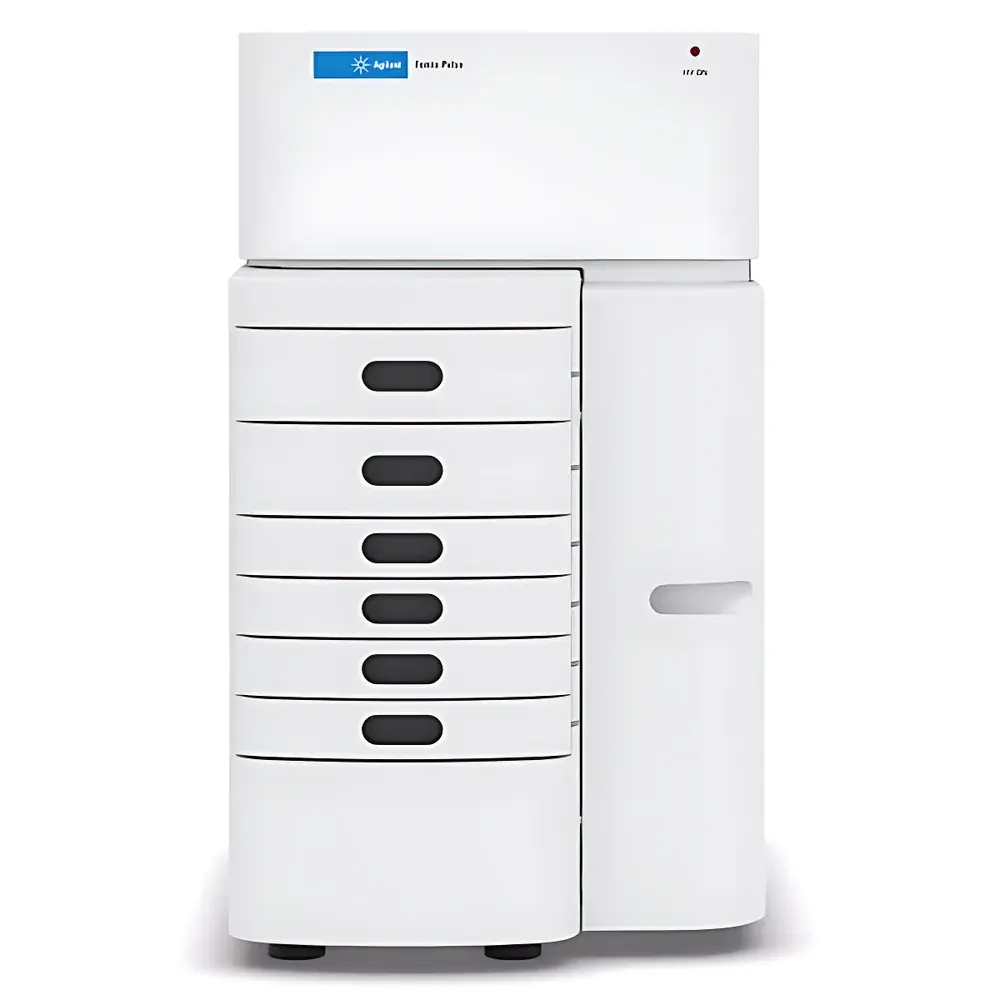
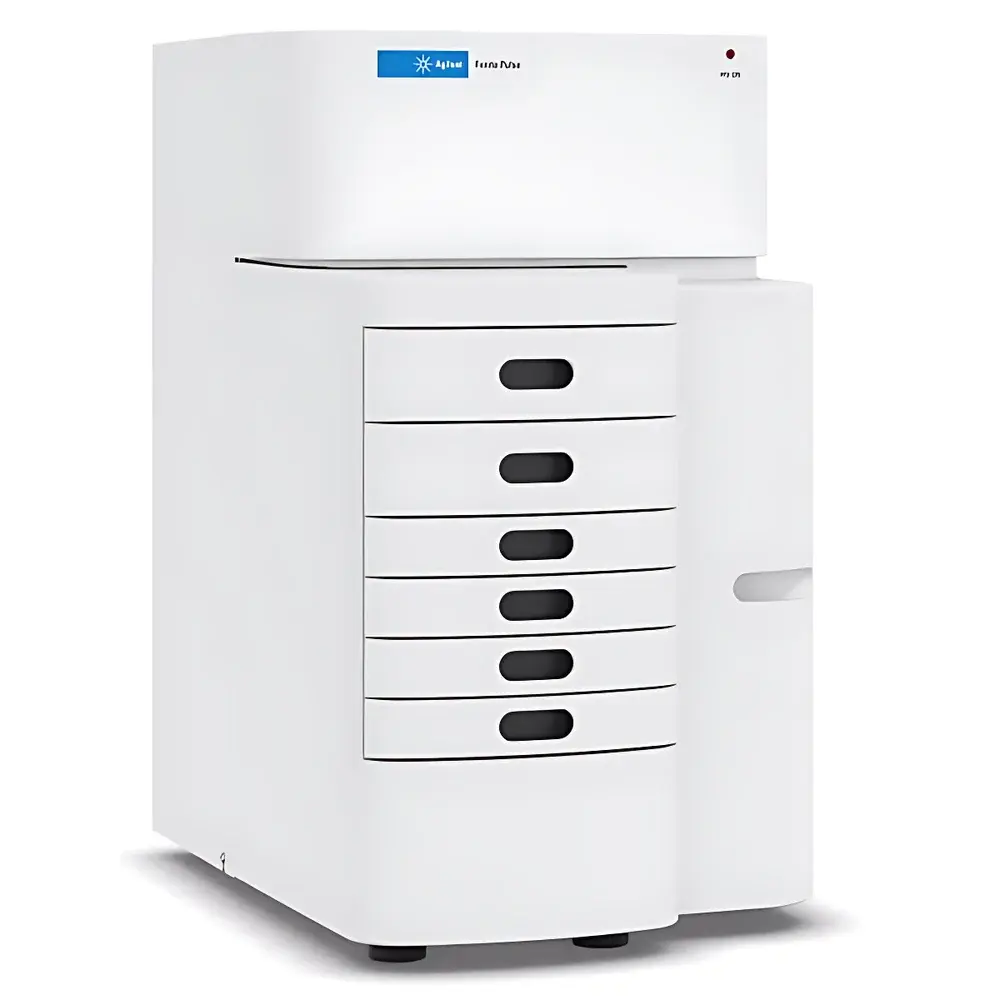
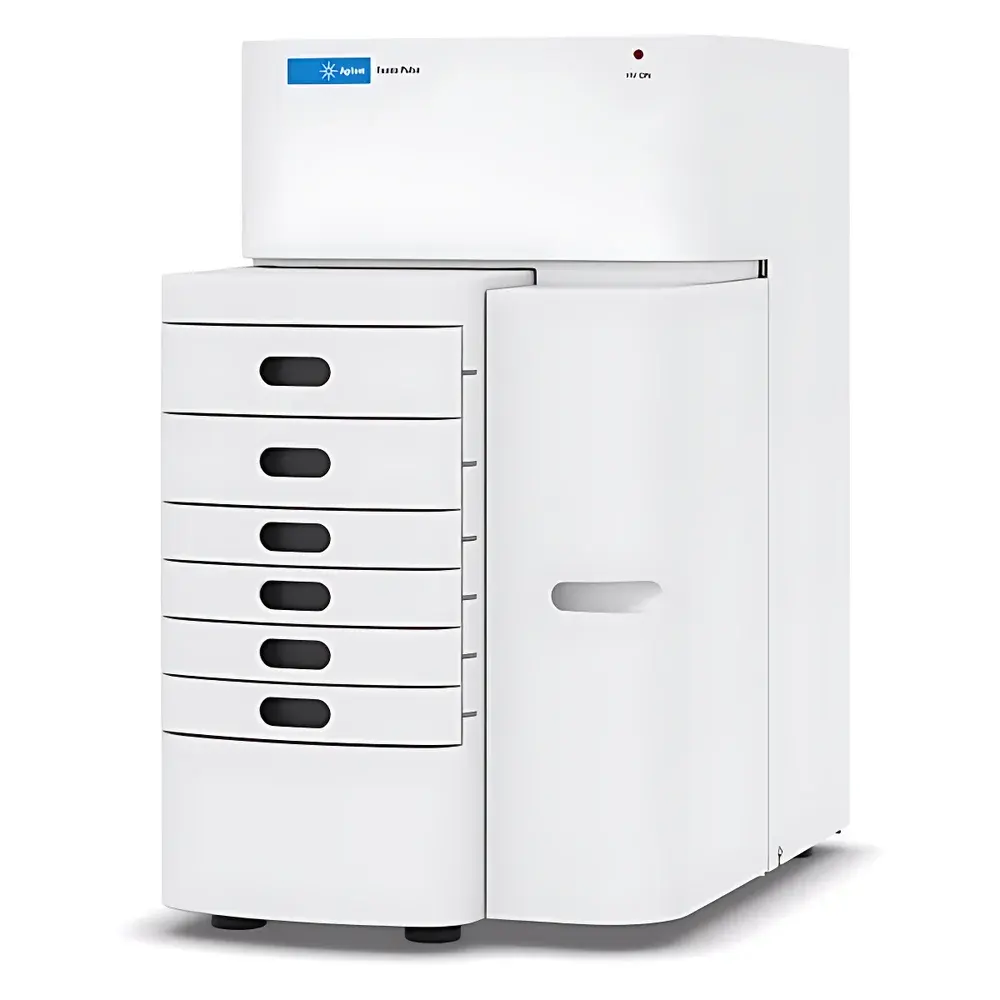
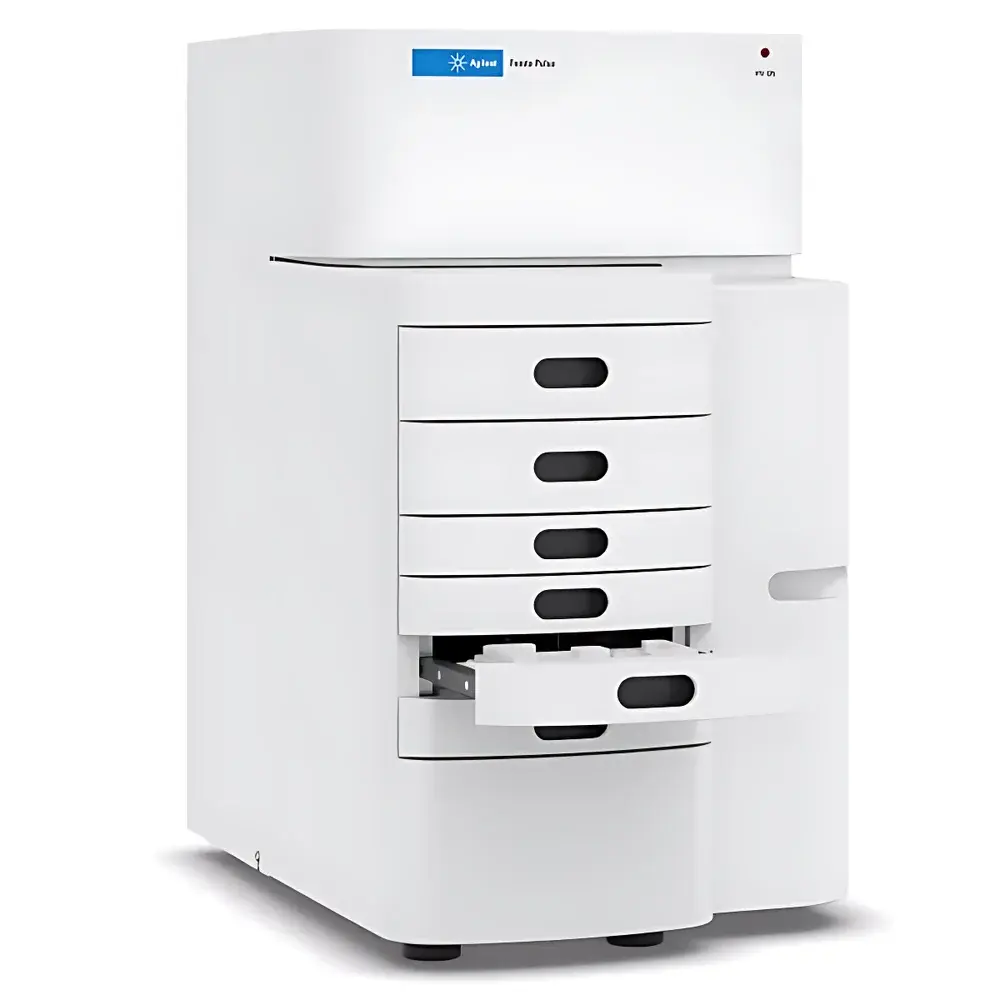
Agilent Femto Pulse Automated Pulsed-Field Capillary Electrophoresis System
| Brand | Agilent Technologies |
|---|---|
| Origin | Malaysia |
| Manufacturer Type | Original Equipment Manufacturer (OEM) |
| Import Status | Imported |
| Model | Femto Pulse |
| Instrument Type | Capillary Electrophoresis (CE) |
| Sample Application | Organic Analysis (Nucleic Acids) |
| Voltage | 100–240 VAC, 47–63 Hz |
| Power Consumption | 150 VA |
| Operating Temperature | 19–25 °C |
| Relative Humidity | 20–80 % |
| Dimensions (W × D × H) | 36 cm × 51 cm × 61 cm |
| Sample Throughput | Up to 288 samples per unattended run (3 × 96-well plates) |
| Sample Volume | 2 µL per injection |
| Detection Sensitivity | 50 fg/µL for nucleic acids |
| Separation Range | Up to 165 kb DNA fragments and smears |
| Run Time | ~90 minutes for full-range HMW DNA analysis |
| Reagent Kit Type | Quantitative Analysis Kits |
Overview
The Agilent Femto Pulse Automated Pulsed-Field Capillary Electrophoresis System is a high-resolution, fully automated platform engineered for the precise sizing and quantitation of high-molecular-weight (HMW) DNA—ranging from 10 kb to 165 kb—using pulsed-field capillary electrophoresis (PF-CE). Unlike conventional constant-field capillary electrophoresis or slab-gel-based pulsed-field gel electrophoresis (PFGE), the Femto Pulse system applies alternating electric field vectors across microfluidic capillaries, enabling controlled reorientation and separation of large DNA molecules based on their mobility in response to pulse timing and field strength. This principle delivers superior resolution of genomic DNA, BAC clones, sheared gDNA, and long-read NGS library fragments—critical for applications where accurate fragment-length distribution directly impacts sequencing efficiency, coverage uniformity, and downstream bioinformatic interpretation.
Key Features
- Extended molecular weight range: Resolves DNA fragments and smears up to 165 kb in a single run (~90 minutes), eliminating the need for multiple gel conditions or manual PFGE optimization.
- Femtogram-level sensitivity: Detects nucleic acid concentrations as low as 50 fg/µL; achieves up to 10× higher sensitivity for smears and 100× for discrete fragments compared to non-denaturing gel-based methods.
- Automated, walk-away operation: Supports up to three 96-well plates (288 samples) with integrated capillary priming, sample loading, electrophoresis, detection, and data export—reducing hands-on time and inter-operator variability.
- Minimal sample requirement: Requires only 2 µL of precious input material, preserving limited clinical, archival, or single-cell-derived DNA/RNA samples.
- Stable, pre-formulated reagents: Uses factory-validated, lyophilized or liquid CE buffers and matrices—minimizing pipetting steps, degradation risk, and lot-to-lot performance drift.
- Robust thermal management: Maintains capillary temperature within ±0.5 °C during runs, ensuring reproducible migration times and sizing accuracy across extended duty cycles.
Sample Compatibility & Compliance
The Femto Pulse system is validated for analysis of double-stranded DNA (dsDNA), including intact genomic DNA, restriction-digested BACs, mechanically sheared gDNA, and long-read NGS libraries (e.g., Oxford Nanopore, PacBio). It supports RNA integrity assessment under denaturing conditions using compatible assay kits. All reagent kits are manufactured under ISO 13485-certified processes and comply with Good Manufacturing Practice (GMP) documentation standards. The system’s software architecture supports audit trails, electronic signatures, and user access controls aligned with FDA 21 CFR Part 11 requirements for regulated laboratories. Data files conform to MIAME-compliant metadata structures and can be exported in .csv, .pdf, and .fsa formats for integration into LIMS and ELN environments.
Software & Data Management
Control and analysis are performed via Agilent’s Femto Pulse Software v3.x, a Windows-based application featuring intuitive workflow wizards, real-time run monitoring, and automated peak calling with smear deconvolution algorithms. The software calculates molar-based distributions—not mass-weighted profiles—enabling accurate prediction of long-read sequencing output (e.g., mean read length, N50, library complexity). Each electropherogram includes calibrated size markers, signal-to-noise ratios, and coefficient-of-variation (CV) metrics for internal quality control. Raw data files retain full detector trace fidelity and support retrospective re-analysis with updated calibration models. Export modules comply with ASTM E1948 and ISO/IEC 17025 reporting guidelines, including instrument identification, environmental logs, and operator credentials.
Applications
- Quality control of long-read NGS library preparation—validating fragment size distribution prior to sequencing.
- Assessment of genomic DNA integrity from FFPE, cryopreserved, or cell-free sources (cfDNA).
- Verification of BAC clone integrity and restriction mapping fidelity.
- Monitoring HMW DNA degradation during extraction, shearing, or storage.
- Quantitative comparison of RNA integrity under native or denaturing conditions.
- Supporting GLP/GMP-compliant method validation studies per ICH Q5A(R2) and USP .
FAQ
What distinguishes pulsed-field capillary electrophoresis from constant-field CE?
Pulsed-field CE alternates voltage polarity across orthogonal electrodes to induce directional reorientation of large DNA molecules, enabling separation beyond the entropic limit of constant-field systems (~50 kb). This yields higher resolution for fragments >10 kb without gel matrix limitations.
Can the Femto Pulse system replace traditional PFGE?
Yes—it provides equivalent or superior sizing accuracy for HMW DNA while reducing run time from 18–24 hours (slab PFGE) to <90 minutes, eliminating gel casting, staining, imaging, and densitometry steps.
Is the system compatible with regulatory submissions?
Yes. Its software supports 21 CFR Part 11 compliance, including secure login, audit trail logging, and electronic signature capture—validated for use in FDA-submitted analytical procedures.
How does molar-based analysis improve long-read sequencing predictions?
Mass-based quantitation over-represents small fragments; molar-based electropherograms reflect true molecule count distribution, enabling accurate modeling of sequencing bias and expected read length yield.
What maintenance is required for routine operation?
Capillary cartridge replacement every 100–150 runs; monthly system calibration using Agilent-supplied reference standards; no user-serviceable optics or high-voltage components.





