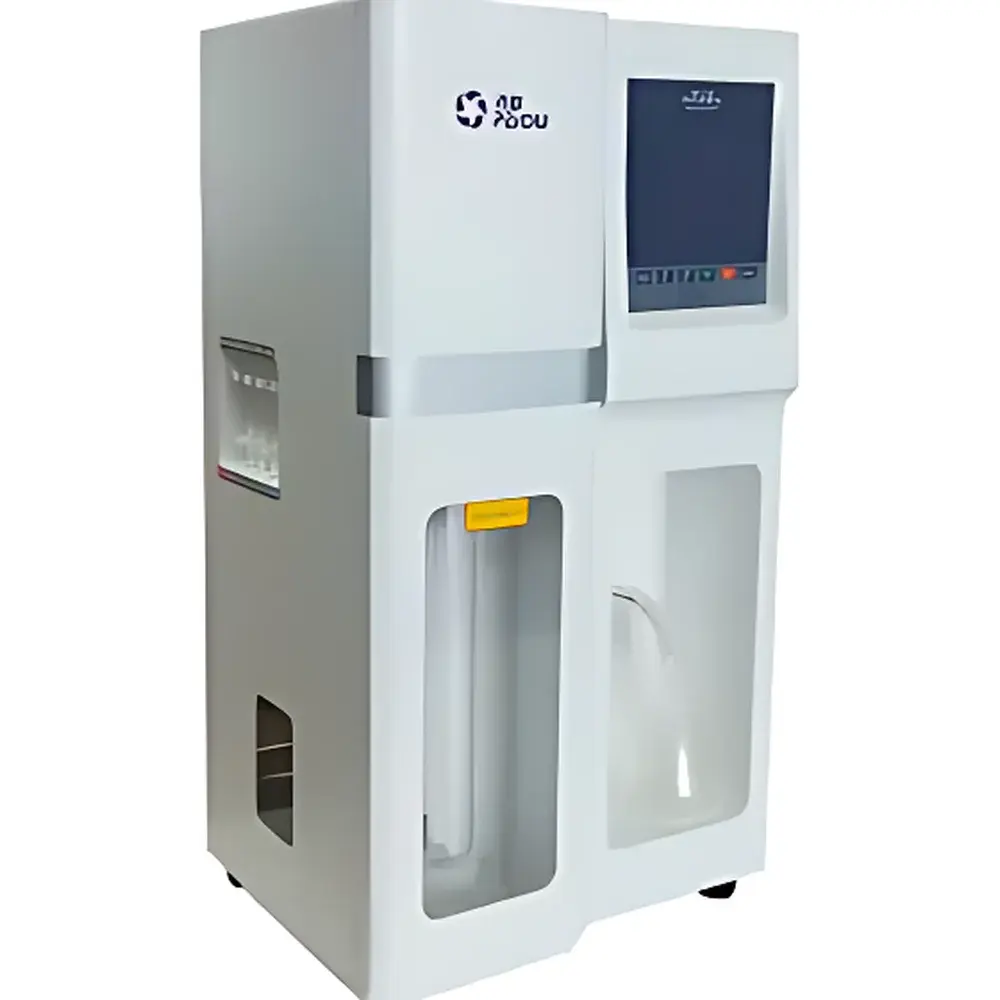
Peiou SKD-380 Automated Sulfur Dioxide Distillation and Detection System
| Brand | Peiou |
|---|---|
| Origin | Shanghai, China |
| Model | SKD-380 |
| Detection Range | 0–50 mg SO₂ |
| Detection Limit | ≤100 g solid or ≤100 mL liquid (sample-dependent) |
| SO₂ Recovery Rate | >99.5% |
| Repeatability (RSD) | ≤0.5% |
| Distillation Time | Programmable, 0–99 min per sample |
| Distillation Speed | 3–8 min/sample |
| Heating Power | Adjustable, 750–1500 W |
| Sample Processing Mode | Automatic & Manual dual mode |
| Memory Capacity | 100 programmable methods (acid volume, absorbent volume, distillation time) |
| Safety Features | Real-time liquid-level monitoring (acid, absorbent, condensate), dry-run protection for digestion cup (Peiou patented), automatic alarm & state-resume function |
| Optional | N₂ purge interface (specify at order) |
Overview
The Peiou SKD-380 Automated Sulfur Dioxide Distillation and Detection System is a dedicated analytical instrument engineered for precise, reproducible quantification of sulfur dioxide (SO₂) in pharmaceutical raw materials, excipients, herbal medicines, food matrices, and traditional Chinese medicinal products. It operates on the principle of acid distillation followed by selective absorption and spectrophotometric or titrimetric determination—fully compliant with pharmacopoeial methodologies including Chinese Pharmacopoeia (ChP) Volume IV, General Chapter 0832 “Sulfur Dioxide Residue”, as well as aligned with USP <231> and ICH Q5C guidelines for residual sulfites in biopharmaceutical excipients. The system integrates controlled thermal distillation, reagent delivery automation, and intelligent safety interlocks to minimize operator intervention while maintaining metrological integrity across batch analyses.
Key Features
- Patented dry-burn prevention technology for the distillation cup—ensures hardware longevity and eliminates risk of thermal damage during unattended operation.
- Automated reagent handling: independent precision dosing of acid solution and absorption medium (e.g., hydrogen peroxide or formaldehyde solution), with programmable volumes per method.
- Intelligent water management: automatic replenishment of cooling water and real-time level monitoring of condensate, acid reservoir, and absorbent vessel; system pauses and logs status upon low-level detection, then resumes from exact point upon restoration.
- Adjustable heating power (750–1500 W) enables optimization for diverse sample matrices—low-power settings for heat-sensitive botanicals, higher output for dense solids or high-SO₂ samples.
- Programmable distillation duration (0–99 minutes) and adaptive cycle timing (3–8 minutes/sample average) support method validation and throughput scalability.
- Dual-mode operation: fully automated sequence execution or granular manual control over individual steps (e.g., acid addition only, or timed distillation without absorbent injection) for troubleshooting and method development.
- Integrated LCD interface with backend parameter access allows calibration verification, method editing, and real-time status diagnostics without external software dependency.
Sample Compatibility & Compliance
The SKD-380 accommodates solid samples up to 100 g and liquid samples up to 100 mL, with flexibility to adjust sample mass/volume based on anticipated SO₂ concentration—critical for achieving optimal signal-to-noise ratio within the 0–50 mg SO₂ linear range. Its design meets essential requirements for GLP-compliant laboratories: full audit trail capability via internal event logging (including alarms, reagent depletion, power interruptions), traceable method storage (100 protocols), and deterministic state recovery after interruption. While not inherently 21 CFR Part 11 compliant out-of-the-box, the system supports integration with validated LIMS or ELN platforms for electronic signature and data integrity workflows. It satisfies ISO/IEC 17025 clause 7.2.2 (method validation) prerequisites through documented recovery (>99.5%) and repeatability (RSD ≤0.5%) performance.
Software & Data Management
The SKD-380 employs embedded firmware—not PC-dependent software—to manage all operational sequences, parameter storage, and event logging. Each method stores acid volume, absorbent volume, distillation time, and power setting as a discrete protocol ID. All system events—including liquid-level alerts, temperature anomalies, and completion signals—are timestamped and retained in non-volatile memory. Data export is supported via RS232 or optional USB interface for transfer to laboratory information systems. For regulated environments, users may implement supplementary validation documentation (IQ/OQ/PQ) covering firmware version control, backup procedures, and change management—consistent with Annex 11 and ALCOA+ principles.
Applications
- Quantitative SO₂ residue testing in herbal decoctions, dried roots, and processed TCM materials per ChP 0832.
- Stability-indicating analysis of sulfite-preservative degradation in injectables and ophthalmic solutions.
- Raw material release testing for excipients such as starch, lactose, and mannitol where SO₂ may originate from bleaching or fumigation processes.
- Method transfer between QC labs due to standardized distillation kinetics and recovery performance.
- Supporting ICH Q5C comparability studies for biosimilar product manufacturing changes involving sulfite-containing buffers.
FAQ
Is the SKD-380 compliant with USP <231> or EP 2.2.36?
The instrument implements the core distillation-absorption principle referenced in these monographs; however, final compliance requires user validation against specified acceptance criteria (e.g., recovery, precision) using certified reference materials.
Can the system be connected to a titrator or UV-Vis spectrophotometer?
Yes—the distillate outlet is standard 1/4″ OD tubing compatible with autosampler inlets; absorbent collection vessels are designed for direct transfer to peripheral analyzers.
What maintenance is required for long-term reliability?
Routine cleaning of the condenser and distillation tube with dilute nitric acid is recommended after every 20–30 runs; cold trap filters should be inspected weekly; firmware updates are distributed annually via Peiou technical support portal.
Does the N₂ purge option affect SO₂ recovery accuracy?
Nitrogen sparging minimizes oxidative loss of volatile SO₂ species during transfer and improves recovery consistency for low-concentration samples (<5 mg); it is recommended for regulatory submissions where RSD <0.5% must be demonstrated across the full range.