
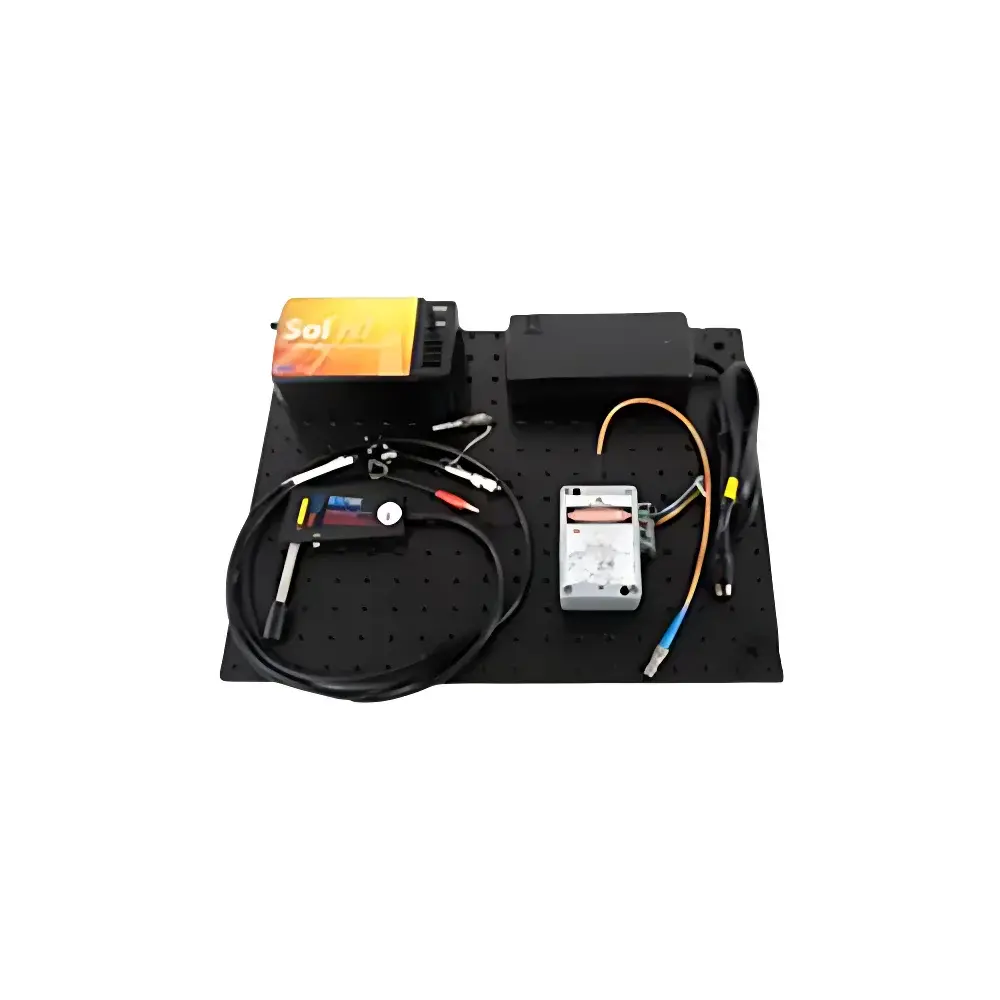
B&W Tek DIY Raman System – 1064
| Brand | B&W Tek |
|---|---|
| Origin | USA |
| Manufacturer Type | Authorized Distributor |
| Origin Category | Imported |
| Model | DIY Raman – 1064 |
| Instrument Type | Grating-Based Raman Spectrometer |
| Spectral Range | 1047 nm – 1450 nm |
| Spectral Resolution | 10 cm⁻¹ @ 1296 nm |
| Excitation Wavelength | 1064 nm |
| Raman Shift Range | 100 – 2500 cm⁻¹ (probe-dependent) |
| Detector | Linear InGaAs Array |
| Thermoelectric Cooling | −20 °C |
| Dimensions | 163 mm × 93.6 mm × 67.8 mm |
| Weight | ~1.25 kg |
| Laser Module | BRM-1064-450-100-22-DIY (450 mW standard, customizable power) |
| Probe Model | BAC100B-1064-HT |
| Laser Attenuation | OD6 (default) |
| Probe Shaft Material | 304 Stainless Steel |
| Probe Shaft Length | 76.2 mm |
| Probe Shaft Diameter | 9.4 mm |
| Working Distance | 5.9 mm |
| Max Operating Temperature | 80 °C (non-immersion) |
Overview
The B&W Tek DIY Raman System – 1064 is a fully modular, OEM-grade near-infrared (NIR) Raman spectroscopy platform engineered for research laboratories, instrument developers, and industrial R&D teams requiring maximum flexibility in system architecture. Built around a 1064 nm excitation source, this system leverages low-fluorescence NIR excitation to minimize sample photodegradation and native fluorescence interference—particularly critical for biological tissues, pharmaceutical formulations, carbon-based materials, and dark-colored or highly autofluorescent samples. The core optical architecture employs a high-throughput Czerny–Turner spectrometer with a ruled transmission grating and thermoelectrically cooled linear InGaAs detector array, delivering robust signal-to-noise performance across the 100–2500 cm⁻¹ Raman shift range (subject to probe selection). Unlike fixed-integration benchtop systems, the DIY Raman – 1064 is delivered as a validated component set—not a pre-assembled instrument—enabling users to integrate subsystems onto custom optical tables, embed them into analytical workflows, or scale configurations for multi-channel or process-monitoring applications.
Key Features
- Modular OEM architecture: Independent, interoperable modules—including spectrometer (Sol™ HTBTC284N-1064), 1064 nm laser (BRM-1064 series), and HT-rated sampling probe (BAC100B-1064-HT)—designed for mechanical, thermal, and optical compatibility
- CleanLaze® laser stabilization technology (U.S. Patent No. US 7,245,369 B2): Actively suppresses mode-hopping and intensity drift, ensuring spectral reproducibility over extended acquisition periods
- Thermoelectrically cooled InGaAs detector (−20 °C): Reduces dark current noise and enables longer integration times without saturation, critical for low-Raman-cross-section samples
- OD6 laser attenuation (standard) with stainless-steel probe housing (304 SS): Supports safe, repeatable alignment and operation in ambient lab environments while maintaining Class 1 or Class 3B compliance per IEC 60825-1 when integrated per system-level safety design
- External trigger interface (TTL-compatible): Enables synchronization with external hardware such as translation stages, shutter controllers, or data acquisition systems for time-resolved or spatially resolved measurements
- Fiber-coupled sampling flexibility: Compatible with standard SMA 905 connectors; supports free-space coupling, immersion probes, flow cells, and custom optical interfaces
Sample Compatibility & Compliance
The 1064 nm excitation wavelength significantly expands compatibility with challenging sample classes including melanin-rich biological tissues, polymer composites, battery cathode materials (e.g., LiFePO₄, NMC), graphite, graphene oxide, and herbal extracts—where visible excitation would induce overwhelming fluorescence or thermal damage. The BAC100B-1064-HT probe operates up to 80 °C in non-immersion mode, supporting in situ monitoring of heated reaction vessels or extrusion processes. All laser modules comply with FDA 21 CFR Part 1040 requirements for laser products sold as components; end-system integrators retain responsibility for final classification, labeling, and interlock implementation per IEC 60825-1 and ANSI Z136.1. While not pre-certified for GMP/GLP environments, the system’s deterministic firmware behavior, full parameter logging via BWSpec®, and SDK-supported audit trail generation enable validation pathways compliant with FDA 21 CFR Part 11 Annex 11 and ISO/IEC 17025 documentation standards.
Software & Data Management
B&W Tek provides two complementary software layers: BWSpec® and the BWSpec SDK. BWSpec® is a production-ready spectral acquisition application supporting real-time dark subtraction, interactive baseline correction (asymmetric least squares, polynomial fit), peak detection, spectral smoothing (Savitzky–Golay), and multi-scan averaging. It exports spectra in industry-standard formats (CSV, TXT, JCAMP-DX) and retains full metadata (integration time, laser power, detector temperature, grating position). The SDK delivers native Windows DLLs (32/64-bit) for programmatic control over spectrometer triggering, laser modulation, calibration loading, and raw frame acquisition. Integrated chemometric algorithms—including PLS regression, PCA, and spectral library matching—are accessible via BWIQ-derived engine modules embedded in the SDK, enabling rapid development of quantitative or qualitative analysis routines without third-party dependencies. All software components support timestamped logging and user-defined annotation fields, facilitating traceability in regulated development workflows.
Applications
- Raman Microscopy Integration: Coupling with motorized stages and objective lenses for high-resolution mapping of pharmaceutical tablet homogeneity or semiconductor defect localization
- Process Analytical Technology (PAT): In-line monitoring of crystallization kinetics, polymer curing, or catalyst deactivation in pilot-scale reactors using fiber-optic probe manifolds
- Biomedical Research: Label-free tissue classification (e.g., tumor margin assessment), biofluid screening (serum, saliva), and single-cell Raman profiling under physiological conditions
- Materials Science: Quantification of stress/strain in 2D materials, oxidation state analysis of transition metal oxides, and carbon nanotube chirality assignment
- OEM Instrument Development: Core optical engine for handheld analyzers, portable mineral identifiers, or automated QA/QC stations in food or agrochemical manufacturing
FAQ
Is the DIY Raman – 1064 suitable for regulatory submissions (e.g., FDA IND/NDA)?
Yes—when validated per your internal SOPs and integrated into a documented system architecture, its deterministic measurement chain, full parameter logging, and SDK audit-trail capability support compliance with FDA 21 CFR Part 11 and ICH M10 guidelines.
Can I upgrade the laser power beyond 450 mW?
Yes—custom laser modules from 100 mW to 1000 mW are available; higher powers require additional thermal management and safety interlocks per IEC 60825-1.
Does the system include wavelength calibration standards?
A NIST-traceable holmium oxide or neon lamp calibration kit is optional; factory calibration certificates (with uncertainty budgets) are provided for all spectrometers.
What is the minimum detectable Raman shift under optimal conditions?
The practical lower limit is ~100 cm⁻¹, constrained by laser line rejection and detector cutoff; Rayleigh rejection is optimized via notch filters integrated into the probe head.
Can I use third-party chemometric software (e.g., MATLAB, Python scikit-learn) with this system?
Yes—the SDK provides raw frame access and metadata export; CSV/JCAMP-DX outputs are natively compatible with open-source and commercial modeling environments.






