
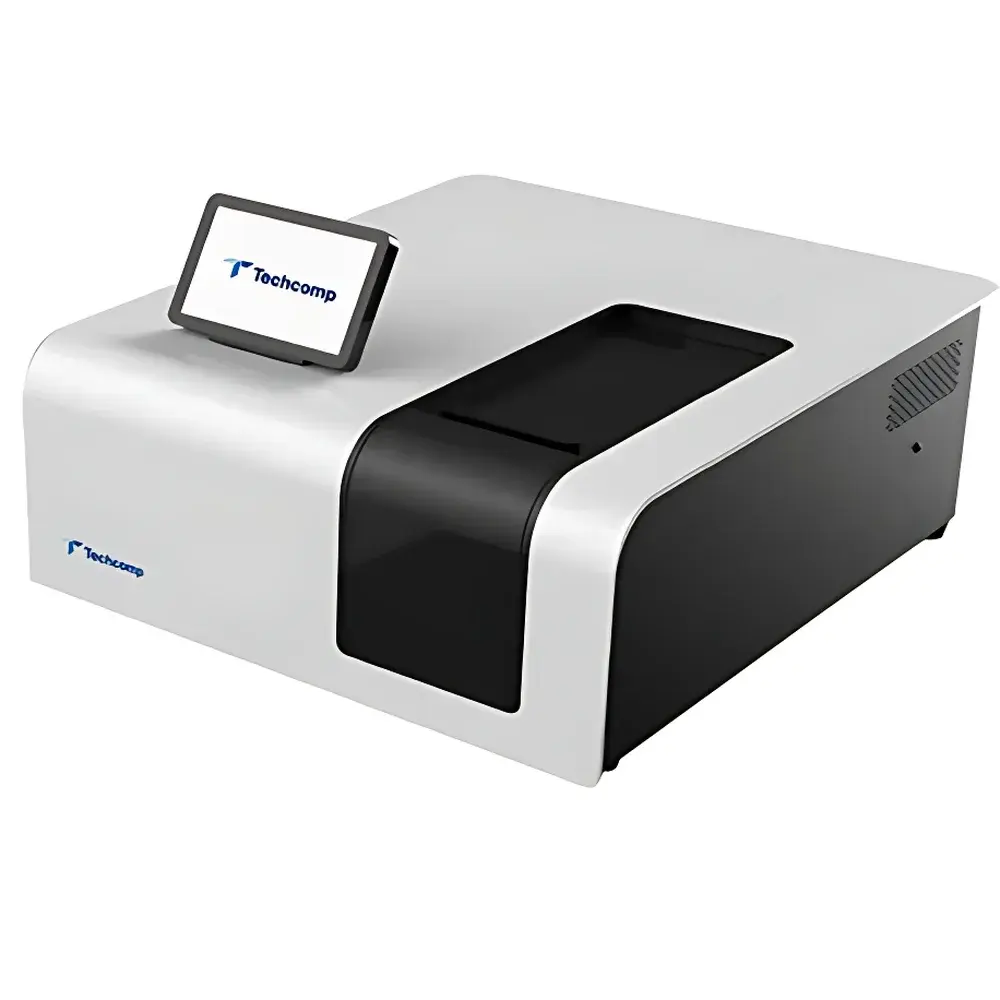
Techcomp UV2500 Dual-Beam Ultraviolet-Visible Spectrophotometer
| Brand | Techcomp |
|---|---|
| Origin | Shanghai, China |
| Manufacturer Type | Original Equipment Manufacturer (OEM) |
| Product Category | Domestic |
| Model | UV2500 |
| Price Range | USD 9,800–13,900 (FOB Shanghai) |
| Optical Design | Dual-Beam |
| Detector | Photodiode Array (PDA) |
| Wavelength Range | 190–1100 nm |
| Wavelength Scanning Mode | Motorized Auto-Scan |
| Spectral Bandwidth | 1.5 nm |
| Wavelength Accuracy | ±0.3 nm |
| Wavelength Repeatability | ±0.1 nm |
| Stray Light | ≤0.05% T at 220 nm and 340 nm |
Overview
The Techcomp UV2500 is a dual-beam ultraviolet-visible (UV-Vis) spectrophotometer engineered for precision absorbance, transmittance, and concentration measurements across research, quality control, and routine analytical laboratories. Based on the Beer–Lambert law, the instrument employs a stable xenon or tungsten-halogen lamp source combined with a high-efficiency holographic grating monochromator to deliver continuous spectral scanning from 190 nm to 1100 nm. Its dual-beam optical architecture actively compensates for source intensity drift and environmental fluctuations by simultaneously splitting light into sample and reference paths—enabling high reproducibility in kinetic studies, stability assays, and long-duration quantitative analyses. The integrated photodiode array (PDA) detector ensures rapid full-spectrum acquisition without mechanical wavelength scanning delays, supporting real-time monitoring of dynamic reactions such as enzyme kinetics or photochemical degradation.
Key Features
- Dual-beam optical system with real-time reference beam correction for enhanced baseline stability and measurement robustness
- Full-touch 7-inch capacitive LCD control panel with intuitive icon-driven interface—no external PC required for basic operation
- Integrated PDA detector enabling full-spectrum acquisition in <1 second with 1 nm data interval resolution
- Optical baseplate constructed from one-piece cast aluminum alloy, thermally stabilized to minimize mechanical drift and maintain collimation integrity over extended use
- Automated wavelength calibration using internal holmium oxide and neutral density filters, traceable to NIST standards
- Onboard GLP/GMP compliance tools including user access levels, electronic signature support, audit trail logging, and automatic timestamped method archiving
- Built-in biological assay modules: DNA/RNA quantification (A260/A280 ratio analysis), protein concentration (Bradford, Lowry, BCA), and OD600 turbidity measurement for microbial culture density estimation
Sample Compatibility & Compliance
The UV2500 accommodates standard 10 mm pathlength quartz, glass, or plastic cuvettes (including disposable and micro-volume variants), as well as optional fiber-optic probes and integrating spheres for solid or turbid sample analysis. It complies with key international performance standards including ISO 9001:2015 (quality management), ISO/IEC 17025:2017 (testing laboratory competence), and relevant sections of USP and EP 2.2.25 for spectrophotometric validation. Stray light performance (≤0.05% T at 220 nm and 340 nm) meets ASTM E275 and JIS K 0115 requirements for pharmaceutical excipient testing. All firmware and software operations adhere to FDA 21 CFR Part 11 principles, supporting electronic records, role-based permissions, and secure data export in CSV, PDF, and XML formats.
Software & Data Management
The instrument operates natively via embedded firmware with optional PC connectivity through USB 2.0 or Ethernet for advanced data handling. The companion UVWin software (Windows 10/11 compatible) provides spectral overlay, derivative analysis, multi-component quantitation using simultaneous equation solving, and customizable report templates compliant with ISO/IEC 17025 documentation requirements. Raw spectral data and method parameters are stored internally with optional SD card expansion (up to 128 GB), enabling offline archiving and regulatory audit readiness. All data files include embedded metadata: operator ID, instrument serial number, calibration date, environmental temperature/humidity logs, and version-stamped software build identifiers.
Applications
The UV2500 supports diverse analytical workflows across regulated and academic environments: quantitative determination of active pharmaceutical ingredients (APIs) per USP monographs; verification of nucleic acid purity and integrity in molecular biology labs; colorimetric endpoint assays in clinical chemistry (e.g., glucose, cholesterol); heavy metal speciation via complexometric titration monitoring; water quality parameter assessment (NO3−, PO43−, COD); and polymer degradation kinetics under UV exposure. Its 1.5 nm spectral bandwidth and ±0.1 nm wavelength repeatability ensure reliable compliance with pharmacopeial resolution criteria for peak identification in impurity profiling.
FAQ
Does the UV2500 support regulatory-compliant data integrity protocols?
Yes—it implements full 21 CFR Part 11 functionality including electronic signatures, audit trails, and role-based access control when used with UVWin software and validated network configurations.
Can the instrument perform kinetic measurements without external hardware?
Yes—the embedded timer and auto-scan trigger allow time-resolved spectral acquisition at user-defined intervals (100 ms to 60 min), suitable for enzymatic reaction monitoring or photochemical kinetics.
Is wavelength calibration traceable to national standards?
Yes—internal holmium oxide and neutral density filters are certified against NIST SRM 2034 and SRM 930e, with calibration certificates provided upon installation.
What is the maximum data storage capacity with optional SD card?
Up to 128 GB, supporting >500,000 full-spectrum scans with metadata, depending on file compression settings.
Does the UV2500 require annual recalibration by an authorized service provider?
While not mandatory, Techcomp recommends biannual performance verification using certified reference materials to maintain ISO/IEC 17025 conformance in accredited laboratories.
Related Products



