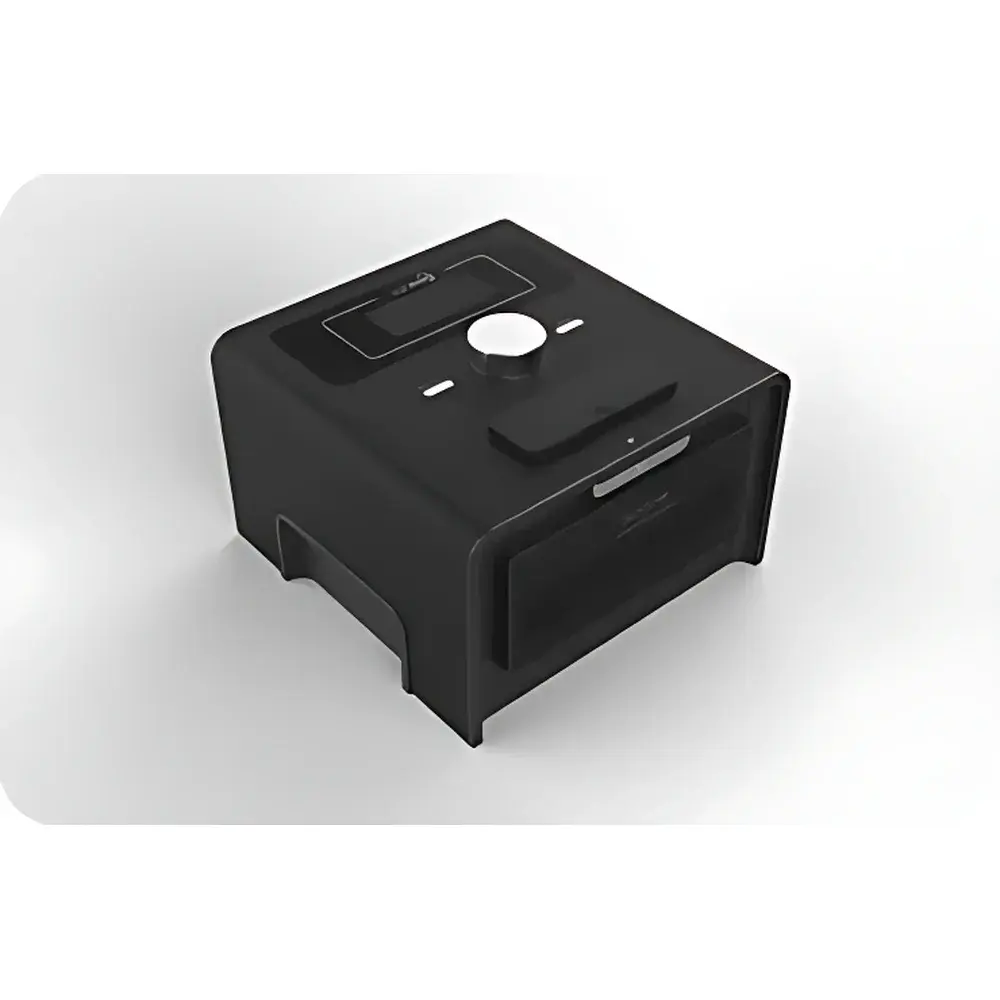
KURABO GF-Q150 Portable Real-Time Fluorescent Quantitative PCR Instrument
| Brand | KURABO |
|---|---|
| Origin | Japan |
| Manufacturer Status | Authorized Distributor |
| Product Origin | Imported |
| Model | GF-Q150 |
| Instrument Type | Real-Time Fluorescent Quantitative PCR System |
| Sample Throughput | 10-well |
| Heating Rate | 8°C/sec |
| Temperature Accuracy | ±0.5°C |
| Inter-Well Temperature Uniformity | ±0.5°C |
| Reaction Volume | 10 µL |
| Operating Temperature Range (RT-PCR) | 35–65°C |
| PCR Temperature Range | 20–99°C (1.0°C increment) |
| Display | 4-line LCD |
| Built-in Protocols | 12 |
| Power Input | AC 100–230 V, 50/60 Hz (DC 12 V input) |
| Dimensions (W×L×H) | 20 × 20 × 12.5 cm |
| Weight | ≤3.2 kg |
| Data Analysis Modes | Real-time amplification curves, qualitative positive/negative calling, melting curve analysis, ΔCT and ΔΔCT-based gene expression quantification |
Overview
The KURABO GF-Q150 is a compact, battery-compatible portable real-time fluorescent quantitative PCR instrument engineered for rapid nucleic acid detection in non-laboratory environments—including field deployments, point-of-care testing, mobile biosurveillance units, and resource-limited settings. It operates on the principle of sequence-specific fluorescence detection during thermal cycling, utilizing intercalating dyes (e.g., SYBR Green I) or hydrolysis probes (TaqMan) to monitor amplicon accumulation in real time. Its thermally optimized aluminum block employs Peltier-based heating and cooling with closed-loop feedback control, enabling precise temperature ramping at 8°C/sec—significantly reducing total assay runtime without compromising thermal fidelity. Designed for robustness under variable ambient conditions, the GF-Q150 maintains ±0.5°C accuracy across its full operating range (20–99°C), with inter-well uniformity also specified at ±0.5°C—meeting critical performance thresholds required for low-input, high-sensitivity applications such as pathogen load quantification and allelic discrimination.
Key Features
- Ultra-compact footprint (20 × 20 × 12.5 cm) and lightweight design (≤3.2 kg), enabling seamless transport and operation in vehicles, clinics, or outdoor biocontainment zones.
- 10-well transparent polymer chip format—compatible with standard 10 µL reaction volumes—minimizes reagent consumption while ensuring optical clarity for consistent fluorescence excitation and emission capture.
- Dual-wavelength LED excitation (470 nm and 530 nm) paired with matched photodiode detection enables multiplexed endpoint and real-time assays using common dye chemistries including FAM, HEX, VIC, and SYBR Green I.
- Integrated thermal calibration routine accessible via onboard menu; supports user-initiated verification of block temperature stability prior to run initiation.
- On-device data storage (internal flash memory) retains up to 100 completed runs with full amplification and melt curve metadata; exportable via USB 2.0 to Windows-compatible systems (Windows XP through Windows 10).
- Preloaded with 12 validated thermal profiles—including fast-cycling protocols achieving 30 cycles in ≤12 minutes—optimized for common diagnostic targets and research-grade gene expression panels.
Sample Compatibility & Compliance
The GF-Q150 accepts single-use, optically clear polymer chips fabricated from cyclic olefin copolymer (COC), eliminating cross-contamination risks and supporting rapid assay turnaround. Chip geometry ensures uniform capillary fill and minimizes evaporation during extended cycling. While not certified for clinical diagnostics under FDA 510(k) or CE-IVD directives, the system complies with ISO 13485-aligned manufacturing practices per KURABO’s quality management system and meets electromagnetic compatibility requirements per IEC 61326-1. Its thermal performance specifications align with ASTM E1535-20 (Standard Test Method for Determining Thermal Stability of PCR Instruments) and support GLP-compliant documentation when used with traceable calibration logs and version-controlled protocol files.
Software & Data Management
Data acquisition and analysis are performed using KURABO’s GF-Q150 Control & Analysis Suite—a Windows-native application supporting real-time monitoring, automatic baseline and threshold setting, Ct value calculation, melt peak deconvolution, and relative quantification via ΔCT/ΔΔCT models. The software enforces audit-trail functionality: all user actions (protocol edits, run starts/stops, analysis parameter changes) are timestamped and logged with operator ID fields. Export formats include CSV (for LIMS integration), PDF reports (with embedded amplification/melt plots), and proprietary .gq150 binary files preserving raw fluorescence intensity values per cycle. Software updates are distributed via secure HTTPS portal with SHA-256 signature validation.
Applications
- Rapid pathogen detection in environmental or agricultural field samples (e.g., plant viruses, bacterial wilt agents, aquatic pathogens).
- Gene expression profiling in non-model organisms where centralized lab access is constrained—enabling longitudinal studies in ecological or veterinary fieldwork.
- Screening for genetically modified organism (GMO) marker sequences in food supply chain checkpoints.
- Validation of CRISPR-Cas editing efficiency via T7E1 or RFLP-coupled qPCR workflows.
- Point-of-collection viral load monitoring in outbreak response scenarios—particularly where RNA extraction is performed off-instrument and purified RNA is directly loaded.
FAQ
Is the GF-Q150 compliant with FDA 21 CFR Part 11 for electronic records and signatures?
No—the GF-Q150 Control & Analysis Suite does not implement Part 11–compliant electronic signatures or role-based access control. It is intended for research use only (RUO) and not for clinical diagnostic reporting.
Can the instrument perform high-resolution melting (HRM) analysis?
Yes—its thermal ramping precision (±0.02°C/sec resolution) and continuous fluorescence sampling during melt stages support basic HRM applications, though it lacks the sub-degree gradient control of dedicated HRM platforms.
What is the minimum detectable template copy number under standard conditions?
Under optimized assay conditions (10 µL reactions, SYBR Green I, human GAPDH reference), the limit of detection is empirically validated at ≤100 copies/reaction with ≥95% amplification efficiency and CV < 5% across replicates.
Does the system support external barcode scanning for sample tracking?
No—sample identification is manual entry via keypad or pre-loaded protocol naming; no integrated barcode reader or RFID interface is provided.
Is DC battery operation supported out-of-the-box?
The unit accepts DC 12 V input and may be powered via compatible external power banks or vehicle adapters; however, no internal rechargeable battery is included or factory-installed.