
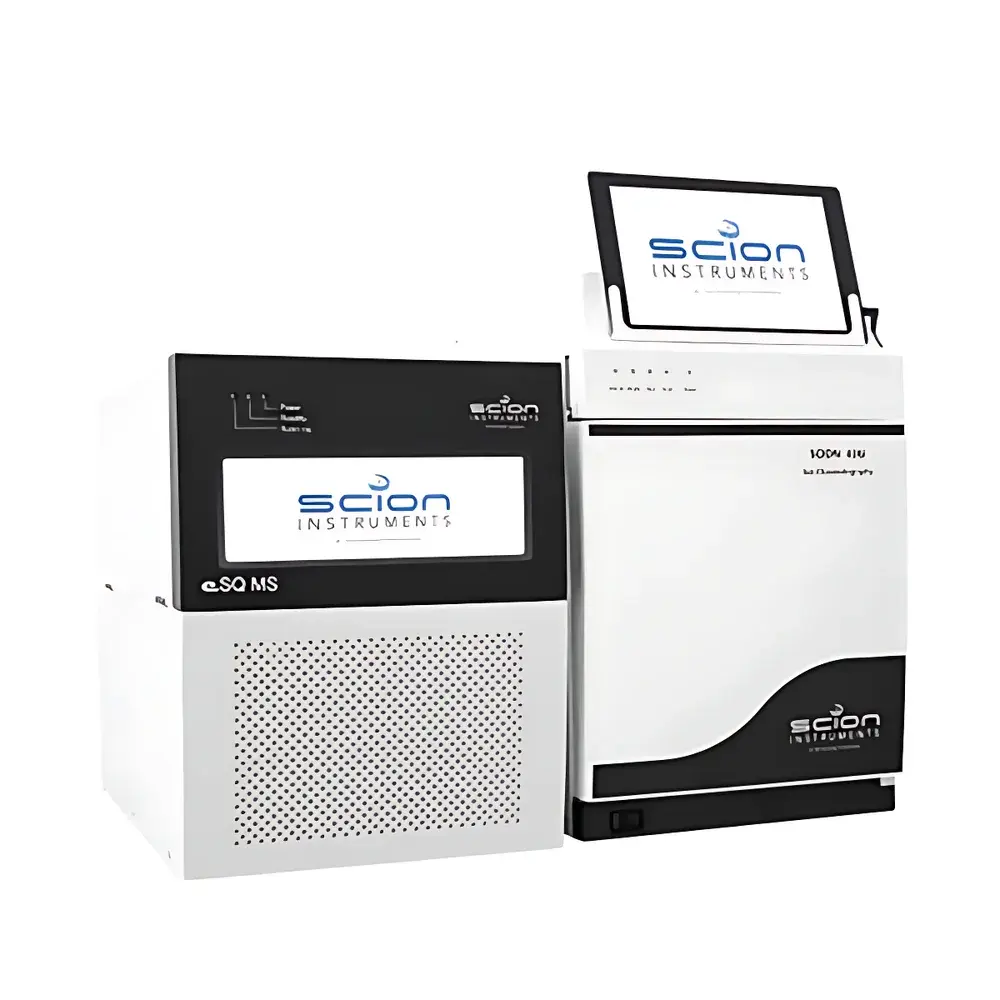
SCION 436i-eSQ Single Quadrupole Gas Chromatography-Mass Spectrometer
| Brand | SCION |
|---|---|
| Origin | Shanghai, China |
| Manufacturer Type | Original Equipment Manufacturer (OEM) |
| Instrument Type | Single Quadrupole Mass Spectrometer |
| GC Configuration | Conventional Gas Chromatography Interface |
| Mass Range | 1–1200 m/z |
| Resolution | 0.7–4 amu (full width at half maximum, FWHM) |
| Detection Limit (IDL) | <1 fg (octafluoronaphthalene, OFN) |
| Scan Speed | ≥14,000 amu/sec |
| Oven Ramp Rate | ≥125 °C/min |
| Pressure Control Accuracy | ±0.001 psi |
| Ion Source | High-Temperature Inert Dual-Filament Electron Ionization Source |
| Pre-filter | Dual-Axis Pre-quadrupole |
| Detector | Long-Life Extended-Dynamic-Range Electron Multiplier |
| Vacuum System | High-Capacity Turbomolecular Pump (≥300 L/s N₂) |
| Flow Control | Digital Electronic Flow Control (EFC) on All Inlets and Detectors |
Overview
The SCION 436i-eSQ is a high-performance single quadrupole gas chromatography-mass spectrometry (GC-MS) system engineered for precision, robustness, and regulatory readiness in routine and research-grade laboratories. It integrates a thermally stable, inert electron ionization (EI) source with a dual-axis pre-quadrupole mass filter and a high-transmission quadrupole mass analyzer to deliver consistent mass filtering performance across the full 1–1200 m/z range. The system operates under ultra-high vacuum conditions maintained by a high-capacity turbomolecular pump (≥300 L/s for nitrogen), minimizing neutral background interference and maximizing ion transmission efficiency. Its scan speed of ≥14,000 amu/sec enables high-fidelity spectral acquisition across narrow GC peaks—critical for complex matrix analysis in environmental, food safety, and forensic applications. Designed and manufactured in Shanghai, the 436i-eSQ complies with fundamental instrumental requirements outlined in ISO/IEC 17025:2017 for testing laboratories and supports method validation per EPA Method 8270, ASTM D7592, and USP .
Key Features
- High-temperature inert EI ion source with dual long-life tungsten-rhenium filaments, optimized for reduced carbon deposition and extended operational lifetime (>6 months typical under continuous use)
- Dual-axis pre-quadrupole design to suppress neutral noise and improve signal-to-noise ratio (S/N) without compromising sensitivity
- Quadrupole mass filter with temperature-stabilized rod assembly and optimized fringing field geometry for reproducible resolution (0.7–4 amu FWHM) and mass accuracy (<0.1 amu, calibrated)
- Digital electronic flow control (EFC) modules on all inlets (split/splitless, PTV, cold on-column) and auxiliary gas lines—enabling pressure/flow programming with ±0.001 psi accuracy and traceable parameter logging
- GC oven with rapid ramp capability (≥125 °C/min) and precise isothermal stability (±0.1 °C), supporting fast method development and high-throughput screening
- Extended-dynamic-range electron multiplier detector with auto-gain switching and linear response over six orders of magnitude
Sample Compatibility & Compliance
The 436i-eSQ accommodates volatile and semi-volatile organic compounds (VOCs/SVOCs) across diverse sample matrices—including aqueous extracts, soil digests, food homogenates, and biological fluids—when coupled with appropriate sample preparation (e.g., SPE, QuEChERS, purge-and-trap). Its inert ion path minimizes adsorption and memory effects for polar and thermally labile analytes. The system meets essential hardware-level compliance for GLP/GMP environments: audit-trail-enabled method storage, user-access controls, electronic signature support (via optional Compass CDS software configuration), and full traceability of instrument parameters, calibration history, and sequence logs. It is compatible with 21 CFR Part 11-compliant data systems when deployed with validated CDS platforms.
Software & Data Management
Controlled via SCION’s Compass CDS software (Windows-based, multi-user capable), the 436i-eSQ supports method building, real-time monitoring, automated calibration (tune, mass calibration, sensitivity check), and spectral library searching (NIST, Wiley, custom libraries). All EFC settings, temperature ramps, and MS acquisition parameters are saved as structured XML method files with embedded metadata. Raw data (.D format) includes full audit trail headers compliant with ISO/IEC 17025 documentation requirements. Optional integration with LIMS via ASTM E1384 or HL7 interfaces enables seamless workflow automation in centralized QA/QC labs.
Applications
The 436i-eSQ is routinely deployed in environmental testing laboratories for PAHs, PCBs, chlorinated pesticides, and emerging contaminants (e.g., PFAS precursors); in food safety labs for pesticide residue screening (EU MRL compliance), mycotoxin quantification, and flavor compound profiling; and in academic and industrial R&D for reaction monitoring, metabolite identification, and synthetic chemistry verification. Its low IDL (<1 fg OFN) and high scan speed make it suitable for trace-level analysis in complex backgrounds—such as wastewater influent, tobacco smoke condensate, or plant extract fractions—without requiring extensive sample cleanup.
FAQ
Is the SCION 436i-eSQ compatible with third-party GC systems?
Yes—it features standard analog and digital GC interface protocols (IEEE-488, RS-232, Ethernet) and supports trigger synchronization and data exchange with Agilent, Thermo, Shimadzu, and PerkinElmer GC platforms.
Does the system support selected ion monitoring (SIM) and full-scan acquisition simultaneously?
No—acquisition modes are discrete: full-scan, SIM, or targeted MS/MS (if equipped with optional collision cell). However, SIM methods achieve sub-femtogram detection limits with dwell times configurable down to 10 ms per ion.
What vacuum maintenance is required?
The turbomolecular pump is oil-free and requires no routine lubrication; annual bearing inspection and foreline pump oil change (every 6 months) constitute standard preventive maintenance.
Can the inert ion source be cleaned in situ without venting the mass spectrometer?
Yes—the source block is removable as a single module, and cleaning can be performed offline while the main vacuum chamber remains under vacuum—reducing system downtime to under 30 minutes.
Is method transfer from legacy GC-MS platforms supported?
Compass CDS includes a method import wizard that maps common Agilent and Thermo method parameters (e.g., retention time locks, SIM groups, tune settings) into native 436i-eSQ syntax with validation reports.




