
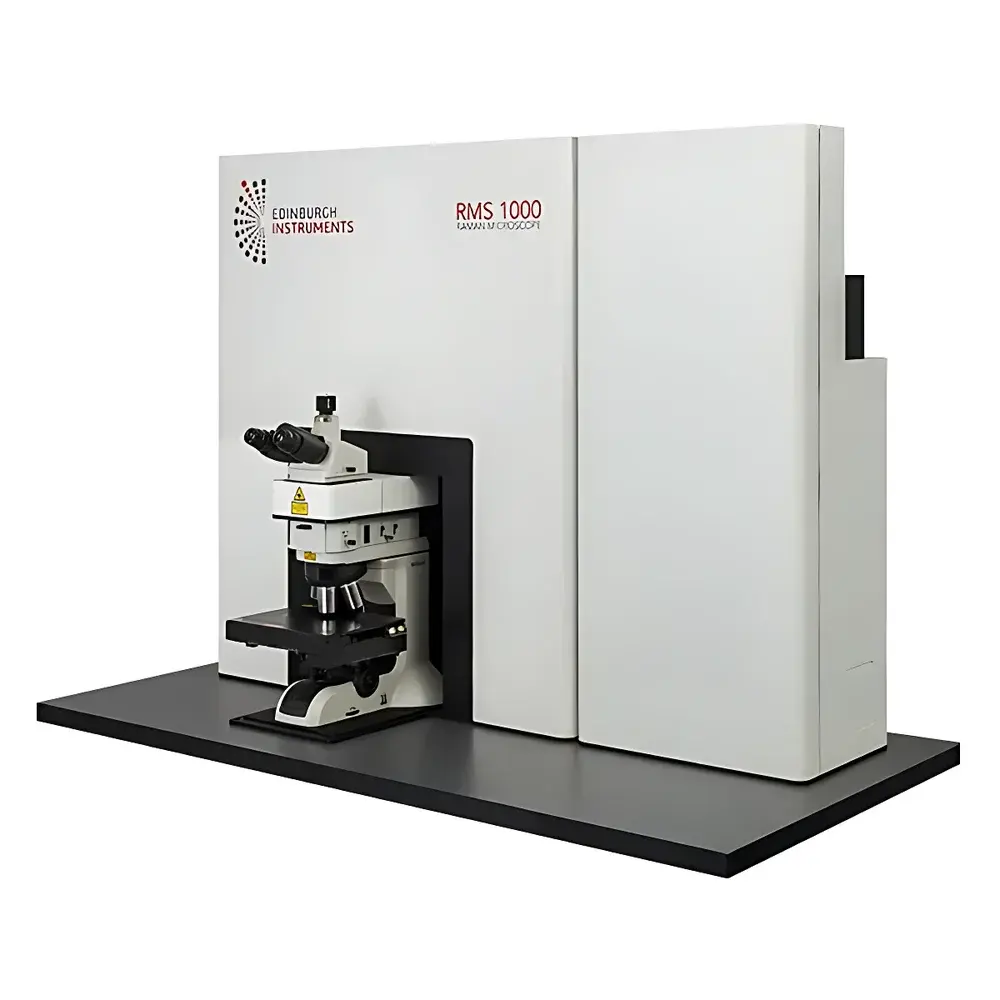
Edinburgh Instruments RMS1000 Research-Grade Open-Architecture Confocal Raman Microscope
| Brand | Edinburgh Instruments |
|---|---|
| Origin | United Kingdom |
| Manufacturer Type | Original Equipment Manufacturer (OEM) |
| Product Category | Imported Instrument |
| Model | RMS1000 |
| Spectral Range | 50–30000 cm⁻¹ |
| Spectral Resolution | ≤0.1 cm⁻¹ (FWHM) at ≥800 mm focal length |
| Spatial Resolution | XY ≤ 0.5 µm, Z ≤ 1 µm |
| Minimum Wavenumber | 50 cm⁻¹ |
| Spectral Reproducibility | ≤ ±0.02 cm⁻¹ |
Overview
The Edinburgh Instruments RMS1000 is a research-grade, open-architecture confocal Raman microscope engineered for high-fidelity molecular fingerprinting at diffraction-limited spatial resolution. Based on true confocal optical design—featuring a pinhole-aligned excitation and detection pathway—the RMS1000 delivers exceptional axial (Z) sectioning capability and background rejection, enabling unambiguous spectral acquisition from sub-micron volumes within heterogeneous or layered samples. Its modular architecture integrates a high-throughput Czerny–Turner spectrograph with interchangeable grating turrets, a motorized XYZ stage with piezo-driven Z-focus, and a suite of laser excitation options (266 nm to 1064 nm), supporting both conventional Raman and advanced variants including resonance Raman, surface-enhanced Raman scattering (SERS), and tip-enhanced Raman spectroscopy (TERS) configurations. The system operates across an extended wavenumber range (50–30000 cm⁻¹), accommodating low-frequency lattice modes and high-energy overtones with metrological stability traceable to NIST-calibrated standards.
Key Features
- True confocal optical geometry with adjustable pinhole diameter and real-time alignment verification, ensuring optimal depth discrimination and signal-to-background ratio.
- High-resolution spectrograph with dual focal lengths (≥800 mm and ≥225 mm), delivering ≤0.1 cm⁻¹ (FWHM) resolution for fine-structure analysis and ≤1 cm⁻¹ (FWHM) for rapid survey mapping.
- Sub-micron spatial resolution: XY ≤ 0.5 µm (with 100× objective, λ = 532 nm), Z ≤ 1 µm—validated per ISO 18563-1 for acoustic microscopy correlation.
- Spectral reproducibility ≤ ±0.02 cm⁻¹ over 8-hour continuous operation, enabled by thermally stabilized optics, active wavelength calibration via internal Ne/Ar lamp, and drift-compensated CCD readout.
- Native support for time-resolved fluorescence lifetime measurements (TCSPC mode) and FLIM integration—leveraging Edinburgh’s heritage in ultrafast photonics and compatible with pulsed lasers down to 20 ps pulse width.
- Open software API (C++, Python, LabVIEW) and hardware trigger interfaces for synchronization with external equipment including AFM, SEM, electrochemical cells, and cryostats.
Sample Compatibility & Compliance
The RMS1000 accommodates solid, liquid, powder, thin-film, and biological specimens—including live cells under environmental control (temperature, humidity, gas atmosphere). Sample stages accept standard microscope slides, Si wafers (up to 200 mm), and custom holders with vacuum or magnetic fixation. All optical paths comply with IEC 61000-6-3 (EMC) and IEC 60825-1 (laser safety Class 1 when interlocked). System validation documentation supports GLP/GMP environments, with audit trails, electronic signatures, and 21 CFR Part 11-compliant data integrity modules available as optional firmware packages. Spectral libraries are interoperable with ASTM E1840-20 reference databases and ISO 17025-accredited calibration protocols.
Software & Data Management
Control and analysis are performed via Edinburgh’s EasiScan™ v5.2 platform—a modular, scriptable environment supporting automated mapping (raster, spiral, ROI-based), multivariate analysis (PCA, MCR-ALS), spectral deconvolution (Voigt fitting), and hyperspectral image reconstruction. Raw data is stored in vendor-neutral HDF5 format with embedded metadata (excitation wavelength, grating position, integration time, objective magnification, ambient temperature). Built-in tools enable batch processing across >10⁴ spectra, spectral subtraction, cosmic ray removal, and baseline correction using asymmetric least squares (AsLS). Export options include CSV, JCAMP-DX, and Bruker OPUS compatibility. Remote access, role-based user permissions, and encrypted network storage integration meet institutional IT security policies.
Applications
- Materials science: Phase identification in battery cathodes (e.g., NMC, LFP), strain mapping in 2D semiconductors (MoS₂, WS₂), and defect quantification in CVD graphene.
- Pharmaceuticals: Polymorph screening of active pharmaceutical ingredients (APIs), crystallinity assessment in amorphous solid dispersions, and counterfeit drug detection via spectral library matching.
- Life sciences: Label-free chemical imaging of lipid droplets, collagen cross-linking in tissue sections, and redox state monitoring via cytochrome c Raman bands.
- Nanotechnology: SERS substrate characterization, plasmonic hot-spot localization, and single-particle spectral heterogeneity analysis.
- Geosciences: Inclusion analysis in fluid-bearing minerals, carbon speciation in meteoritic samples, and high-pressure phase transitions in diamond-anvil cells.
FAQ
Is the RMS1000 compatible with vacuum or inert-gas sample environments?
Yes—optional environmental chambers (vacuum down to 10⁻⁶ mbar; N₂/Ar purge) integrate seamlessly with the XYZ stage and optical train without compromising confocality.
Can the system be upgraded to include stimulated Raman scattering (SRS) capability?
Yes—RMS1000’s open laser port architecture and synchronized detector timing allow integration of dual-output picosecond OPOs and lock-in detection modules for SRS imaging.
What calibration standards are supplied for routine wavenumber and intensity validation?
NIST-traceable polystyrene film (for wavenumber), silicon wafer (520.7 cm⁻¹ reference), and certified fluorescent microspheres (for spatial registration) are included with each system.
Does the software support automated focus tracking during long-duration Raman mapping?
Yes—integrated autofocus routines use either sharpness maximization or confocal reflectance feedback, with configurable update intervals and Z-stack compensation.
Are service contracts and on-site application support available globally?
Yes—Edinburgh Instruments provides tiered support plans (Standard, Premium, Platinum), including remote diagnostics, annual performance verification, and dedicated application scientist visits aligned with ISO/IEC 17025 technical scope.
Related Products





