
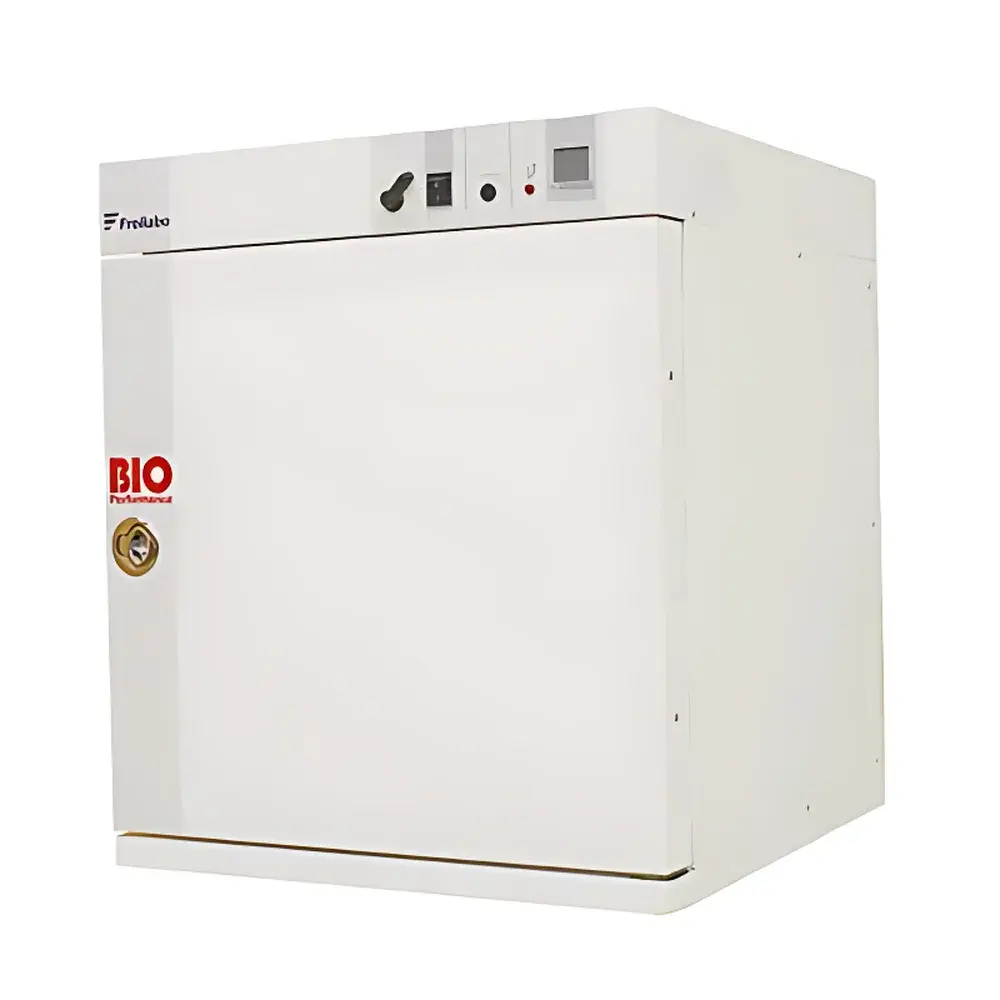
Froilabo BC Series Forced-Air Biochemical Incubator
| Brand | Froilabo |
|---|---|
| Origin | France |
| Manufacturer Status | Authorized Distributor |
| Origin Category | Imported |
| Model | BC |
| Pricing | Upon Request |
Overview
The Froilabo BC Series Forced-Air Biochemical Incubator is a precision-engineered temperature-controlled environment system designed for demanding life science applications requiring high thermal stability, uniformity, and operational reliability. Utilizing forced-air convection—driven by a calibrated axial fan and optimized airflow channeling—the incubator ensures rapid heat distribution and minimizes thermal gradients across the chamber. Its core control architecture integrates a high-resolution digital PID (Proportional-Integral-Derivative) algorithm with real-time feedback from multiple platinum resistance thermometers (Pt100), enabling dynamic compensation for door openings, load changes, and ambient fluctuations. Temperature regulation spans from ambient +5 °C to 100 °C, with typical stability of ±0.5 °C at 37 °C and ±1.0 °C at 60 °C (measured per ISO 15378 Annex A and ASTM E2922-21 methodology). The unit complies with IEC 61010-1:2010 safety standards for laboratory equipment and meets essential requirements for GLP-compliant environments.
Key Features
- Precision PID temperature control with 0.1 °C display resolution and adaptive tuning for load-dependent thermal inertia
- Dual-stage overtemperature protection: independent mechanical safety cut-off (120 °C) and electronic limit override (programmable up to 105 °C)
- 304 stainless steel interior chamber—electropolished finish for corrosion resistance, non-porous surface integrity, and compatibility with common lab disinfectants (e.g., 70% ethanol, 0.5% sodium hypochlorite)
- Reinforced stainless steel adjustable shelving with anti-slip edge retention; load capacity: 15 kg per shelf (uniformly distributed)
- Epoxy-polyester powder-coated exterior housing—tested to ISO 20485 salt-spray resistance (500 h neutral salt fog)
- High-compression silicone gasket sealing system—validated for >10,000 door cycles without loss of thermal integrity or air exchange rate deviation
- Double-glazed, low-emissivity inner door with anti-fog coating—maintains optical clarity while reducing radiant heat loss by ≥40% versus single-pane alternatives
- Standardized auxiliary port configuration (2× Ø25 mm pass-throughs + 1× 4-pin power socket)—enables integration of external sensors (CO₂, humidity, O₂), data loggers, or powered probes without compromising chamber seal
Sample Compatibility & Compliance
The BC incubator accommodates standard microbiological vessels (Petri dishes, test tubes, flasks, roller bottles) and supports multi-tiered stacking configurations without impeding airflow. Its chamber geometry and fan placement have been validated via computational fluid dynamics (CFD) simulation to ensure ≥95% volumetric air exchange per minute under nominal operating conditions. The integrated dry-heat sterilization cycle operates at 160 °C for 2.5 h—aligned with USP , Ph. Eur. 5.1.3, and JP 17 sterilization validation guidelines for non-volatile residue removal and endotoxin inactivation. Post-cycle automatic cooldown follows a user-defined ramp profile (default: 0.5 °C/min), returning the chamber to setpoint without manual intervention. The system supports audit-ready operation under FDA 21 CFR Part 11 when paired with Froilabo’s optional validated software suite (BC-Link v3.2+).
Software & Data Management
While the base model features standalone microprocessor control, optional connectivity modules enable RS485/Modbus RTU or Ethernet (TCP/IP) communication. Froilabo BC-Link software provides time-stamped event logging (door status, alarm triggers, setpoint changes), configurable alarm escalation (email/SNMP), and exportable CSV reports compliant with ISO/IEC 17025 documentation requirements. All firmware updates are digitally signed and verified prior to installation. Audit trails include operator ID, timestamp, action type, and pre-/post-value parameters—fully traceable for GMP/GLP inspections.
Applications
The BC Series serves as a foundational platform for bacterial culture propagation (E. coli, Bacillus spp.), fungal growth studies (Aspergillus, Candida), enzyme kinetics assays, cell line maintenance (non-CO₂-dependent adherent lines), pharmaceutical stability testing (ICH Q1A–Q1E), clinical specimen incubation (urine, stool, blood cultures), and industrial QC procedures including bioburden monitoring and media performance verification. Its thermal consistency and repeatability make it suitable for ISO 13485-certified medical device manufacturing environments.
FAQ
What is the recommended calibration frequency for the BC incubator?
Annual calibration against NIST-traceable reference standards is advised; internal verification using certified Pt100 probes should be performed before each critical experiment.
Can the BC incubator be used for BSL-2 applications?
Yes—when equipped with HEPA-filtered exhaust (optional accessory) and operated with validated decontamination protocols, it meets containment requirements for BSL-2 agents per CDC/NIH Biosafety Manual 6th Ed.
Is the 160 °C sterilization cycle validated for depyrogenation?
Yes—the cycle delivers ≥3-log reduction in endotoxin activity and satisfies depyrogenation criteria per USP when chamber loading does not exceed 70% volume occupancy.
Does the incubator support remote monitoring via cloud platforms?
Via optional BC-Link Gateway hardware, real-time chamber data can be routed to secure private cloud instances or on-premise SCADA systems using TLS 1.2 encrypted MQTT.
What power supply specifications are required?
230 V AC ±10%, 50/60 Hz, 16 A dedicated circuit; voltage stabilization recommended where grid fluctuation exceeds ±5%.





