
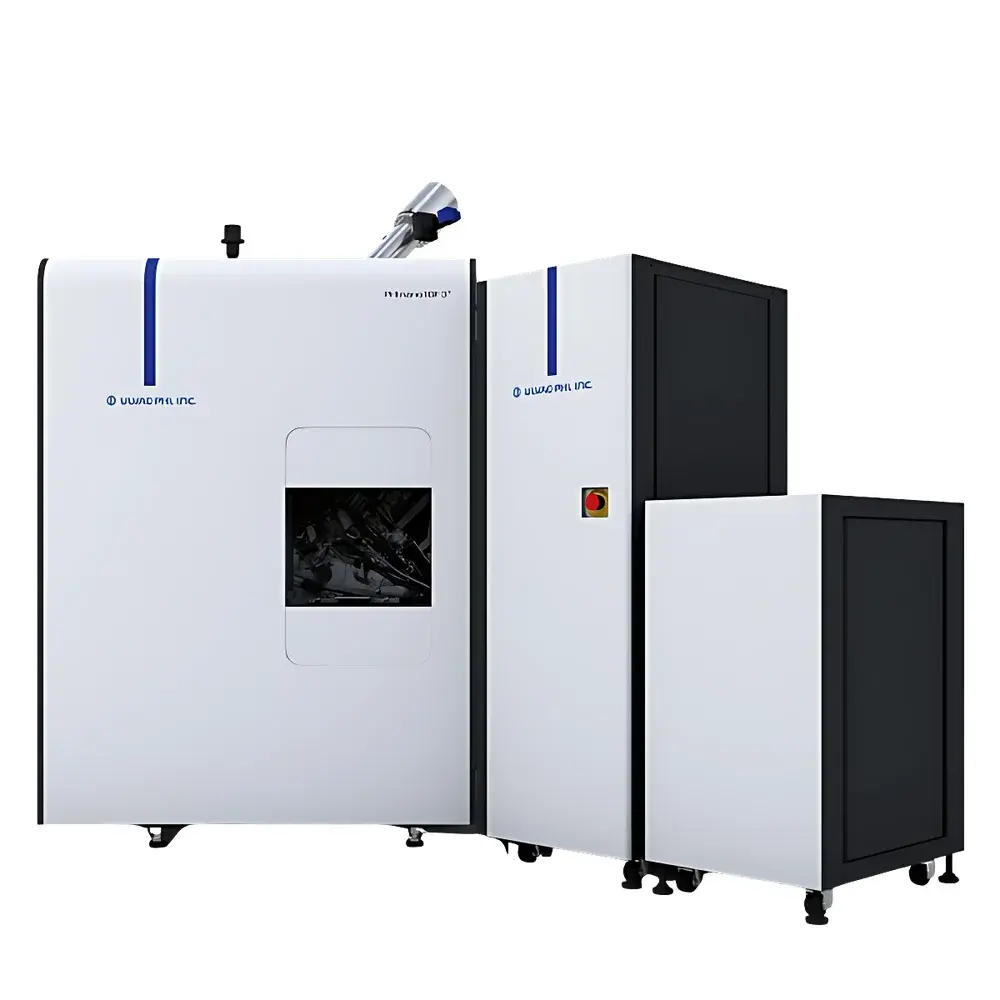
ULVAC-PHI PHI oTOF3+ Time-of-Flight Secondary Ion Mass Spectrometer
| Brand | ULVAC-PHI |
|---|---|
| Origin | Japan |
| Model | PHI oTOF3+ |
| Type | TOF-SIMS Instrument with TRIFT Analyzer |
| Ion Sources | Liquid Metal Ion Gun (Ga⁺), Optional Ar-GCIB, Cs⁺, O₂⁺ |
| Spatial Resolution | <50 nm (high-resolution mode), <500 nm (high-mass-resolving mode) |
| Automation | Fully Automated Sample Transfer & Unattended Multi-Sample Analysis |
| Charge Neutralization | Dual-Beam Electron/Ar⁺ Neutralization System |
| Optional Features | Parallel Imaging MS/MS, FIB Cross-Sectioning, Cryo-Stage, Detachable Glovebox Integration |
| Compliance | Designed for GLP/GMP environments |
Overview
The ULVAC-PHI PHI oTOF3+ is a high-performance time-of-flight secondary ion mass spectrometer (TOF-SIMS) engineered for quantitative surface and depth-profiling analysis of inorganic, organic, and polymeric materials. It employs a next-generation TRIFT™ (Time-lag Focusing Ion Mass Spectrometer) mass analyzer — a triple-stage reflectron design that simultaneously corrects for both kinetic energy spread and emission angle dispersion of secondary ions. This enables exceptional mass resolution (M/ΔM > 10,000 at m/z 100) without sacrificing detection sensitivity or spatial fidelity, even on topographically complex or insulating samples. Unlike conventional linear or single-stage reflectron TOF instruments, the TRIFT architecture ensures consistent flight times for ions of identical mass-to-charge ratio, minimizing peak broadening and background artifacts. The system integrates a high-brightness liquid metal ion gun (LMIG) for Ga⁺ primary ion bombardment, delivering sub-50 nm lateral resolution in high-spatial-mode operation and <500 nm resolution under high-mass-resolving conditions — all within typical acquisition times of 2–5 minutes per spectrum.
Key Features
- TRIFT™ mass analyzer: Delivers simultaneous energy and angular focusing for superior mass resolution and signal-to-noise ratio across heterogeneous surfaces.
- Automated unattended multi-sample analysis: Adaptive sample stage biasing and height adjustment based on real-time conductivity assessment enables robust TOF-SIMS characterization of insulators without manual intervention.
- Dual-beam charge neutralization: Synchronized low-energy electron and argon ion beams provide fully automated, sample-agnostic charge compensation — eliminating manual tuning for ceramics, oxides, polymers, and biological films.
- FIB-integrated cross-sectioning: On-board focused ion beam (FIB) capability using the same Ga⁺ source allows sequential site-specific milling and TOF-SIMS analysis — including cryogenic FIB processing and optional 3D reconstruction of sputtered volumes.
- Parallel imaging MS/MS: Optional tandem mass spectrometry module enables concurrent acquisition of precursor (MS¹) and fragment (MS²) ion images, facilitating structural elucidation of lipids, peptides, and synthetic macromolecules.
- Modular ion source compatibility: Supports interchangeable primary ion sources including Ar gas cluster ion beam (Ar-GCIB) for gentle organic depth profiling, Cs⁺ for enhanced negative-ion yield from inorganics, and O₂⁺ for positive-ion enhancement.
Sample Compatibility & Compliance
The PHI oTOF3+ accommodates samples up to 100 mm × 100 mm in size via its fully automated sample transfer system. Its vacuum-integrated sample parking station enables queued analysis of >20 specimens per run. For air-sensitive materials — such as lithium-ion battery electrodes, OLED layers, or hydrated biomaterials — an optional detachable glovebox can be directly coupled to the load-lock chamber, maintaining inert-atmosphere handling from mounting through insertion. All analytical workflows adhere to principles of Good Laboratory Practice (GLP) and are compatible with quality systems requiring traceability: instrument logs record operator identity, timestamped method parameters, calibration events, and raw data checksums. When configured with electronic signatures and audit trail modules, the system meets documentation requirements outlined in FDA 21 CFR Part 11 for regulated environments.
Software & Data Management
Acquisition and processing are managed through PHI’s proprietary MultiPack software suite, which includes Queue Editor for defining multi-sample sequences, SurfaceLab for spectral deconvolution and multivariate analysis (PCA, MCR), and DepthProfile Studio for quantitative sputter-depth correlation. Raw data files conform to the ASTM E1947 standard format for mass spectral interchange, ensuring interoperability with third-party chemometric platforms. Remote operation is supported over secure LAN or internet connections, allowing full control of load-lock cycling, stage positioning, beam alignment, and spectral acquisition from off-site locations. Diagnostic telemetry enables proactive service interventions, with firmware updates delivered via encrypted channels.
Applications
The PHI oTOF3+ serves critical roles in advanced materials R&D, semiconductor process development, pharmaceutical solid-state characterization, and failure analysis. Typical use cases include mapping dopant segregation at Si/SiO₂ interfaces; quantifying molecular diffusion gradients in polymer blend thin films; identifying oxidation states and interfacial reaction products in solid-electrolyte interphases (SEI); correlating lipid raft distribution with membrane protein localization in frozen-hydrated tissue sections; and validating batch-to-batch consistency of surface-modified medical device coatings. Its ability to combine nanoscale imaging, isotopic fidelity, and molecular fragmentation pathways makes it uniquely suited for regulatory submissions requiring structural confirmation beyond elemental composition.
FAQ
What vacuum level does the PHI oTOF3+ maintain during analysis?
The analysis chamber operates at ultra-high vacuum (UHV) conditions ≤2 × 10⁻⁹ Torr, achieved via turbomolecular pumping combined with cryogenic trapping to minimize hydrocarbon contamination and ensure stable secondary ion yields.
Is depth profiling possible on organic layers without chemical damage?
Yes — when equipped with the optional Ar-GCIB ion source, the system achieves sub-monolayer sputter rates with minimal bond scission, preserving molecular integrity for reliable organic depth profiling up to several hundred nanometers.
Can the instrument perform true 3D chemical tomography?
With integrated FIB milling and sequential TOF-SIMS layer removal, volumetric reconstruction is achievable; optional Ga⁺ source enables FIB-generated 3D topographic maps co-registered with chemical ion distributions.
Does the system support external trigger inputs for synchronized measurements?
Yes — TTL-compatible trigger ports allow synchronization with external laser pulses, stage encoders, or environmental control units for time-resolved or in situ experiments.
What training and qualification support is provided?
ULVAC-PHI offers IQ/OQ/PQ documentation packages, hands-on application workshops, and remote-assisted method development — all aligned with ISO/IEC 17025 and ASTM E1598 guidelines for analytical instrument validation.






