
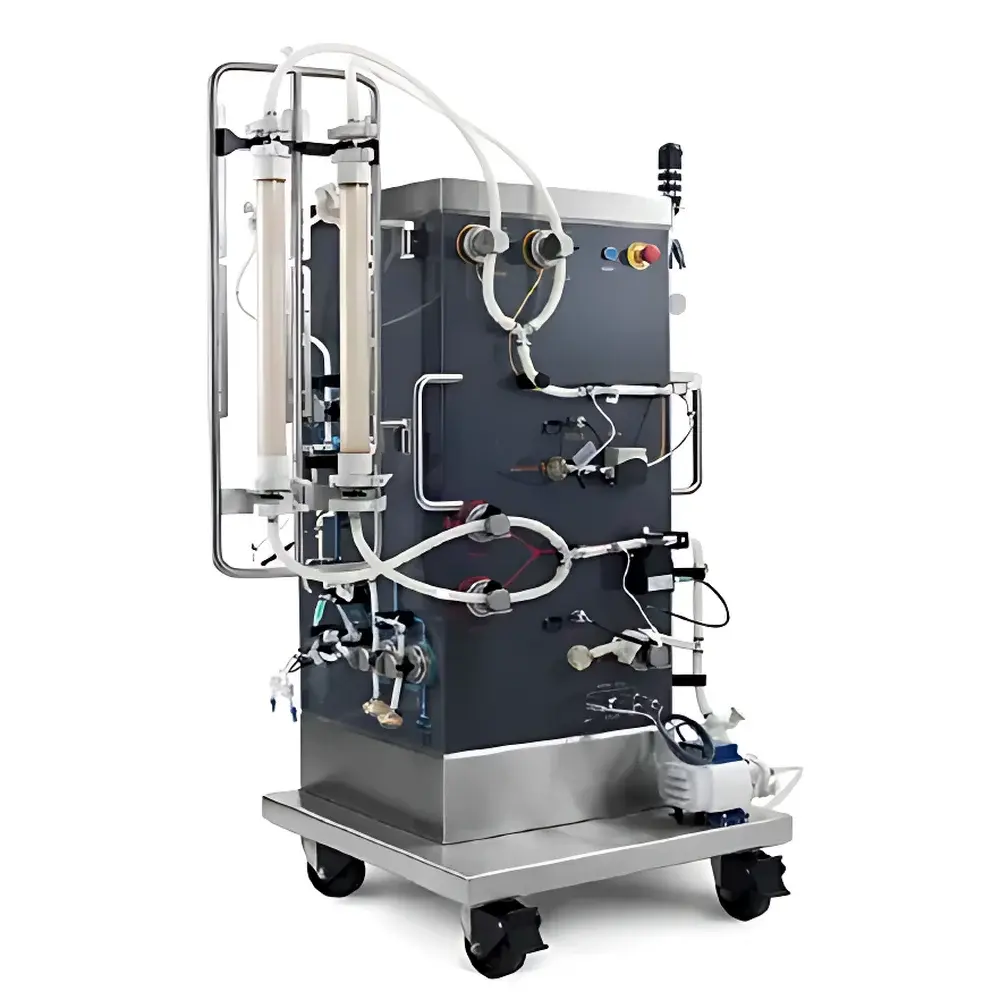
Cytiva Xcellerex™ Automated Perfusion System (APS)
| Brand | Cytiva |
|---|---|
| Origin | USA |
| Manufacturer Type | Authorized Distributor |
| Product Origin | Imported |
| Model | Xcellerex™ |
| Pricing | Available Upon Request |
Overview
The Cytiva Xcellerex™ Automated Perfusion System (APS) is an integrated, single-use platform engineered for robust and scalable perfusion bioprocessing across process development and clinical/commercial manufacturing. Built upon tangential flow filtration (TFF) principles, the APS enables high-density, long-duration mammalian cell culture under controlled, cGMP-compliant conditions. Its architecture supports both classical steady-state perfusion and intensified N-1 seed train expansion—critical for accelerating upstream timelines in therapeutic protein, monoclonal antibody (mAb), and viral vector production. Unlike modular or semi-automated alternatives, the APS unifies cell retention, media exchange, filtrate handling, and real-time parameter monitoring within a single control environment—eliminating inter-system communication latency and reducing validation burden across scale-up transitions.
Key Features
- Integrated TFF-based cell retention with low-shear, magnetically coupled recirculation pump—designed to maintain >95% viable cell density over multi-week runs at densities exceeding 50 × 10⁶ cells/mL.
- Automated filter switching logic that monitors transmembrane pressure (TMP), flux decline, and permeate conductivity to trigger seamless transition between primary and secondary hollow-fiber modules—minimizing manual intervention and eliminating need for redundant backup systems.
- Unified liquid management architecture supporting automatic media bag switching, harvest tank pressurization, and filtrate volume tracking—reducing operator dependency and human error during extended perfusion campaigns.
- Scalable from <50 L to 500 L working volumes via standardized XDR bioreactor integration—enabling direct tech transfer from lab-scale process characterization to clinical batch manufacturing without requalification of core unit operations.
- Pre-validated ReadyToProcess™ hollow-fiber modules (available in both microfiltration and ultrafiltration configurations) with documented extractables/leachables profiles compliant with USP , ISO 10993-18, and ICH Q5A(R2).
Sample Compatibility & Compliance
The APS is validated for use with CHO, HEK293, CAP-T, and Sf9 suspension cultures, including those expressing complex glycoproteins and lentiviral vectors. All wetted contact materials—including fluid paths, sensor housings, and filter housings—meet USP Class VI biological reactivity requirements and comply with FDA 21 CFR Part 11 for electronic records and signatures. The system’s automation architecture supports audit trail generation, user access control (UAC), and electronic signature capture per ALCOA+ principles—ensuring full traceability for GLP, GMP, and regulatory submissions (e.g., IND, BLA, MAA). Process data are stored in encrypted SQLite databases with configurable retention policies aligned with EMA Annex 11 and PIC/S PI 011-3 expectations.
Software & Data Management
The APS operates under Cytiva’s proprietary UniVerve™ control software—a deterministic, real-time operating system (RTOS) with deterministic loop timing (<100 ms cycle resolution). The interface provides role-based access (Operator, Supervisor, Administrator), configurable alarm thresholds, and automated batch report generation (PDF + CSV) containing all critical process parameters (e.g., viable cell density, lactate/glucose concentration trends, TMP, filtrate volume, pump RPM). Raw data archives include timestamped sensor values, event logs, and system state snapshots—exportable for third-party analysis tools (e.g., SIMCA, JMP, Python Pandas). Software validation documentation (IQ/OQ/PQ protocols, risk assessments, and change control history) is provided as part of the system delivery package.
Applications
- High-yield mAb production under continuous perfusion mode (≥3–5 g/L/day titers achievable with optimized feed strategies)
- N-1 perfusion seed expansion for fed-batch main bioreactors—reducing inoculum volume by up to 75% and improving lot-to-lot consistency
- Stable cell line evaluation and clone selection under prolonged stress conditions (e.g., nutrient limitation, metabolic byproduct accumulation)
- Viral vector manufacturing (LV, AAV) where high viability and low shear are essential to preserve infectivity titer
- Process characterization studies requiring DOE-driven variation of perfusion rate, harvest frequency, and TFF cut-off MWCO
FAQ
What bioreactor platforms is the APS compatible with?
The APS is natively integrated with Cytiva’s Xcellerex XDR series bioreactors (XDR-10, XDR-50, XDR-200, XDR-500) via standardized pneumatic and digital I/O interfaces. Third-party bioreactors may be connected using Modbus TCP or OPC UA gateways—subject to site-specific qualification.
Does the APS support PAT integration?
Yes—the system provides analog 4–20 mA outputs and Modbus registers for real-time streaming of key parameters (e.g., biomass estimate via capacitance probe, pH, DO, temperature) to external PAT platforms such as FBRM, Raman spectrometers, or soft sensors.
Can the APS operate under closed processing conditions?
All fluid paths are designed for closed-system operation per ISPE Baseline Guide Volume 4 (Biotechnology) and EU GMP Annex 1. Sterile connectors, pre-sterilized tubing sets, and gamma-irradiated filters enable aseptic connection without open handling.
Is remote monitoring supported?
Remote desktop access is disabled by default for cybersecurity compliance. However, secure, encrypted web-based dashboards (via TLS 1.2+) can be deployed on customer-controlled infrastructure for authorized personnel to view real-time KPIs and historical trends.
What validation support is included?
Cytiva supplies factory-verified IQ/OQ protocols, URS traceability matrices, and risk assessments (FMEA). Site-specific PQ execution support and commissioning assistance are available through Cytiva’s Global Validation Services team.



