
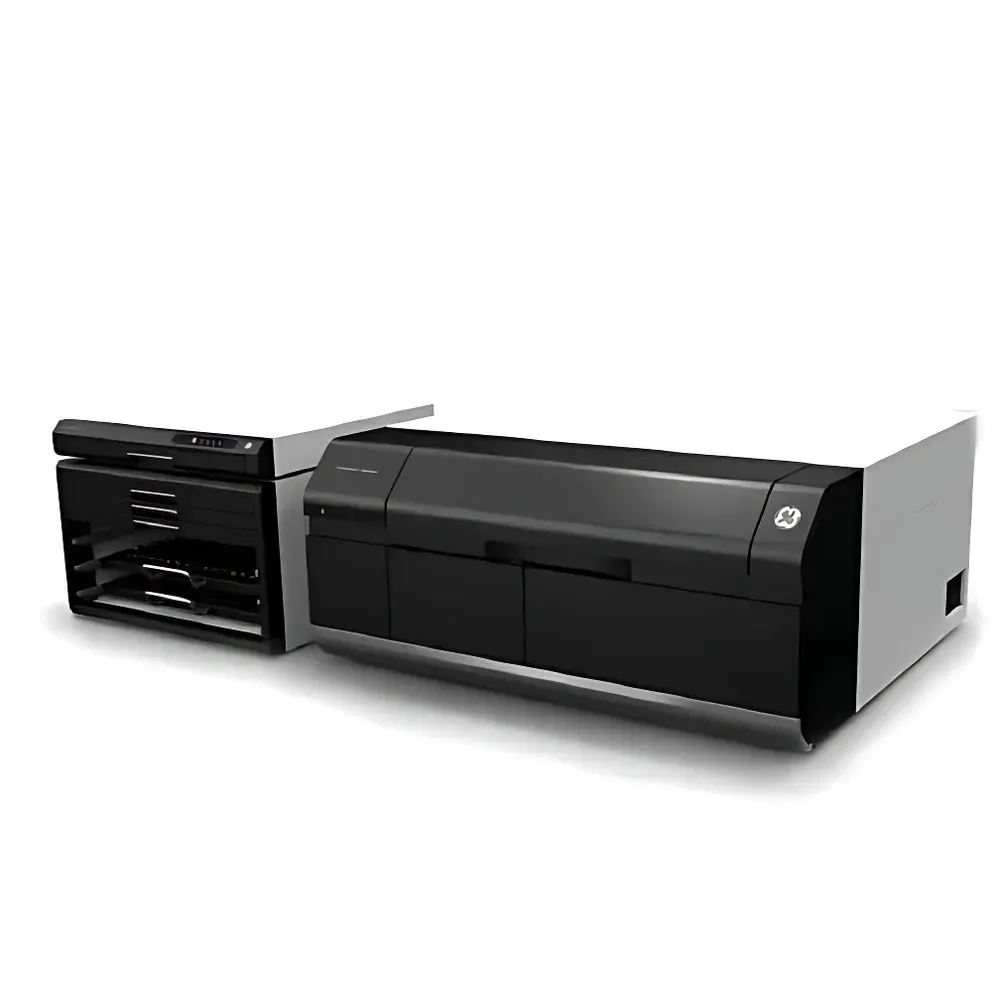
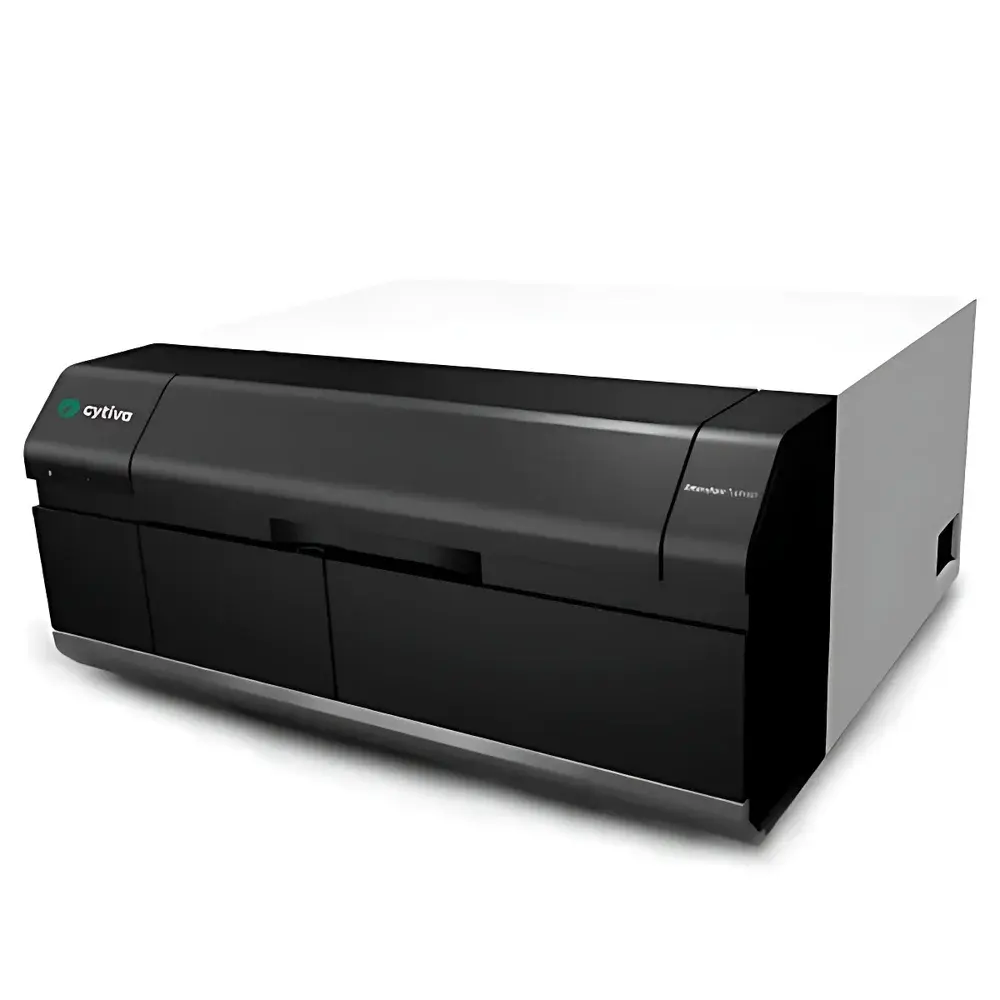
Cytiva Amersham Typhoon IP Laser Scanner
| Brand | Cytiva |
|---|---|
| Origin | Japan |
| Model | Amersham Typhoon IP |
| Dynamic Range | >5 decades |
| Scan Area | 40 × 46 cm |
| Imaging Modes | Phosphor Imaging, Fluorescence (RGB), Near-Infrared (NIR), Optical Density (OD) |
| Detector Type | High-Sensitivity PMT-based Scanning System |
| Lens | Fujifilm Precision Optics |
| Compliance | Supports IQ/OQ Documentation, GLP/GMP-Ready Data Acquisition |
Overview
The Cytiva Amersham Typhoon IP Laser Scanner is a high-performance, multi-modal molecular imaging platform engineered for quantitative detection across life science research and biopharmaceutical development. Based on laser-excited phosphor storage plate (PSP) scanning technology, it captures ionizing radiation (e.g., 32P, 35S, 14C, 3H, 125I) and fluorescence emissions with exceptional sensitivity and linearity. Unlike film-based autoradiography, the Typhoon IP employs a photostimulable phosphor screen (BAS-IP) that stores latent radiation energy and releases it as visible light upon laser stimulation—enabling digital quantitation, re-readability, and elimination of darkroom processing. Its optical architecture integrates Fujifilm-designed lenses and precision galvanometer-driven laser scanning to deliver uniform illumination and spatial resolution optimized for large-format gels (up to 40 × 46 cm), membranes, tissue sections, and microarrays. The system is widely adopted in academic, clinical, and regulatory environments where reproducible, audit-ready data are required for publications, IND submissions, and process validation.
Key Features
- Multi-modal detection: Native support for phosphor imaging, RGB fluorescence, NIR, and optical density (OD) quantification within a single instrument platform
- Dynamic range exceeding five orders of magnitude (>5 decades), enabling simultaneous quantification of low-abundance and highly expressed targets in a single scan
- Large-format scanning area (40 × 46 cm) accommodates full-size 2D gels, SDS-PAGE slabs, and macroarrays without tiling or stitching artifacts
- Fujifilm optical train ensures minimal chromatic aberration and high signal fidelity across excitation/emission wavelengths
- Automated PMT gain optimization and region-of-interest (ROI) pre-scan functionality reduce user-dependent variability and accelerate workflow turnaround
- Modular hardware design allows field-upgradable configurations—from basic IP-only to full RGB/NIR capability via laser and filter cartridge integration
- Reusable BAS-IP phosphor screens eliminate film costs, chemical developers, and darkroom infrastructure while maintaining archival stability
Sample Compatibility & Compliance
The Typhoon IP accepts diverse sample formats including phosphor imaging plates (BAS-IP series), polyacrylamide and agarose gels, nitrocellulose/PVDF membranes, glass slides (IHC, tissue sections), microtiter plates (96-/384-well), TLC plates, and X-ray diffraction films. It supports isotopes commonly used in radiolabeling studies (3H, 14C, 32P, 33P, 35S, 125I, 131I, 99mTc) and fluorescent dyes spanning UV–NIR spectra (e.g., SYBR Safe, Cy dyes, Alexa Fluor, IRDye). For regulated environments, the system supports IQ/OQ documentation packages compliant with ISO/IEC 17025 and FDA 21 CFR Part 11 requirements. Audit trails, electronic signatures, and secure user access control can be implemented through optional software modules aligned with GLP and GMP quality systems.
Software & Data Management
Acquisition and analysis are performed using ImageQuant TL software—a validated, Windows-based application offering intuitive workflow automation, batch processing, and export to standard formats (TIFF, PNG, CSV, XML). The software provides calibrated intensity calibration curves, background subtraction algorithms, spot-matching for 2D DIGE, and integrated tools for HCP (host cell protein) coverage assessment in bioprocess development. All raw image data, acquisition parameters, and processing history are stored in a structured, timestamped database supporting traceability and reanalysis. Data export conforms to MIAME and MIAPE reporting standards, facilitating submission to public repositories such as PRIDE or GEO.
Applications
The Typhoon IP serves as a core imaging platform across molecular biology, proteomics, and biopharmaceutical analytics. Key use cases include: quantitative phosphor imaging for Southern/Northern/Western blotting and 2D-DIGE; fluorescence-based detection in EMSA, in-cell Westerns, and glycoprotein profiling; NIR multiplexing for antibody validation and receptor binding assays; OD-based densitometry for Coomassie- or silver-stained gels; and high-throughput screening of reporter gene arrays and microbial colonies. In bioprocess development, it enables rigorous HCP mapping via 2D-DIBE analysis—supporting comparability studies and late-stage clinical manufacturing consistency assessments per ICH Q5E guidelines.
FAQ
What is the difference between phosphor imaging and traditional autoradiography?
Phosphor imaging uses reusable storage phosphor screens that capture radiation energy and release it as light upon laser stimulation—allowing digital quantitation, dynamic range >5 decades, and no chemical processing. Traditional film lacks linearity, requires darkroom handling, and offers limited dynamic range (~2 orders of magnitude).
Can the Typhoon IP be upgraded from IP-only to fluorescence or NIR capability?
Yes—the platform supports field-installable laser modules (488 nm, 532 nm, 635 nm, 685 nm, 785 nm) and corresponding filter cartridges, enabling expansion from phosphor-only to multi-color fluorescence and NIR detection.
Is the system compatible with LIMS or ELN integration?
ImageQuant TL supports standardized data export (CSV, TIFF, XML) and can be integrated into enterprise informatics systems via configurable APIs and network file sharing protocols.
What validation documentation is available for regulated labs?
Cytiva provides IQ/OQ protocols, installation qualification checklists, operational qualification test scripts, and software validation summaries aligned with ASTM E2500 and Annex 11 principles.
How does the Typhoon IP support host cell protein (HCP) analysis in biologics development?
It enables high-resolution 2D-DIBE (Difference Gel Electrophoresis) with internal standard labeling, allowing precise spot matching, quantification, and coverage mapping across purification steps—critical for demonstrating process consistency per ICH Q5A(R2).





