
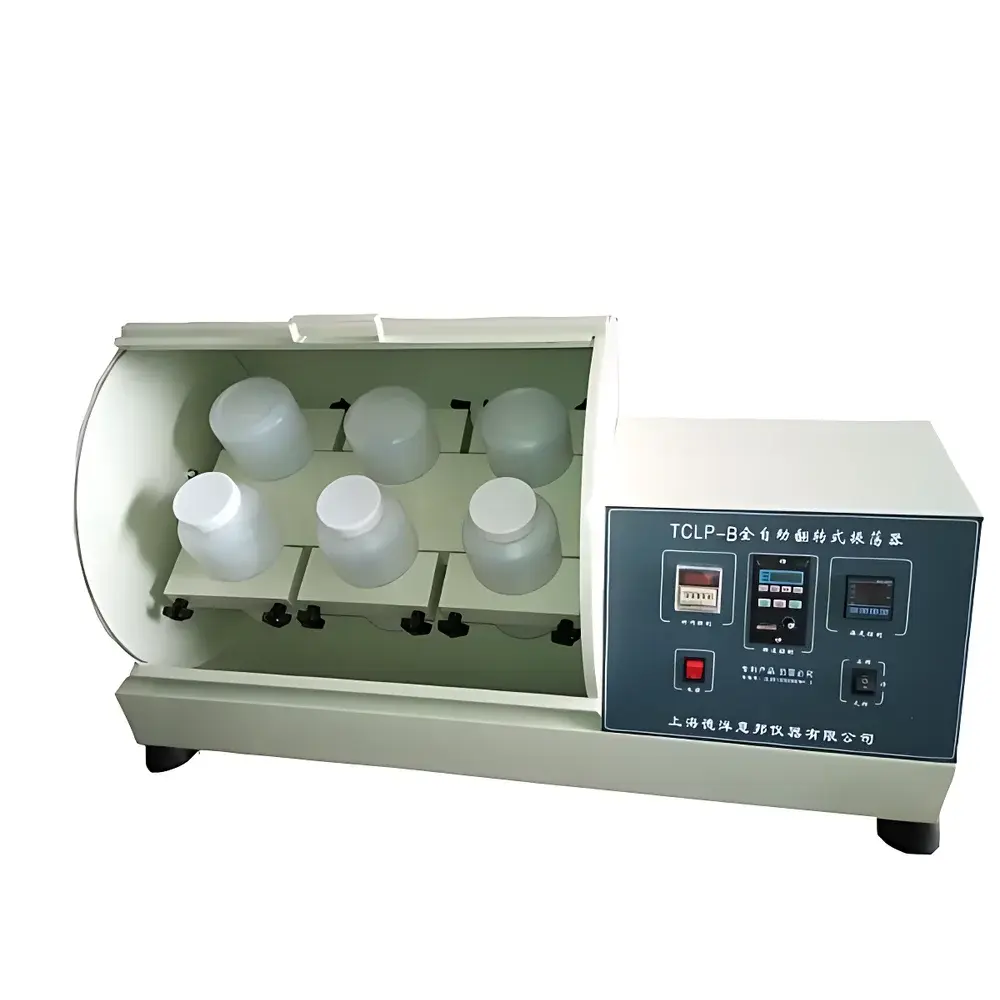
Deyang Yibang TCLP-6B Tumbling Oscillator for Solid Waste Toxicity Leaching
| Brand | Deyang Yibang (DYYB) |
|---|---|
| Origin | Shanghai, China |
| Model | TCLP-6B |
| Oscillation Frequency | 0–45 rpm |
| Time Control Range | 0–9999 h |
| Sample Bottle Capacity | 6 positions |
| Temperature Range | Ambient +5°C to 55°C |
| Temperature Control Accuracy | ±1°C |
| Maximum Load Capacity | ≥150 kg |
| Bottle Opening Diameter | 120 mm |
| Power Supply | AC 220 V, 50/60 Hz |
Overview
The Deyang Yibang TCLP-6B Tumbling Oscillator is an engineered platform designed specifically for regulatory-compliant toxicity characteristic leaching procedure (TCLP) testing in accordance with U.S. EPA Method 1311 and related international standards including ASTM D5233, ISO 11372, and China’s HJ/T 299–2007. It implements the tumbling (rotational inversion) principle—where sample containers are rotated end-over-end along a horizontal axis—to simulate landfill leaching conditions under controlled temperature and time parameters. Unlike orbital or reciprocating shakers, this design ensures uniform, low-shear agitation critical for preserving solid matrix integrity while maximizing analyte release from heterogeneous waste matrices. Its full-temperature capability (ambient +5°C to 55°C) supports method-specific thermal conditioning, particularly essential for volatile organic compound (VOC) stability and pH-dependent metal speciation during extraction.
Key Features
- Robust stainless steel housing with corrosion-resistant epoxy-polyester coating—engineered for long-term exposure to acidic (e.g., acetic acid buffer, pH 4.93) and alkaline leaching media used in TCLP and SPLP protocols.
- Aluminum alloy sample clamps with identical anti-corrosion finish, ensuring mechanical stability and chemical inertness during extended 18–24 h extraction cycles.
- Precision DC motor drive with digital speed control (5–45 rpm, ±2 rpm repeatability), enabling strict adherence to EPA-specified 30 ± 2 rpm rotation rate for TCLP compliance.
- Intelligent temperature regulation system featuring high-temperature-rated axial fans and PID-controlled heating elements, delivering ±1°C uniformity across all six bottle positions—even under full load and ambient fluctuations.
- Integrated safety architecture: dual-stage over-temperature cutoff, electronic overload protection, earth-leakage circuit interrupter (ELCI), and mechanical door interlock to halt rotation when lid is open.
- Front-access flip-lid enclosure with drip tray and drain channel—designed to contain accidental spills of hazardous leachates and facilitate decontamination between runs.
- Digital LED display showing real-time rpm, elapsed time, and setpoint temperature; programmable timer supports durations up to 9999 hours (exceeding maximum required leaching periods by orders of magnitude).
Sample Compatibility & Compliance
The TCLP-6B accommodates standard 2 L PE, borosilicate glass, PTFE-coated, or zero-headspace extraction (ZHE) vessels with 120 mm neck diameter—fully compatible with EPA-recommended container specifications. Its symmetrical cross-pattern fixture layout minimizes rotational imbalance and ensures consistent g-force distribution across all positions. The unit meets mechanical and environmental requirements for GLP-compliant laboratories and supports audit-ready documentation when paired with validated SOPs. While not certified to IEC 61000-6-2/6-3 or UL 61010-1 out-of-the-box, its electrical design conforms to CE-equivalent safety principles and may be integrated into ISO/IEC 17025-accredited workflows following local risk assessment and calibration verification.
Software & Data Management
This standalone instrument operates without proprietary software; all operational parameters are configured via front-panel controls with non-volatile memory retention. Time, speed, and temperature settings persist through power interruption. For laboratories requiring electronic records per FDA 21 CFR Part 11 or EU Annex 11, integration with external data loggers (e.g., Omega OM-DAQPRO-5300 or Campbell Scientific CR1000X) is supported via analog 0–5 V output signals for rpm and temperature. Audit trails must be maintained externally—no internal event logging or user authentication is provided. Calibration certificates for temperature and rotational speed sensors should be renewed annually per ISO/IEC 17025 Clause 6.5 guidelines.
Applications
- Toxicity Characteristic Leaching Procedure (TCLP) screening of municipal, industrial, and hazardous solid wastes prior to landfill disposal.
- Synthetic Precipitation Leaching Procedure (SPLP) and California Waste Extraction Test (WET) for assessing metal mobility under simulated rainfall conditions.
- Leachate generation for subsequent analysis by ICP-MS, ICP-OES, GC-MS, or ion chromatography per EPA Methods 200.7, 200.8, 8260, and 300.0.
- Soil and sediment partitioning studies evaluating contaminant bioavailability and sorption kinetics under controlled thermal and mechanical stress.
- Method validation and interlaboratory comparison exercises where reproducible, low-shear tumbling is mandatory.
FAQ
Does the TCLP-6B comply with U.S. EPA Method 1311?
Yes—its rotational speed range (30 ± 2 rpm), temperature control (±1°C), and mechanical design meet all physical equipment requirements specified in EPA SW-846 Method 1311 Section 7.1.
Can it accommodate 1-L bottles or only 2-L containers?
The 120 mm aperture supports both 1 L and 2 L bottles; however, EPA Method 1311 mandates use of 2 L containers for representative leaching volume and headspace ratio.
Is temperature uniformity verified across all six positions?
Yes—validation per ASTM E2251 confirms ≤ ±0.8°C deviation between positions at 55°C under full load, verified using NIST-traceable PT100 probes.
What maintenance intervals are recommended for long-term reliability?
Motor brush inspection every 5,000 operating hours; fan filter cleaning quarterly; annual recalibration of temperature sensor and tachometer.
Is remote monitoring or Ethernet connectivity available?
No—this is a benchtop stand-alone unit without network interface; optional analog signal outputs enable connection to third-party SCADA or LIMS systems.
Related Products







