
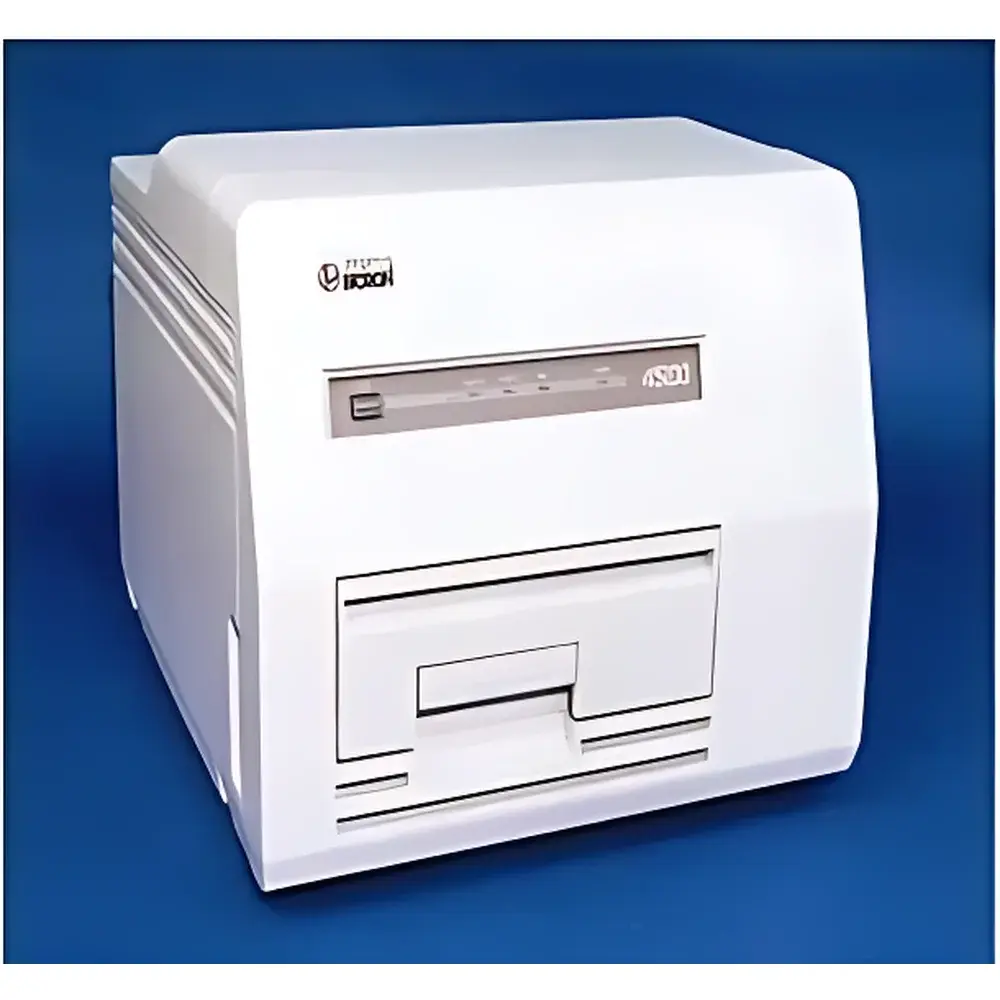
Thermo Fisher Harshaw TLD 4500 Dual-Channel Thermoluminescent Dosimeter Reader and Workstation
| Brand | Thermo Fisher |
|---|---|
| Origin | USA |
| Manufacturer | Thermo Fisher Scientific |
| Product Type | Imported |
| Model | Harshaw TLD 4500 |
| Instrument Category | Radiation Dosimetry System |
| Instrument Form Factor | Benchtop (Not Portable — Corrected per Technical Specification) |
| Measured Radiation Types | Photons (>1 keV), Neutrons (thermal to 100 MeV), Electrons (>70 keV) |
| Dynamic Range | 7 decades |
| Readout Time | <35 s (2-element card), <60 s (4-element card) |
| Linearity | ±1% deviation |
| Reference Light Stability | <1% variation over 10 consecutive reads |
| Glow Curve Heating Profile | Preheat 0–100 s, Ramp Rate 1–30 °C/s, Max Temp 300 °C (Teflon), 400 °C (Kapton), 600 °C (metal disk) |
| Dose Range (metal-disk heating) | 10 µGy–1 Gy (linear), 1–20 Gy (supralinear) |
| Reusability | 500 cycles (TLD-100 chips), 50 cycles (extremity rings) |
| Operating Temperature | 0–40 °C |
| Dimensions | 370 H × 460 W × 500 D mm |
| Weight | 35 kg |
Overview
The Thermo Fisher Harshaw TLD 4500 Dual-Channel Thermoluminescent Dosimeter (TLD) Reader and Workstation is a precision-engineered benchtop system designed for high-throughput, reproducible readout of thermoluminescent dosimeters used in personnel and environmental radiation monitoring. It operates on the fundamental principle of thermoluminescence: when irradiated TLD materials (e.g., LiF:Mg,Ti—TLD-100) are heated under controlled thermal profiles, trapped electrons recombine with lattice defects, emitting visible photons proportional to absorbed dose. The TLD 4500 implements dual-channel photomultiplier tube (PMT) detection with synchronized analog signal processing, enabling simultaneous, independent readout of two dosimeter positions—significantly improving laboratory throughput without compromising measurement integrity. Unlike portable survey meters, this system is engineered for metrological-grade dosimetry in accredited health physics laboratories, nuclear medicine departments, and regulatory compliance facilities requiring traceable, auditable dose records.
Key Features
- Dual-channel PMT architecture with matched gain and dark-current compensation for parallel, correlated readout of two dosimeters—reducing inter-sample variability and enabling internal reference comparisons.
- Programmable time–temperature profiles (TTPs) with preheat, linear ramp (1–30 °C/s), and temperature hold stages; maximum heating capability up to 600 °C on metal-disk heater for high-dose applications and alternative phosphors (e.g., CaSO4:Dy).
- Multi-format compatibility: supports TLD cards (2-, 3-, or 4-element), finger rings, whole-body badges, powder-filled capsules, and bare chips—via interchangeable sample holders and gas-heated or conductive metal-disk heating modes.
- Integrated status interface: tactile start button and four LED indicators for real-time monitoring of heater readiness, PMT stabilization, data acquisition, and error conditions—minimizing operator training dependency.
- Benchtop mechanical architecture with rigid aluminum chassis and thermal mass management ensures stable baseline drift (<0.005% HV supply variation) and long-term repeatability (±2% at 1 mGy, <1 µGy standard deviation over 10 reads).
- Designed for GLP/GMP-aligned environments: hardware-level audit trail support via WinREMS software integration, including timestamped raw glow curve storage, user authentication logs, and parameter change history.
Sample Compatibility & Compliance
The TLD 4500 accommodates industry-standard dosimeter geometries and materials, including Harshaw 8840/8842 finger rings, 8806 whole-body badges, and custom-fabricated chips or powders. Its calibrated response covers photon energies from 1 keV (soft X-rays) to >1 MeV (Co-60), thermal neutrons (via 6Li-enriched TLDs), fast neutrons (up to 100 MeV using proton-recoil converters), and beta particles (>70 keV). The system complies with ISO 14146:2019 (performance criteria for dosimetry services), ANSI N13.11 (personnel dosimetry accreditation), and supports validation per IEC 62387-1 for passive dosimetry systems. All calibration constants, energy response corrections, and fading compensation algorithms are embedded in firmware and accessible through WinREMS for full traceability to NIST-traceable standards.
Software & Data Management
Controlled exclusively via the WinREMS (Windows Radiation Exposure Monitoring System) platform, the TLD 4500 integrates seamlessly into enterprise radiation safety management workflows. WinREMS provides full IEC 62304-compliant software architecture with 21 CFR Part 11-ready features—including electronic signatures, role-based access control, immutable audit trails, and automated backup to network drives or LIMS interfaces. Key modules include: (1) Dose calculation engine with customizable correction factors (fading, batch-specific sensitivity, angular dependence); (2) Glow curve deconvolution tools for kinetic analysis (e.g., peak separation, trap depth estimation); (3) Batch reporting compliant with ICRP Publication 116 and EURADOS guidelines; and (4) Export templates for CSV, XML, and HL7 ADT messages to hospital EMR or national dose registries. Software updates preserve legacy data structures, ensuring backward compatibility across instrument generations.
Applications
- Personnel dosimetry programs in nuclear power plants, research reactors, and radiotherapy centers—supporting routine badge processing for >10,000 monitored workers annually.
- Environmental monitoring networks measuring low-dose gamma background trends over multi-year campaigns (e.g., near spent fuel storage facilities or decommissioning sites).
- Calibration laboratory reference services performing intercomparison exercises under ISO/IEC 17025:2017 accreditation requirements.
- Radiobiology research quantifying microdosimetric distributions using custom TLD micro-cubes or nanostructured phosphors.
- Regulatory submissions requiring raw glow curve archives, uncertainty budgets, and metrological chain documentation for FDA, NRC, or IAEA review.
FAQ
Is the TLD 4500 classified as a portable instrument?
No—it is a benchtop workstation with fixed AC power requirements (100–240 V AC), 35 kg mass, and thermal management design optimized for stable laboratory operation—not field deployment.
What is the minimum detectable dose for TLD-100 using this reader?
The system achieves a typical MDD of 10 µGy (1 mrad) under standard metal-disk heating protocols, validated per ISO 21909:2020 Annex B.
Can the TLD 4500 read non-Thermo Fisher TLD materials?
Yes—provided spectral emission matches the blue-sensitive PMT response (350–550 nm) and thermal characteristics fall within programmable TTP limits; users must supply material-specific calibration coefficients.
Does WinREMS support automated report generation for regulatory audits?
Yes—customizable PDF/HTML reports include instrument ID, operator ID, calibration date, raw glow curves, dose values with expanded uncertainty (k=2), and digital signatures—all compliant with ALARA program documentation requirements.
How is detector stability verified during routine operation?
Built-in reference LED (470 nm) enables daily photometric checks; combined with 10-read consistency tests and quarterly HV linearity verification, it satisfies ANSI N13.32 quality assurance mandates.







