
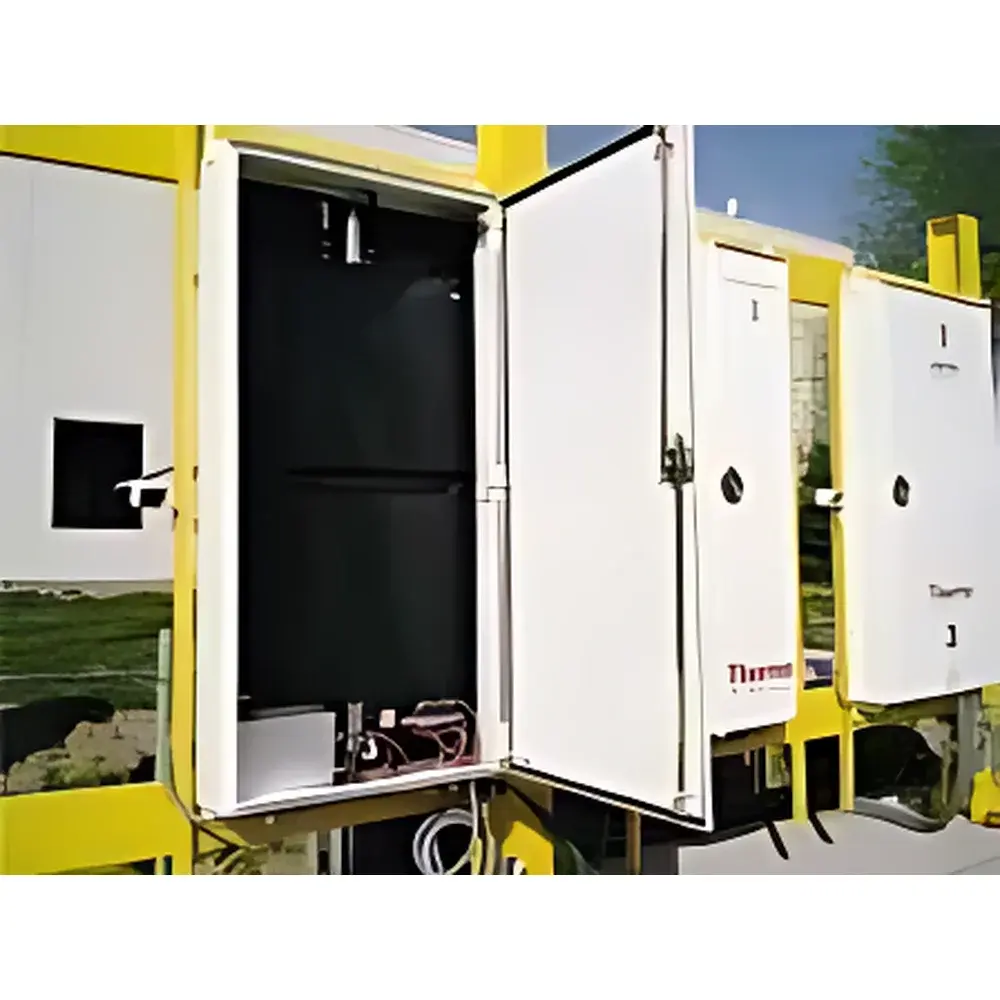
Thermo Fisher Scientific ASM-IV Vehicle Radiation Monitoring System
| Brand | Thermo Fisher |
|---|---|
| Origin | USA |
| Manufacturer | Thermo Fisher Scientific |
| Product Type | Imported |
| Model | ASM-IV |
| Instrument Category | Radiation Dose Rate Meter |
| Form Factor | Portable |
| Measured Substance | Radioactive Materials |
| Detector Type | Large-Volume Scintillation Detector |
| Measurement Scope | Wide Dynamic Range |
| Sensitivity | High |
| Compliance | ANSI N42.35-2006 |
Overview
The Thermo Fisher Scientific ASM-IV Vehicle Radiation Monitoring System is a field-deployable, portal-based radiation detection platform engineered for rapid, non-intrusive screening of vehicles—including trucks, cargo containers, and passenger cars—for the presence of radioactive materials. Operating on the principle of gamma-ray and neutron detection via large-volume scintillation detectors, the ASM-IV leverages pulse-height analysis and spectral discrimination algorithms to distinguish naturally occurring radioactive material (NORM), medical isotopes, industrial sources, and potential threat radionuclides (e.g., 137Cs, 60Co, 241Am, and 252Cf). Its design prioritizes high sensitivity across a broad energy range (typically 50 keV to 3 MeV for gamma; thermal to fast neutrons with optional moderation), low false-alarm rates, and robust performance under variable environmental conditions—critical for border crossings, nuclear facility perimeters, scrap metal yards, and customs checkpoints.
Key Features
- Large-volume scintillation detector array optimized for high detection efficiency and uniform vertical coverage—ensuring reliable interrogation of vehicle undercarriages, cargo beds, and roof compartments.
- Low-noise, high-stability photomultiplier tube (PMT) readout electronics coupled with adaptive baseline restoration and digital pulse processing to maintain signal fidelity at high count rates.
- Modular control unit available in both desktop and wall-mount configurations, supporting flexible integration into existing security infrastructure.
- 10.4-inch high-brightness, sunlight-readable capacitive touchscreen display with intuitive graphical user interface (GUI) for real-time spectrum visualization, alarm status, and system diagnostics.
- Ruggedized mechanical architecture compliant with IP54 environmental rating, designed for continuous outdoor operation across temperature ranges from −20 °C to +50 °C and relative humidity up to 95% non-condensing.
- Embedded firmware supports configurable alarm thresholds, multi-level alert classification (e.g., NORM, medical, orphan source, SNM), and time-synchronized event logging.
Sample Compatibility & Compliance
The ASM-IV is validated for detection of gamma-emitting radionuclides and neutron-emitting special nuclear materials (SNM) in diverse vehicular configurations—including fully loaded freight containers, armored vehicles, and mixed-load transport. It does not require sample preparation or physical access to cargo. The system conforms to ANSI N42.35-2006, “Radiation Detection Instrumentation for Homeland Security – Portal Monitors for Vehicles and Pedestrians,” which defines minimum performance requirements for detection probability, false alarm rate (< 1×10⁻³ per vehicle pass), energy response, and environmental resilience. It further supports operational alignment with IAEA Nuclear Security Series No. 1 and U.S. Department of Homeland Security (DHS) guidelines for radiological dispersal device (RDD) interdiction. While not certified for regulatory compliance under 10 CFR Part 20 or ISO 22187, its measurement traceability is maintained through factory calibration against NIST-traceable 137Cs and 252Cf standards.
Software & Data Management
The ASM-IV runs on embedded Linux-based firmware with secure boot and signed firmware update capability. Data acquisition, spectral analysis, and alarm decision logic are executed locally without dependency on external servers. All detection events—including timestamp, vehicle ID (via optional RFID/barcode integration), gross count rate, energy spectrum snapshot, and alarm classification—are stored in an encrypted SQLite database with configurable retention policies. Export options include CSV and XML formats compatible with centralized command-and-control platforms (e.g., DHS’s RAPID, CBP’s RADAR). Audit trails record operator logins, configuration changes, and calibration history—supporting GLP-aligned documentation practices. Remote diagnostics and firmware updates may be performed over TLS-secured Ethernet or cellular (LTE-M) connections, with role-based access control (RBAC) enforced per NIST SP 800-53 Rev. 5 requirements.
Applications
- Border security checkpoints and international ports of entry for illicit radiological material interdiction.
- Perimeter monitoring at nuclear power plants, fuel fabrication facilities, and radioactive waste storage sites.
- Scrap metal recycling facilities to prevent inadvertent melting of radioactive sources (e.g., orphaned 60Co irradiators).
- Emergency response staging areas during radiological incident management (e.g., post-accident vehicle triage).
- Customs and excise operations verifying declared radioactive shipments against manifest data.
- Defense logistics hubs screening military transport for contamination or undeclared sources.
FAQ
What radiation types does the ASM-IV detect?
It detects gamma radiation across 50 keV–3 MeV and thermal-to-fast neutrons (with optional polyethylene moderator). Alpha and beta emitters are not directly detected unless accompanied by gamma/X-ray emissions.
Does the system require routine calibration?
Yes—annual calibration using NIST-traceable sources is recommended; field verification checks with check sources (e.g., 133Ba) can be performed daily or per shift.
Can the ASM-IV integrate with existing security management software?
Yes—it provides open TCP/IP and Modbus TCP interfaces, and supports HL7 and ASTM E2811-11 message protocols for interoperability with PSIM and C2 systems.
Is the system suitable for all-weather outdoor deployment?
Yes—its enclosure meets IP54 ingress protection, and operating specifications are validated from −20 °C to +50 °C with condensation-resistant optics and sealed detector housings.
How many units have been deployed globally?
Over 3,500 ASM-IV systems are installed across more than 40 countries, including installations at major nuclear utilities, U.S. Customs and Border Protection facilities, and EU external border checkpoints.







