
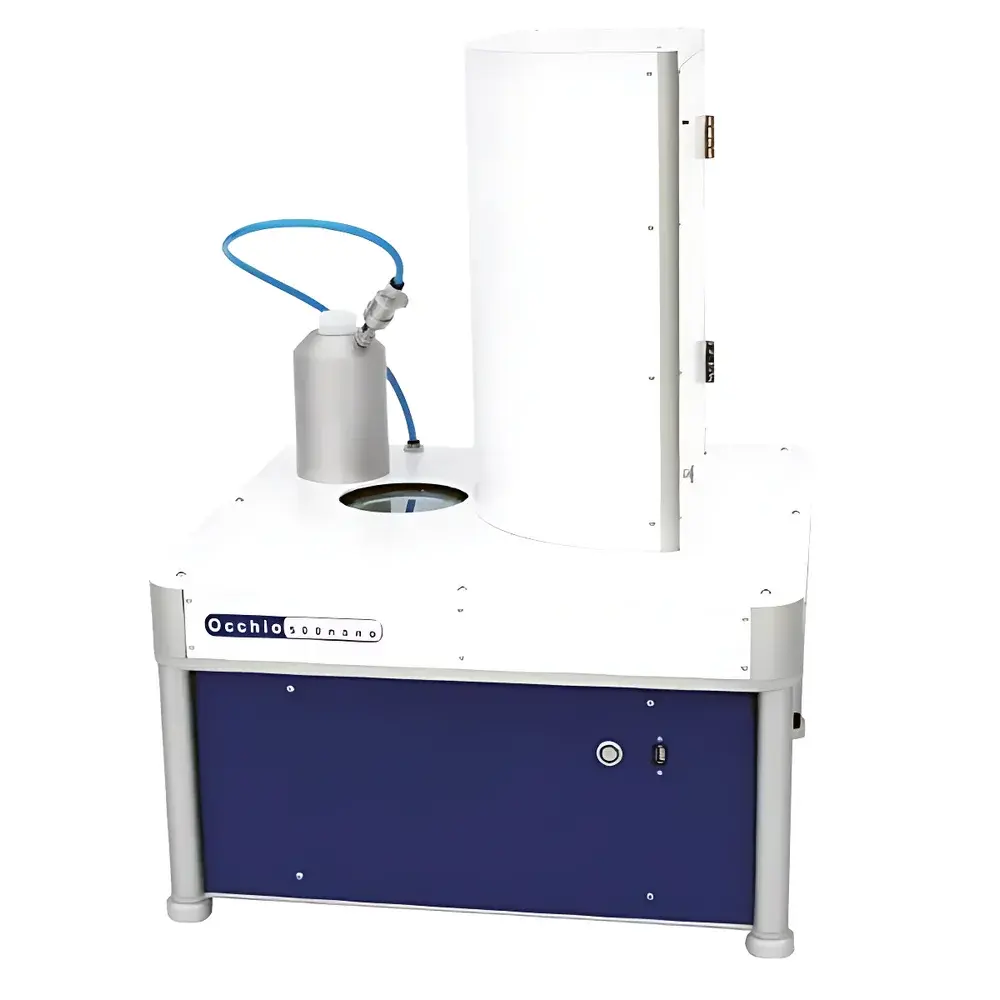
Occhio 500nano HR Static Image-Based Particle Size and Shape Analyzer
| Brand | Occhio |
|---|---|
| Origin | Belgium |
| Model | 500nano HR |
| Measurement Principle | Static image analysis with high-resolution CMOS imaging and collimated blue backlighting |
| Measurement Mode | Dry dispersion (integrated vacuum dispersion system) and reflective mode |
| Particle Size Range (dry) | 0.4–2000 µm |
| Pixel Resolution | 0.38–4.7 µm/pixel |
| Camera | 6.6 MP or 10 MP progressive-scan industrial CMOS |
| Optical System | Zoom telecentric lens |
| Light Source | 440 nm collimated blue LED |
| Field of View | 836 × 1140 µm @ 0.38 µm/pixel to 10266 × 1400 µm @ 4.7 µm/pixel |
| Software | Callisto 2D |
| Compliance Options | IQ/OQ/PQ validation support |
| Dimensions (W×D×H) | 540 × 540 × 720 mm (standard) |
| Weight | 38.5 kg / 43.5 kg |
Overview
The Occhio 500nano HR is a high-precision static image-based particle size and shape analyzer engineered for rigorous physical characterization of dry powders, suspensions, and reflective surfaces. It operates on the principle of digital image acquisition under controlled, collimated illumination—specifically 440 nm monochromatic blue light—to eliminate diffraction artifacts and ensure sharp, high-contrast silhouettes of individual particles. Unlike dynamic or laser-diffraction systems, the 500nano HR captures static, in-focus images of particles immobilized in a defined measurement zone, enabling direct geometric measurement of size (e.g., area-equivalent diameter, Feret diameters), shape (circularity, aspect ratio, convexity, solidity), and surface texture. Its dual-camera configuration—offering either 6.6 MP or optional 10 MP resolution—combined with zoom telecentric optics provides scalable pixel resolution from 0.38 µm/pixel (for sub-micron detail) to 4.7 µm/pixel (for rapid wide-field screening), ensuring adaptability across diverse sample types without optical recalibration.
Key Features
- Integrated vacuum dispersion system ensures consistent, contamination-free particle deagglomeration and monolayer presentation—critical for reproducible dry powder analysis.
- Collimated 440 nm blue LED backlight eliminates wavelength-dependent scattering and minimizes edge diffraction, yielding true silhouette geometry for accurate morphological quantification.
- Telecentric zoom lens architecture maintains constant magnification across focus depth, preserving dimensional fidelity and eliminating perspective distortion—essential for metrologically traceable measurements.
- “Optics-in-one” design: each particle is automatically brought into optimal focus via software-controlled z-axis adjustment, ensuring all objects within the field are imaged at their sharpest contrast.
- High-speed progressive-scan CMOS sensors suppress motion blur during image capture—even under vacuum-induced vibration—supporting robust throughput of 1–3 minutes per analysis.
- Fixed optical train (camera + light source + lens) reduces mechanical drift and alignment dependency, enhancing long-term stability and minimizing routine maintenance.
- Full SOP-driven operation within Callisto 2D software, including automated calibration, auto-focus, threshold optimization, and batch processing with audit-trail logging.
Sample Compatibility & Compliance
The 500nano HR supports three operational modes: dry dispersion (for free-flowing and cohesive powders), wet suspension analysis (via custom cuvette modules), and reflective mode (for membrane-filtered particles, porous substrates, or colored particulates). Validated applications include metal powders (e.g., Ti-6Al-4V, Inconel, stainless steel), catalysts (zeolites, alumina-supported Pt), pharmaceutical excipients and APIs, ceramic precursors (SiO₂, Al₂O₃), battery materials (graphite, Si anodes), food-grade particles (cocoa, coffee, starch), and hazardous powders handled under inert or enclosed conditions. The system is compatible with GLP/GMP workflows: Callisto 2D supports user access control, electronic signatures, and 21 CFR Part 11–compliant audit trails. Optional IQ/OQ/PQ documentation packages facilitate installation and operational qualification per ISO 13322-1 (static image analysis) and ASTM E2454 (powder morphology).
Software & Data Management
Callisto 2D is a dedicated, Windows-based analytical platform that transforms raw image data into statistically robust particle descriptors. It performs real-time segmentation using adaptive thresholding based on local intensity gradients, followed by morphometric classification (e.g., by circularity vs. aspect ratio clusters). Output includes full distribution histograms (number-, area-, and volume-weighted), scatter plots (e.g., roundness vs. elongation), and customizable report templates exportable to PDF, CSV, or XML. Data integrity is enforced through version-controlled method files, time-stamped result archives, and encrypted database storage. Integration with LIMS is supported via ODBC and REST API interfaces, enabling traceability from raw image to final QC release decision.
Applications
This instrument delivers quantitative insight where shape and surface heterogeneity directly impact performance: sintering behavior of metal AM feedstocks; flowability and compaction of pharmaceutical granules; catalytic site accessibility in porous supports; dispersion stability of pigment suspensions; filtration efficiency of membrane-retained contaminants; and crystallinity assessment in polymorphic drug substances. In R&D labs, it enables correlation of particle morphology with downstream process outcomes—such as binder jetting fidelity or tablet tensile strength. In production QA, its SOP-driven repeatability supports specification conformance testing against internal or regulatory limits (e.g., USP <429>, Ph. Eur. 2.9.31).
FAQ
What particle size range is reliably measurable in dry mode?
The system achieves validated detection from 0.4 µm to 2000 µm under dry dispersion, with optimal resolution and statistical confidence above ~1 µm depending on pixel scaling and particle contrast.
Can the 500nano HR analyze agglomerated or fibrous materials?
Yes—its vacuum dispersion module applies controlled shear and turbulence to break weak agglomerates; fiber length/diameter ratios are quantified using Feret and Martin diameter algorithms.
Is wet analysis performed in flow cell or static cuvette mode?
Wet measurements use static cuvettes with sedimentation control; optional flow-cell integration is available for higher-throughput suspension analysis.
How does the system handle colored or translucent particles?
In reflective mode, the instrument uses top illumination and surface-scatter detection to characterize color distribution, pore structure, and particle retention on filters—bypassing transparency limitations of transmission imaging.
Does Callisto 2D support multi-parameter gating for population sub-classification?
Yes—users define logical gates (e.g., “circularity < 0.6 AND aspect ratio > 5”) to isolate subpopulations and generate independent statistics, reports, and image galleries for each class.



