
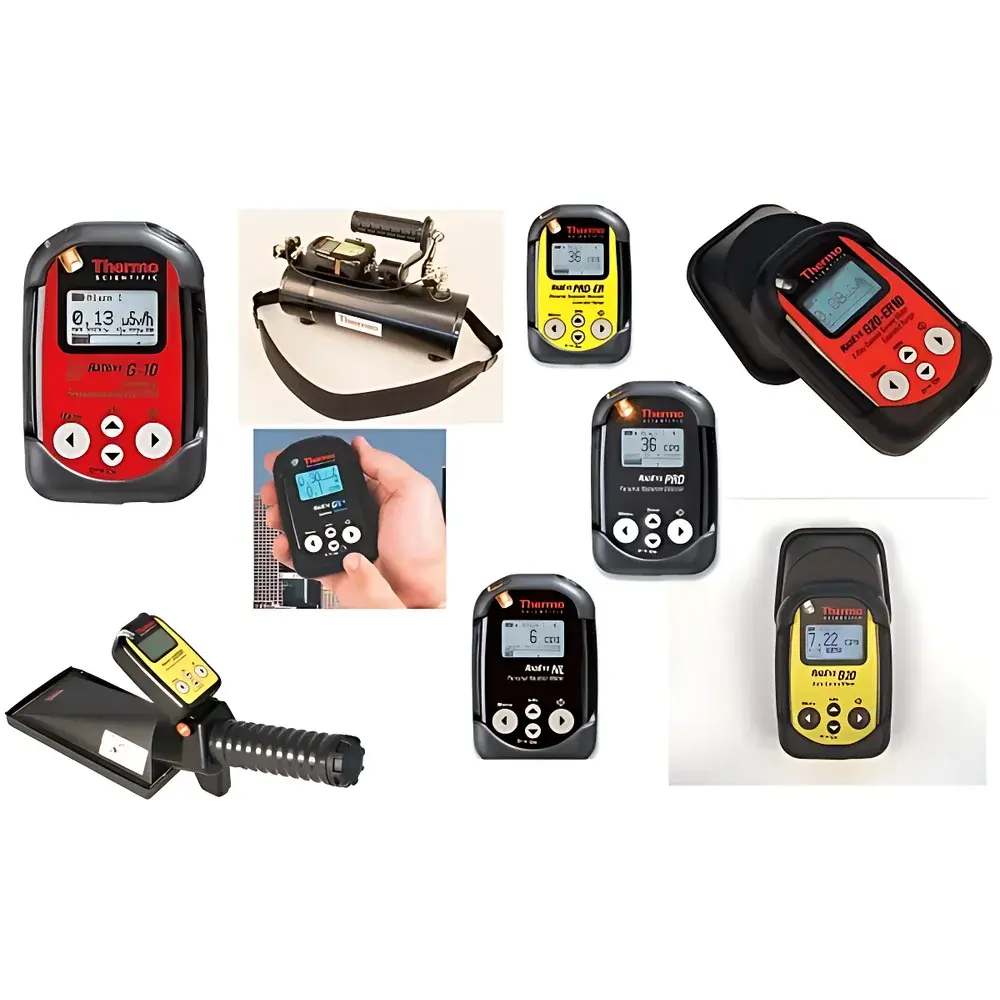
Thermo Fisher RadEye Series Portable Radiation Survey Meters
| Brand | Thermo Fisher |
|---|---|
| Origin | USA |
| Manufacturer | Thermo Fisher Scientific |
| Product Type | Portable Radiation Survey Meter / Dose Rate Meter |
| Detector Type | NaI(Tl), GM Tube, ZnS(Ag)-Plastic Scintillator, He-3 Proportional Counter |
| Radiation Types Detected | Alpha (α), Beta (β), Gamma (γ), X-ray, Neutron |
| Measurement Modes | Dose rate (μSv/h, mR/h), Count rate (cps), Surface contamination (Bq, Bq/cm², dpm), Spectral identification (RadEye GN+/NBR) |
| Dose Rate Range (RadEye PRD) | 0.01 μSv/h – 250 μSv/h |
| Sensitivity (Cs-137, RadEye PRD) | 150 cps per 1 μSv/h |
| Energy Response | 30 keV – 4 MeV (model-dependent) |
| Compliance | IEC 62533, IEC 62401, ANSI N42.32, ATEX II 2G Ex ia IIB T4 (G-10-Ex) |
| Operating Environment | Field-deployable, battery-powered, ruggedized for industrial, emergency response, and regulatory use |
Overview
The Thermo Fisher RadEye Series represents a family of field-deployable, high-reliability portable radiation survey instruments engineered for rapid, accurate detection and quantification of ionizing radiation across diverse operational environments. Built upon proven scintillation, gas-filled, and neutron-specific detection architectures, each RadEye model is purpose-designed to meet distinct measurement requirements — from low-level environmental gamma screening and nuclear material search (e.g., RadEye NBR with Natural Background Rejection) to high-range dose rate assessment in industrial or emergency scenarios (e.g., RadEye G-10-ER), surface alpha/beta contamination monitoring (RadEye AB100, B20), and dual-channel γ/neutron threat identification (RadEye GN+). The core measurement principle varies by configuration: NaI(Tl) detectors provide energy-resolved gamma spectroscopy and high sensitivity via photoelectric and Compton interactions; energy-compensated GM tubes deliver robust, wide-range dose rate estimation compliant with IEC 62387; ZnS(Ag)-plastic scintillators enable large-area, low-threshold alpha/beta counting; and He-3 proportional counters offer thermal neutron detection with intrinsic discrimination against gamma background. All units operate under strict adherence to international radiation protection standards, supporting ALARA-based decision-making in real time.
Key Features
- Multi-modal detection capability across α, β, γ, X-ray, and neutron radiation fields — configurable per mission requirement
- Advanced on-board self-test routines including detector bias verification, pulse-height calibration, and battery health diagnostics
- User-configurable alarm thresholds with simultaneous audible (adjustable tone), tactile (vibration), and audio-output (via 3.5 mm headset jack) notification modes
- Ergonomic, glove-compatible keypad design with tactile feedback and backlighting for low-light operations
- Ultra-low power architecture enabling >200 hours of continuous operation on standard AA alkaline batteries (model-dependent)
- Integrated data logging with timestamped event storage (up to 10,000 records) and USB/RS-232 connectivity for post-mission analysis
- ATEX-certified explosion-proof variant (RadEye G-10-Ex) rated II 2G Ex ia IIB T4 for use in Zone 1 hazardous areas
- Natural Background Rejection (NBR) algorithm available in RadEye NBR and GN+ models to enhance detection sensitivity for weak artificial radionuclides amid variable terrestrial background
Sample Compatibility & Compliance
The RadEye platform supports direct measurement of radiation fields from sealed sources, contaminated surfaces, airborne particulates (via swipe assays), and mixed-field environments encountered in nuclear medicine, decommissioning, border security, and first-response operations. Surface contamination measurements (RadEye AB100, B20) comply with ISO 7503-1 for alpha/beta activity quantification and report results in standardized units (Bq, Bq/cm², dpm). Dose rate measurements conform to IEC 60846-1 (for GM-based meters) and IEC 62387 (for scintillation-based systems), ensuring traceable accuracy across the specified energy ranges. Neutron detection performance meets ANSI N42.32 and IEC 62401 for handheld neutron survey instruments. All devices are manufactured under Thermo Fisher’s ISO 9001-certified quality management system and support GLP/GMP-aligned audit trails when used with optional PC software (RadEye Connect).
Software & Data Management
RadEye instruments interface seamlessly with RadEye Connect — a Windows-based desktop application designed for instrument configuration, firmware updates, and comprehensive data review. The software enables export of measurement logs in CSV and XML formats compatible with laboratory information management systems (LIMS) and regulatory reporting workflows. Audit trail functionality includes user login timestamps, parameter change history, and calibration event records — supporting compliance with FDA 21 CFR Part 11 where electronic records are subject to validation. For networked deployments, RadEye Area Monitor units integrate with centralized radiation monitoring platforms via RS-232 or optional Ethernet gateway modules, allowing remote alarm escalation and GIS-enabled mapping of radiation hotspots.
Applications
- Nuclear emergency response: Rapid identification and localization of orphan sources, dirty bombs, or lost radiography sources using spectral analysis (GN+) and NBR-enhanced sensitivity (NBR)
- Border and customs inspection: Screening cargo, vehicles, and personnel for illicit radioactive materials with multi-isotope discrimination capability
- Hospital and radiopharmacy QA: Verification of shielding integrity, wipe test validation, and dose rate mapping around PET/CT suites and LINAC vaults
- Decommissioning and waste characterization: Alpha/beta surface scanning (AB100), gamma dose rate profiling (G-10), and neutron verification (N/NL) in legacy nuclear facilities
- Industrial radiography safety: Real-time monitoring during pipeline weld inspections or turbine blade NDT to ensure worker exposure remains within regulatory limits
- Environmental baseline surveys: Long-term gamma dose rate trending in proximity to nuclear power plants or uranium mining sites
FAQ
What radiation types can the RadEye PRD detect?
The RadEye PRD is optimized for gamma and X-ray detection using a NaI(Tl) scintillator; it does not detect alpha, beta, or neutron radiation.
Is RadEye G-10 suitable for high-dose-rate environments?
Yes — the RadEye G-10 offers a measurement range up to 100 mSv/h and is commonly deployed for industrial radiography safety and post-incident triage where elevated gamma fields are expected.
Does RadEye AB100 require calibration for different radionuclides?
While factory-calibrated for Am-241, Co-60, and Sr/Y-90, users may apply correction factors in RadEye Connect for other isotopes based on published emission spectra and detector efficiency curves.
Can RadEye GN+ distinguish between gamma emitters?
Yes — the GN+ integrates basic gamma spectroscopy (1024-channel MCA) enabling gross isotope identification (e.g., Cs-137 vs. Co-60) and energy-compensated H*(10) dose rate calculation.
How is intrinsic neutron detection performance verified?
Each RadEye N/NL unit undergoes individual calibration using a calibrated Cf-252 neutron source per ANSI N42.32 Annex B, with certificate of calibration traceable to NIST standards.
Are firmware updates and technical documentation available internationally?
Yes — all RadEye firmware, user manuals, calibration certificates, and regulatory compliance statements are accessible via Thermo Fisher’s secure customer portal with region-specific language support and local service center coordination.







