
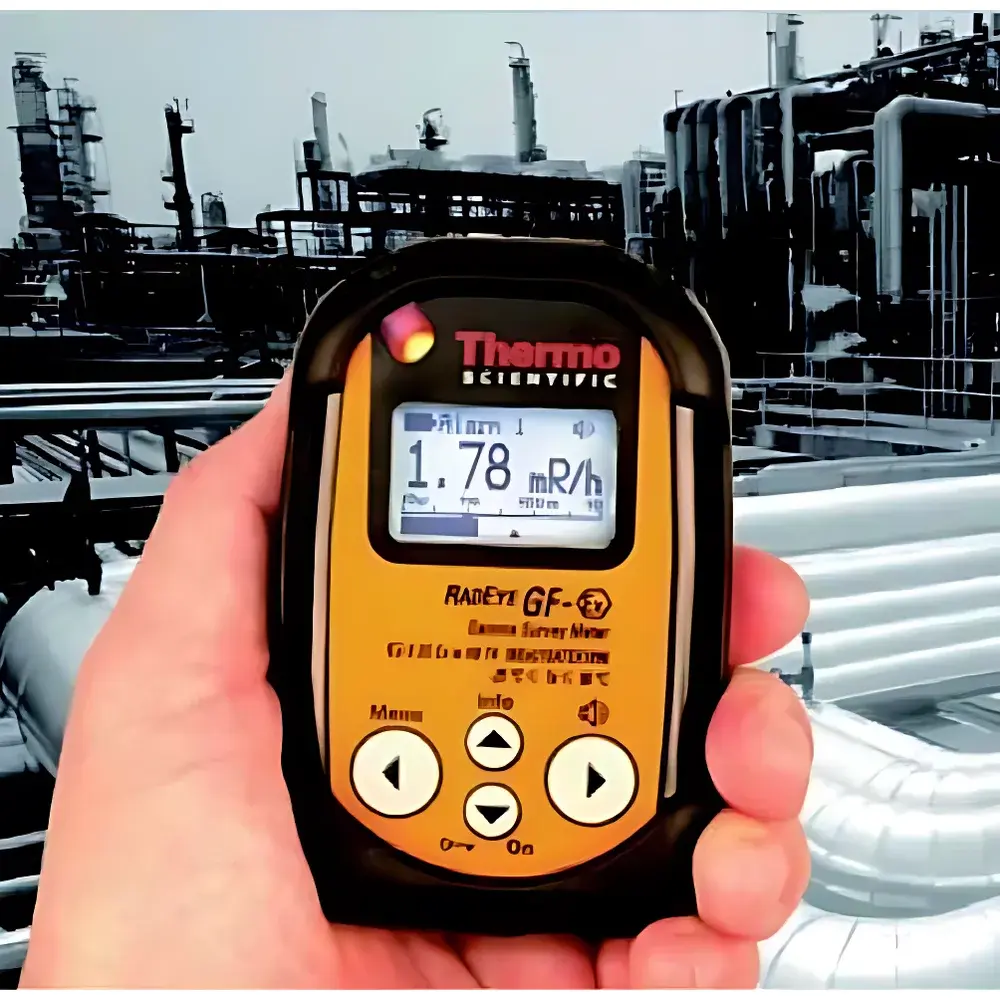
Thermo Fisher RadEye G-EX Intrinsically Safe Portable Radiation Survey Meter
| Brand | Thermo Fisher |
|---|---|
| Origin | USA |
| Manufacturer | Thermo Fisher Scientific |
| Product Type | Imported |
| Model | RadEye G-EX |
| Instrument Category | Dose Rate Meter |
| Form Factor | Portable |
| Radiation Types Detected | Alpha, Beta, Gamma, Neutron |
| Measurement Range | 0.5 μSv/h – 100 mSv/h |
| Sensitivity (Cs-137, 662 keV) | ~1.7 cps/μSv/h |
| Ingress Protection | IP65 |
| ATEX Certification | II 2G Ex ia IIB T4, IBExU 10ATEX 1096 |
| Weight | 160 g |
| Display | Backlit High-Contrast LCD |
| Alarm Modes | Dual Adjustable Thresholds (Dose & Dose Rate) |
Overview
The Thermo Fisher RadEye G-EX is an intrinsically safe, lightweight portable radiation survey meter engineered for reliable gamma dose rate measurement in hazardous environments where explosive atmospheres may be present. Designed around a robust scintillation-based detection architecture—optimized for high sensitivity and low-power operation—the instrument employs a CsI(Tl) or NaI(Tl) scintillator coupled with low-noise photodiode readout to deliver stable, real-time gamma dose rate quantification across five decades of range. Its intrinsic safety certification (ATEX II 2G Ex ia IIB T4) ensures compliance with stringent European Union directives governing equipment used in Zone 1 and Zone 2 explosive gas atmospheres. The device operates without compromising measurement fidelity: zero-error digital readout, temperature-compensated response, and automatic background subtraction eliminate drift-related inaccuracies during extended field deployment. With a mass of only 160 g and battery life exceeding 2,000 hours on standard AA cells, the RadEye G-EX supports prolonged use by first responders, HAZMAT teams, and industrial health physicists conducting routine surveys in oil refineries, offshore platforms, steel mills, and nuclear support facilities.
Key Features
- Intrinsically safe design certified to ATEX Directive 2014/34/EU and IECEx standards (Certificate No. IBExU 10ATEX 1096), enabling safe operation in classified hazardous areas.
- High-contrast backlit LCD display with intuitive icon-driven interface and real-time graphical trend indication for rapid situational assessment.
- Dual independent alarm thresholds configurable for both accumulated dose (µSv–Sv) and dose rate (µSv/h–mSv/h), supporting customizable alert logic aligned with ICRP and national regulatory limits.
- IP65-rated enclosure providing full protection against dust ingress and low-pressure water jets—suitable for outdoor, marine, and industrial environments.
- Low-power electronics architecture enabling >2,000 hours of continuous operation on four standard AA alkaline batteries; no charging infrastructure required.
- Automatic energy compensation across 50 keV–3 MeV photon energy range ensures accurate dose rate reporting for common isotopes including 137Cs (662 keV), 60Co (1.17/1.33 MeV), and 192Ir (300–610 keV).
Sample Compatibility & Compliance
The RadEye G-EX is optimized for gamma-emitting radionuclides but maintains detectability for high-energy beta particles and moderated neutrons when used with optional external probes (e.g., neutron rem counters). It complies with ISO 4037-3:2019 for reference radiation fields and meets performance criteria outlined in ANSI N42.33-2022 for portable radiation detection instruments. Its calibration traceability follows NIST-traceable protocols per ISO/IEC 17025-accredited laboratory practices. The instrument satisfies functional safety requirements for emergency response under NFPA 472 and supports audit-ready documentation for GLP/GMP-regulated operations. ATEX certification covers operation in gas groups IIB (propane-class) and temperature class T4 (surface temp ≤135°C), making it suitable for petrochemical, LNG, and chemical processing applications.
Software & Data Management
Data logging is supported via internal memory (up to 10,000 timestamped readings) with export capability through USB-C interface using Thermo Fisher’s RadEye PC Utility software. The utility enables spectral review, dose accumulation analysis, and report generation compliant with ALARA recordkeeping standards. All logged events—including alarms, threshold crossings, and battery status changes—are time-stamped with UTC synchronization. Audit trail functionality records user-initiated configuration changes, satisfying FDA 21 CFR Part 11 requirements for electronic records in regulated environments. Firmware updates are delivered via signed binary packages to ensure integrity and version control.
Applications
- First responder radiation screening at hazmat incidents involving orphan sources or RDD scenarios.
- Routine area monitoring in oil & gas facilities where hydrocarbon vapors coexist with naturally occurring radioactive material (NORM/TENORM).
- Decommissioning support in legacy industrial sites with mixed alpha/beta/gamma contamination profiles.
- Border security and customs inspection for illicit radioactive materials transport.
- Emergency preparedness drills requiring validated, explosion-proof instrumentation under simulated Class I, Division 1 conditions.
FAQ
What radiation types does the RadEye G-EX detect natively?
The base unit detects gamma photons and high-energy beta particles. Alpha detection requires optional ZnS(Ag) probe attachment; neutron detection requires external moderated 3He or BF3 proportional counters.
Is the device suitable for underwater or submerged use?
No—while IP65 rated, it is not submersible. Immersion beyond brief splashing may compromise sealing integrity and intrinsic safety certification.
Can the alarm thresholds be locked to prevent unauthorized modification?
Yes—password-protected configuration mode restricts access to dose/dose rate thresholds, units, and audio/visual alert parameters per site-specific security policies.
Does the RadEye G-EX meet IEC 62327:2017 requirements?
It conforms to the essential safety and performance criteria for handheld X- and gamma-ray monitors specified in IEC 62327:2017, including linearity, angular dependence, and electromagnetic compatibility (EMC) testing per IEC 61000-4 series.
How frequently must the instrument be calibrated?
Annual calibration is recommended per ISO/IEC 17025 guidelines; however, operational verification using check sources (e.g., 137Cs disk) should be performed before each shift in critical applications.
Related Products







