
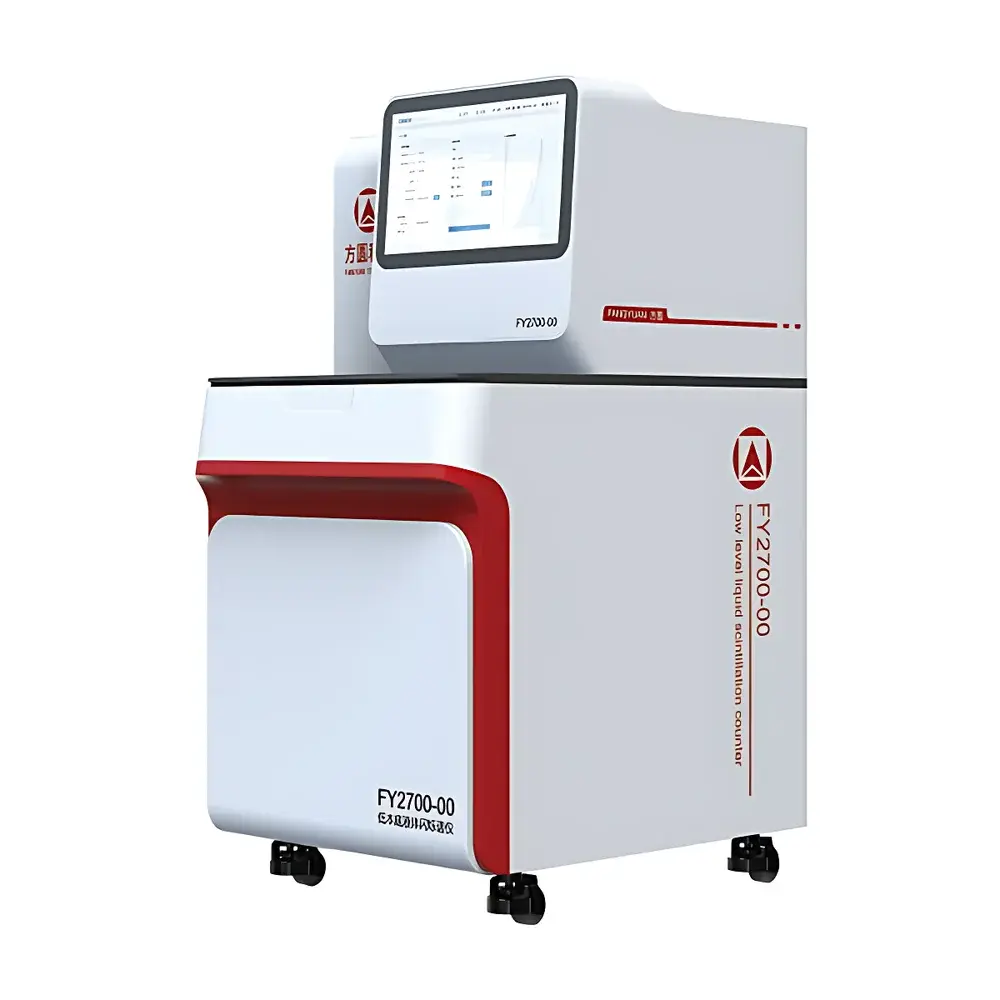
Fangyuan Scientific Instruments FY2700-00 Ultra-Low-Background Liquid Scintillation Spectrometer
| Brand | Fangyuan Scientific Instruments |
|---|---|
| Origin | Hubei, China |
| Manufacturer Type | Authorized Distributor |
| Country of Origin | China |
| Model | FY2700-00 |
| Detection Limits | α: 3–10 MeV |
| β | 0–5 MeV |
| Stability | Count rate drift < 0.2% over 24 h |
| Resolution | 0.01 (channel width in keV per channel, typical for digital pulse-height analysis) |
Overview
The Fangyuan Scientific Instruments FY2700-00 Ultra-Low-Background Liquid Scintillation Spectrometer is a high-sensitivity dual-channel liquid scintillation counter engineered for quantitative measurement of low-energy alpha and beta emitters in environmental, nuclear, and life science samples. It operates on the principle of liquid scintillation counting (LSC), where radioactive decay events in a dissolved sample induce photon emission in an organic scintillation cocktail; these photons are detected by two ultra-low-noise photomultiplier tubes (PMTs) operating in coincidence mode to suppress background noise and improve signal-to-noise ratio. The instrument features a purpose-built shielded chamber constructed from oxygen-free high-conductivity (OFHC) copper and lead with active anti-coincidence veto capability, enabling an effective background count rate below 0.5 cpm in the low-energy beta window (0–50 keV). Designed for compliance with ISO 8529-1:2021 (reference neutron and gamma radiation fields) and ASTM D7283-22 (standard test method for determination of gross alpha and beta activity in water by LSC), the FY2700-00 supports regulatory monitoring programs requiring trace-level radionuclide quantification in drinking water, soil leachates, biological tissues, and nuclear effluents.
Key Features
- Ultra-low-background detection architecture: Multi-layer passive shielding (60 mm Pb + 3 mm OFHC Cu) combined with cosmic-ray veto via external plastic scintillator panel and real-time coincidence rejection logic.
- Dual-PMT coincidence counting system with digital pulse-shape discrimination (PSD) to separate α/β events and reject chemiluminescence and phosphorescence artifacts.
- Automated sample changer accommodating up to 20 × 20 mL low-diffusion vials with programmable queue management and temperature-stabilized sample chamber (±0.1 °C).
- Integrated quench correction algorithms including tSIE (transformed Spectral Index of the External standard), SQP(E) (Sample Quench Parameter), and internal standard normalization.
- Real-time spectral acquisition with 1024-channel pulse-height analysis and adjustable energy windows for simultaneous α/β/³H/¹⁴C quantification.
- Compliance-ready firmware supporting audit trails, user access levels (admin/operator/analyst), and electronic signature functionality aligned with FDA 21 CFR Part 11 requirements.
Sample Compatibility & Compliance
The FY2700-00 accepts standard glass or low-potassium plastic vials (e.g., 20 mL PerkinElmer Ultima Gold™ AB, Beckman Ready Gel™) and supports aqueous, organic, and heterogeneous samples—including acid digests, filtered particulates, and tissue homogenates—via optimized cocktail selection (e.g., Ultima Gold LLT for high-efficiency tritium counting). All hardware and software modules are validated per IEC 61000-4-3 (EMC immunity) and meet CE marking requirements for electromagnetic compatibility and safety (EN 61326-1:2013). The system is routinely deployed in laboratories accredited to ISO/IEC 17025:2017 for environmental radioactivity testing and supports reporting formats compliant with EPA Method 900.0, ISO 11704:2019 (determination of tritium in water), and IAEA Technical Reports Series No. 488 (guidance on LSC performance verification).
Software & Data Management
The FY2700-00 is controlled by LSC-Suite v3.2, a Windows-based application offering method-driven workflow automation, live spectral visualization, and GLP-compliant data archiving. Raw spectra and metadata—including vial ID, cocktail type, quench index, count time, and operator log—are stored in encrypted SQLite databases with automatic daily backup and SHA-256 hash integrity verification. Audit trail records capture all parameter modifications, calibration events, and result exports with timestamp, user ID, and IP address. Export options include CSV, PDF analytical reports (with uncertainty propagation per GUM), and direct integration with LIMS via HL7 or ODBC protocols. Remote diagnostics and firmware updates are supported over TLS-secured HTTPS connections.
Applications
- Regulatory compliance testing of drinking water, groundwater, and wastewater for gross alpha/beta activity (EPA 900.0, ISO 10703).
- Environmental surveillance of ³H, ¹⁴C, ⁹⁰Sr, and ²¹⁰Po in air filters, sediment cores, and biota samples.
- Radiopharmaceutical quality control (USP <821>) for residual solvent and radiolytic impurity assays.
- Low-level dating studies using ¹⁴C in archaeological and geological matrices.
- Decommissioning and waste characterization in nuclear facilities (IAEA SSG-39).
- Research in radiobiology, tracer kinetics, and metabolic labeling experiments requiring sub-Bq sensitivity.
FAQ
What is the minimum detectable activity (MDA) for ³H in 10 mL of water using standard Ultima Gold AB cocktail?
Typical MDA is 0.04 Bq/L at 95% confidence (100-min count, 2σ), assuming 40% counting efficiency and background of 0.35 cpm in the tritium window.
Does the FY2700-00 support alpha/beta separation for mixed nuclide samples?
Yes — via digital pulse-shape discrimination calibrated against ²⁴¹Am (alpha) and ⁹⁰Sr/⁹⁰Y (beta) standards, with separation efficiency >99.2% and cross-talk <0.8%.
Is the system compatible with third-party scintillation cocktails?
Yes — all commercially available LSC cocktails are supported; optimal performance is verified with manufacturer-provided quench curves and efficiency tables.
Can raw spectral data be exported for independent reanalysis?
Yes — full-resolution 1024-channel spectra (.spe format) and event-list files (.elc) are exportable without proprietary lock-in.
What maintenance intervals are recommended for PMT gain stability?
Automatic daily gain stabilization via internal ¹³³Ba reference source; full PMT calibration recommended every 6 months or after 1,000 operating hours.







