
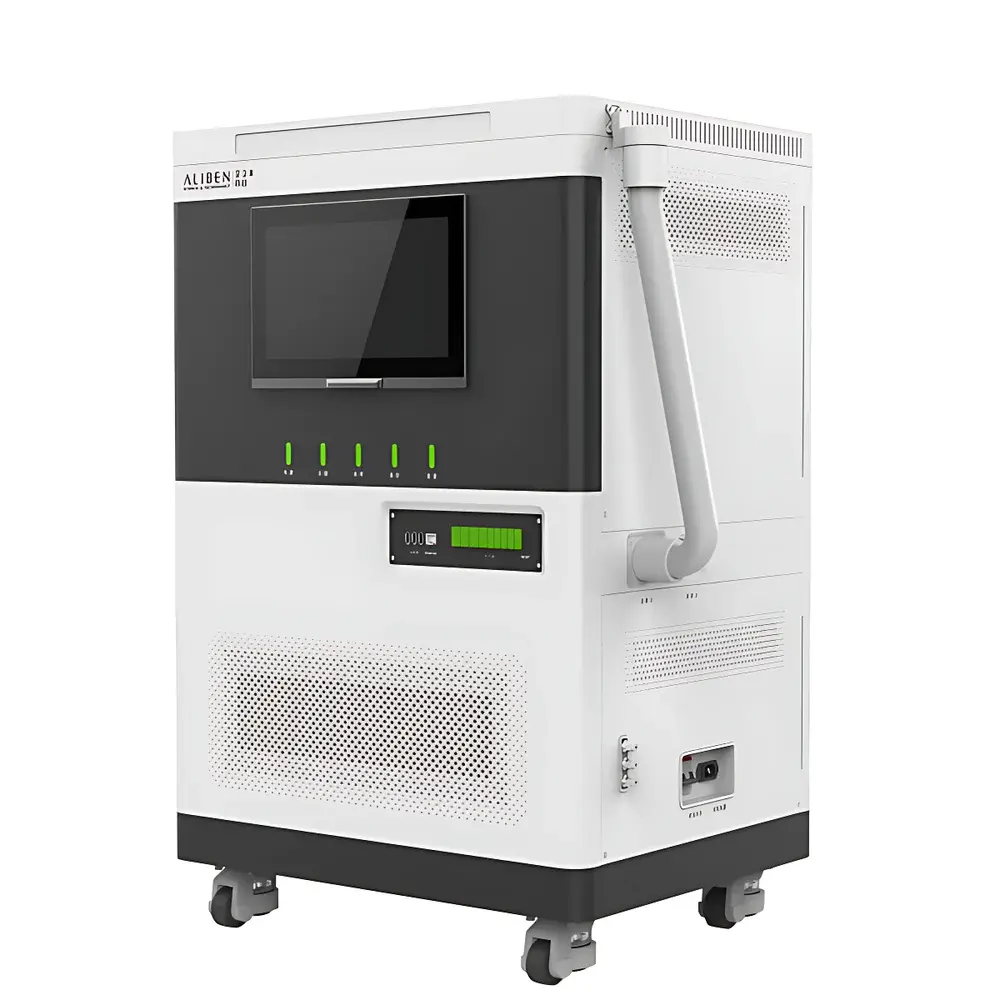
Aliben PTR-TOF MS 8000 Proton Transfer Reaction Time-of-Flight Mass Spectrometer
| Brand | Aliben |
|---|---|
| Origin | Sichuan, China |
| Manufacturer Type | Original Equipment Manufacturer (OEM) |
| Product Category | Domestic Instrument |
| Model | PTR-TOF MS 8000 |
| Detection Principle | Proton Transfer Reaction (H₃O⁺-based soft ionization) |
| Instrument Type | Online Real-Time Analyzer |
| Configuration | Integrated VOCs Monitoring System |
| Mass Resolution (m/Δm) | ≥ 8,000 (FWHM at m/z 100) |
| Mass Range | m/z 10–500 |
| Detection Limit | < 10 pptv (for common VOCs, 1-s integration) |
| Data Acquisition Rate | Up to 10 Hz full-spectrum acquisition |
| Vacuum System | Multi-stage differential pumping with turbomolecular pumps |
| Ion Source | RF-driven hollow cathode H₃O⁺ generator |
| Mass Analyzer | Orthogonal acceleration reflectron TOF |
| Software Platform | ALIBEN Acquire v3.2 with real-time spectral deconvolution and compound identification engine |
Overview
The Aliben PTR-TOF MS 8000 is a high-performance, online proton transfer reaction time-of-flight mass spectrometer engineered for real-time, quantitative trace analysis of volatile organic compounds (VOCs) in complex gaseous matrices. It operates on the well-established principle of chemical ionization via proton transfer from hydronium reagent ions (H₃O⁺) to analyte molecules with proton affinity higher than water (≈691 kJ/mol), yielding predominantly intact [M+H]⁺ ions with minimal fragmentation. This soft ionization mechanism preserves molecular identity while enabling direct, calibration-free quantification under controlled drift-tube conditions—leveraging the known reaction kinetics (rate constants k) and instrument transmission efficiency. Designed for unattended field deployment and laboratory-grade precision, the system integrates a robust RF-driven hollow-cathode H₃O⁺ ion source, an optimized multi-stage vacuum architecture (base pressure 8,000 (FWHM at m/z 100) across a mass range of m/z 10–500. Its fully integrated design supports continuous operation in mobile platforms—including vehicle-mounted atmospheric monitoring systems—without requiring cryogenic cooling or consumable reagents.
Key Features
- Real-time full-spectrum acquisition at up to 10 Hz, enabling sub-second temporal resolution for dynamic process monitoring and plume tracking.
- Calibration-free quantitative analysis supported by fundamental reaction kinetics and internal standard normalization (e.g., H₂O⁺/H₃O⁺ ratio monitoring).
- No sample preconcentration or chromatographic separation required—direct gas-phase introduction ensures zero memory effects and minimal latency.
- Sub-pptv detection limits (e.g., 5–10 pptv for isoprene, benzene, and acetaldehyde at 1-second integration) validated against certified reference standards per ISO 16000-6 and EPA TO-15 protocols.
- Modular RF quadrupole-based ion optics for efficient transmission and reduced space-charge distortion, coupled with active temperature stabilization (±0.1 °C) for long-term signal stability.
- Integrated environmental control unit maintaining constant inlet pressure (2.0 ± 0.02 mbar), humidity (<5% RH), and temperature (25 ± 0.5 °C) to ensure reproducible ion chemistry.
Sample Compatibility & Compliance
The PTR-TOF MS 8000 accepts ambient air, stack emissions, breath samples (via disposable mouthpieces), headspace vapors, and industrial process streams without modification. It complies with key regulatory frameworks governing environmental and occupational monitoring, including ISO 16000-28 (indoor air VOCs), ASTM D6196 (ambient air sampling), and EU Directive 2008/50/EC (ambient air quality assessment). For GLP/GMP-aligned applications—such as pharmaceutical cleanroom monitoring or food packaging emission testing—the system supports 21 CFR Part 11-compliant audit trails, electronic signatures, and data integrity controls through optional ALIBEN SecureMode licensing. All firmware and software updates undergo IEC 62304 Class B medical device software validation procedures where deployed in clinical breath research settings.
Software & Data Management
ALIBEN Acquire v3.2 provides a unified interface for instrument control, real-time spectral visualization, automated peak detection, and library-assisted compound identification using NIST MS Search 2.4 and the PTR-MS Compound Database (v2024.1, containing >1,200 experimentally verified VOCs). Raw .tdf files are stored in HDF5 format with embedded metadata (pressure, temperature, dwell time, reagent ion intensity). Batch processing supports retention-time-aligned spectral deconvolution, isotopic pattern fitting, and time-series concentration mapping. Export modules generate CSV, NetCDF, and mzML-compatible outputs for integration with third-party platforms such as MATLAB, Python (via pyOpenMS), and commercial LIMS systems. Remote diagnostics and firmware updates are performed over TLS-encrypted SSH connections.
Applications
- Environmental Atmospheric Science: Mobile mapping of industrial VOC plumes via drive-by surveys; urban emission inventory refinement; biogenic VOC flux quantification using eddy covariance coupling.
- Indoor Air Quality Monitoring: Real-time tracking of formaldehyde, terpenes, and plasticizers from building materials and consumer products per ISO 16000-22 protocols.
- Food & Flavor Research: In vivo nasal and oral cavity VOC profiling during food consumption; headspace fingerprinting of fermentation processes; shelf-life stability assessment.
- Medical Breath Analysis: Non-invasive detection of disease biomarkers (e.g., acetone for diabetes, aldehydes for oxidative stress, limonene for liver function) with sub-second temporal resolution.
- Industrial Process Control: Closed-loop monitoring of solvent recovery units, catalyst deactivation indicators in petrochemical reactors, and fugitive emission verification in Fenceline Monitoring programs (EPA Method 325B).
FAQ
What is the typical response time from sample inlet to spectral output?
The system achieves end-to-end latency of ≤ 800 ms, including ionization, flight time, detection, and centroiding—enabling true real-time feedback for fast transient events.
Can the instrument operate unattended for extended periods?
Yes—field-deployed units routinely achieve >30 days of continuous operation with remote health monitoring, automated vacuum pump cycling, and self-diagnostic routines.
Is external calibration required for quantitative analysis?
No. Absolute quantification is derived from first-principles reaction kinetics and instrument-specific sensitivity factors determined during factory characterization; periodic verification with certified gas standards is recommended every 90 days.
Does the system support multi-reagent ion chemistry (e.g., NO⁺, O₂⁺)?
The PTR-TOF MS 8000 platform is configurable with optional reagent ion switching modules (available as ALIBEN RIS-2 upgrade kit), enabling selective ionization for isomeric differentiation and low-proton-affinity compounds.
What maintenance intervals are specified for routine operation?
Ion source cleaning is recommended every 6 months under typical ambient air use; turbomolecular pump oil replacement every 24 months; no consumables (e.g., filaments, septa, or GC columns) are required.
Related Products







