
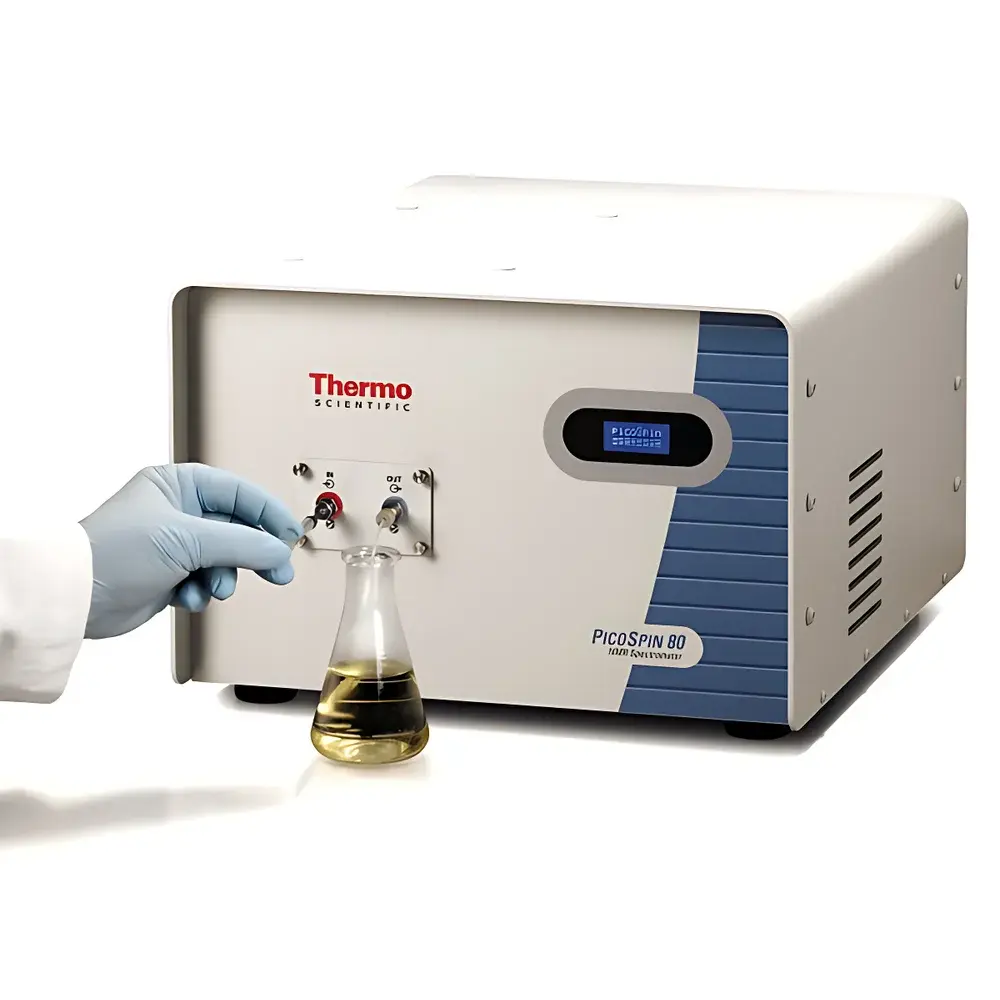
Thermo Fisher picoSpin 80 Benchtop Nuclear Magnetic Resonance Spectrometer
| Brand | Thermo Fisher |
|---|---|
| Origin | USA |
| Manufacturer Type | Original Equipment Manufacturer (OEM) |
| Product Origin | Imported |
| Model | picoSpin 80 |
| Instrument Type | Low-Field NMR Analyzer |
| Sample Form | Liquid |
| Sensitivity | 18 ppb (at 1.44 Hz linewidth) |
| Resolution | 5000 (for H₂O, single-scan) |
Overview
The Thermo Fisher picoSpin 80 is a compact, permanent-magnet benchtop nuclear magnetic resonance (NMR) spectrometer engineered for routine structural analysis and compound verification in teaching, research, and quality control environments. Operating at a proton Larmor frequency of 82 MHz (corresponding to a static magnetic field strength of ~1.85 T), the instrument leverages high-field stability inherent to its sintered NdFeB permanent magnet architecture—eliminating the need for cryogenic cooling, shimming coils, or external infrastructure. Unlike conventional superconducting NMR systems, the picoSpin 80 delivers reproducible 1H spectra with sub-Hertz linewidth performance under ambient conditions, enabling direct observation of chemical shift dispersion, J-coupling patterns, and integration ratios critical for qualitative and semi-quantitative analysis.
Key Features
- Benchtop footprint & plug-and-play operation: Weighing only 19 kg and requiring standard 110–240 V AC power, the system integrates seamlessly into undergraduate labs, QC rooms, or fume hoods without facility modifications.
- Capillary-based microsample handling: Uses disposable 40 µL glass capillaries—minimizing sample consumption while ensuring consistent magnetic susceptibility matching and reduced field distortion.
- Passive temperature stabilization: The magnet assembly incorporates thermal mass and low-coefficient materials to maintain field homogeneity within ±0.01 ppm/°C over typical lab temperature ranges (15–30 °C), eliminating active temperature control hardware.
- Single-scan capability with high dynamic range: Achieves a resolution of 5000 (measured as FWHM of the water peak in D2O) and a sensitivity of 18 ppb for ethylbenzene under standardized acquisition parameters (90° pulse, 1 s relaxation delay, 16 K data points).
- No consumables or cryogens: Permanent magnet design requires zero liquid nitrogen or helium, reducing total cost of ownership and operational complexity.
Sample Compatibility & Compliance
The picoSpin 80 accepts standard 5 mm outer-diameter NMR capillaries filled with 35–45 µL of homogeneous liquid samples—including deuterated solvents (CDCl3, DMSO-d6), aqueous solutions, reaction mixtures, polymer melts (below Tg), and biofluid extracts. It complies with IEC 61000-6-3 (EMC emission standards) and meets CE marking requirements for laboratory equipment. While not certified for GMP/GLP-regulated release testing, its data output supports ALCOA+ principles when used with validated acquisition protocols and audit-trail-enabled software configurations. All spectral metadata—including pulse sequence, receiver gain, number of scans, and temperature logs—are embedded in raw FID files for traceability.
Software & Data Management
Controlled via the proprietary picoSpin Software Suite (v4.x), the system provides intuitive acquisition, real-time Fourier transformation, phase/baseline correction, peak picking, and integration tools. Export formats include JCAMP-DX (.jdx), ASCII (.txt), and Bruker-compatible .fid directories. The software supports batch processing for reaction monitoring workflows and allows user-defined report templates compliant with institutional SOPs. Audit trail functionality records operator ID, timestamp, parameter changes, and file export events—facilitating alignment with FDA 21 CFR Part 11 expectations where electronic records are subject to review.
Applications
- Undergraduate chemistry education: Teaching fundamental NMR concepts—chemical shift, spin-spin coupling, integration, and symmetry—using authentic small-molecule spectra without access to high-field infrastructure.
- Reaction monitoring: Tracking kinetic profiles of esterifications, Grignard additions, or Suzuki couplings via time-resolved 1H acquisitions (e.g., every 30–120 s over 2–24 h).
- QA/QC in petrochemicals & polymers: Verifying monomer identity, detecting residual solvents, quantifying crosslink density (via T2 relaxometry add-ons), and confirming batch-to-batch consistency of synthetic intermediates.
- Pharmaceutical development: Rapid screening of reaction completeness, identification of diastereomeric ratios in chiral syntheses, and purity assessment of APIs prior to HPLC purification.
- Materials science: Characterizing solvent content in battery electrolytes, assessing hydration states in hydrogels, and probing molecular mobility in thermoplastic elastomers.
FAQ
Can the picoSpin 80 perform 13C NMR?
No—the system is optimized exclusively for 1H detection at 82 MHz. Its RF electronics, probe tuning, and pulse calibration are fixed for proton resonance; no hardware or firmware upgrade path exists for heteronuclear operation.
What is the minimum sample volume required for quantitative analysis?
For reliable integration-based quantitation (±5% RSD), a minimum of 40 µL of homogeneous solution containing ≥0.1 mM analyte in deuterated solvent is recommended. Lower concentrations require signal averaging across multiple scans.
Is field locking supported?
No—field-frequency lock is omitted due to the passive magnet design. Stability is maintained mechanically and thermally; typical drift is <0.1 Hz/hour under stable lab conditions.
Does the instrument support variable temperature experiments?
No—temperature control is not integrated. The magnet’s thermal inertia ensures stable operation between 15–30 °C; deliberate temperature variation requires external environmental chambers and is not supported by the software.
How is calibration performed?
The system uses tetramethylsilane (TMS) or residual CHCl3 in CDCl3 as internal chemical shift references. No hardware calibration is required; frequency scale accuracy is traceable to NIST-standardized reference compounds.




