
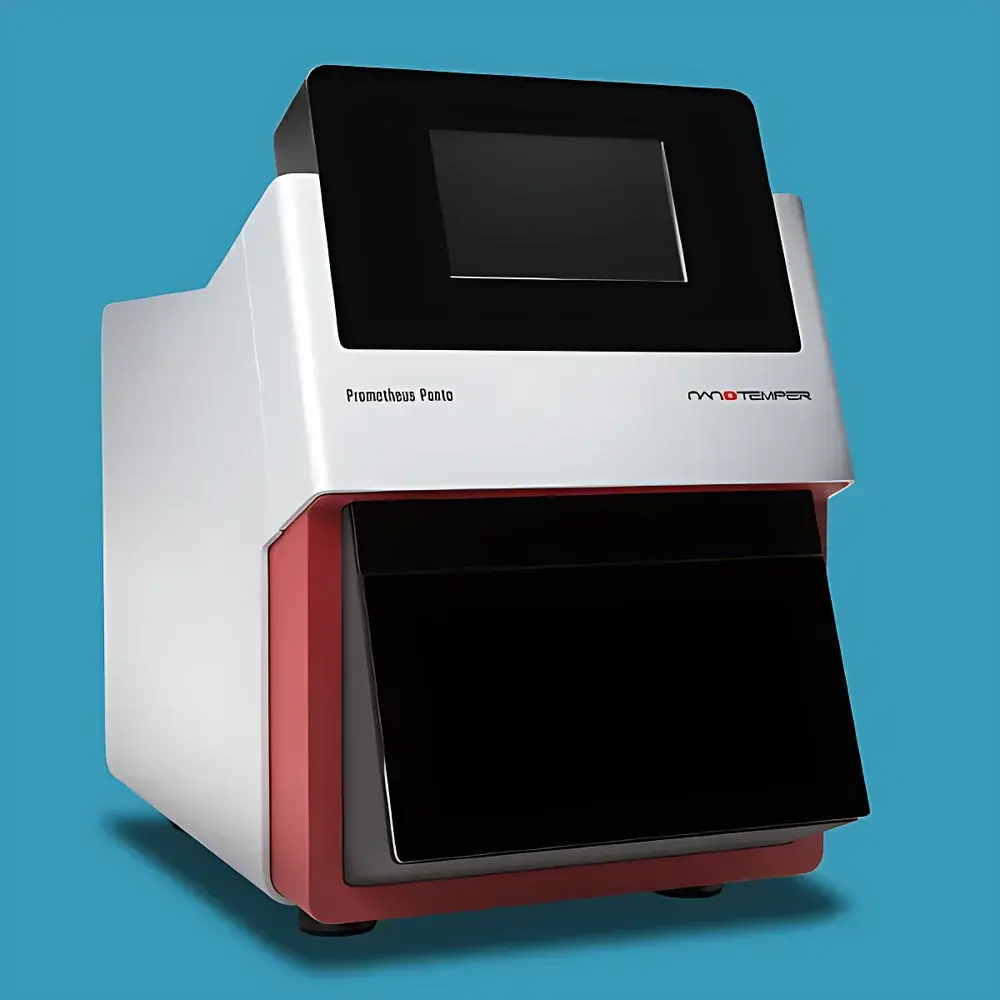
NanoTemper Prometheus Panta Protein Stability Analyzer for Chemical Denaturation Assays
| Brand | NanoTemper |
|---|---|
| Origin | Germany |
| Manufacturer | NanoTemper Technologies GmbH |
| Product Type | Imported Instrument |
| Model | Prometheus oDSF |
| Principle | Differential Scanning Fluorimetry (oDSF) |
| Sample Volume | 10 µL |
| Temperature Control Range | 15–110 °C |
| Sample Loading | Single capillary or capillary array |
| Dimensions | 35 cm (W) × 51 cm (H) × 52 cm (D) |
Overview
The NanoTemper Prometheus Panta Protein Stability Analyzer is an integrated, label-free biophysical platform engineered for high-resolution, multi-parameter stability characterization of therapeutic proteins and other biomolecules. It leverages orthogonal optical detection modalities—orthogonal Differential Scanning Fluorimetry (oDSF), Dynamic Light Scattering (DLS), Static Light Scattering (SLS), and Backreflection—to simultaneously monitor conformational transitions, hydrodynamic size distribution, molecular weight shifts, and aggregation onset across a controlled thermal or chemical gradient. Unlike conventional DSF systems that rely on single-wavelength fluorescence intensity changes, the oDSF module employs dual-wavelength ratiometric detection (typically 330 nm and 350 nm excitation with emission collected at 330 nm and 350 nm) to resolve intrinsic tryptophan and tyrosine fluorescence signatures, enabling robust discrimination between native, intermediate, and unfolded states—even in complex formulations containing detergents or high-viscosity excipients. The instrument operates without fluidic pumps or microfluidic channels, eliminating carryover, reducing maintenance, and ensuring long-term operational stability.
Key Features
- Multi-modal, real-time stability profiling: Simultaneous acquisition of thermal/chemical denaturation curves (oDSF), size distribution (DLS), molar mass (SLS), and turbidity/aggregation kinetics (Backreflection) within a single experiment.
- Label-free, low-volume analysis: Requires only 10 µL per sample loaded via passive capillary action into proprietary glass capillaries—no labeling, no dilution, no dye interference.
- Chemical denaturation compatibility: Fully supports guanidine HCl, urea, and other chaotropic agents; validated for concentration-dependent ΔGfolding determination under equilibrium conditions.
- Detergent- and viscosity-tolerant: Robust performance in membrane protein solubilization buffers (e.g., DDM, CHAPS, LMNG) and high-concentration mAb formulations (up to 200 mg/mL).
- Modular scalability: oDSF module is standard; DLS, SLS, and Backreflection modules can be added or upgraded post-purchase via software license and hardware integration.
- No moving parts in fluid path: Capillary-based loading eliminates valves, tubing, and syringes—ensuring zero cross-contamination and minimal routine maintenance.
Sample Compatibility & Compliance
The Prometheus Panta accommodates a broad range of sample types critical to biopharmaceutical development: monoclonal antibodies (IgG, bispecifics), Fc-fusion proteins, enzymes, viral capsid proteins, and detergent-solubilized membrane proteins. Its oDSF assay is compatible with common formulation excipients including sucrose, trehalose, histidine, acetate, polysorbates, and amino acids. The system meets core regulatory expectations for analytical method suitability in QC and development labs: data integrity is ensured through audit-trail-enabled software compliant with FDA 21 CFR Part 11 requirements; raw data files are stored in vendor-neutral, timestamped HDF5 format; and all instrument parameters—including temperature ramp rate, dwell time, laser power, and detector gain—are fully traceable and exportable. While not certified as GMP equipment per se, the platform is routinely deployed in GLP-compliant environments and supports ICH Q5C, Q5E, and USP <1117> guidance for stability-indicating methods.
Software & Data Management
PantaControl software provides a unified interface for method setup, real-time monitoring, and advanced data interpretation. It includes built-in algorithms for automated Tm, Tonset, ΔH, and ΔGfolding calculation from chemical denaturation titrations using linear extrapolation or Gibbs-Helmholtz modeling. Batch processing supports comparative analysis across multiple formulations or variants. All datasets are stored with full metadata (user ID, timestamp, instrument serial number, calibration history), and reports can be exported in PDF, CSV, or structured JSON for LIMS integration. Optional API access enables programmatic control and integration into automated lab workflows. Software updates follow a documented change control process aligned with ISO 13485 principles.
Applications
- Formulation screening for mAbs, bispecifics, and fusion proteins
- Prediction of long-term storage stability via accelerated chemical denaturation assays
- Comparability assessment during biosimilar development (ICH Q5A/Q5E)
- Buffer optimization for protein purification and lyophilization
- Detergent selection and stability mapping for membrane proteins
- Ligand-binding thermodynamics via Thermal Shift Assay (TSA) and chemical shift variants
- Aggregation propensity ranking based on concentration-dependent ΔG trends
FAQ
Can the Prometheus Panta perform both thermal and chemical denaturation experiments?
Yes. The instrument supports programmable linear or stepwise temperature ramps (15–110 °C) for thermal unfolding, as well as isothermal incubation protocols with variable chaotrope concentrations for chemical denaturation studies.
Is calibration required before each experiment?
No routine recalibration is needed. The system uses factory-calibrated temperature sensors and optical detectors; users perform periodic verification using NanoTemper’s reference standards (e.g., lysozyme for Tm, polystyrene beads for DLS).
How is ΔGfolding calculated from chemical denaturation data?
The software applies the linear extrapolation method (LEM) or the Gibbs-Helmholtz equation to fit unfolding transitions at varying denaturant concentrations, yielding ΔGH2O, m-value, and Cm. Full uncertainty propagation is reported.
Does the system support 96-capillary arrays for high-throughput screening?
The standard configuration uses single capillaries or 4-capillary strips. High-throughput modes (up to 96 samples) require optional robotic liquid handling integration—not natively supported by the base Panta platform.
Are raw data files compatible with third-party analysis tools?
Yes. All primary data (fluorescence ratios, correlation functions, scattering intensities) are saved in open HDF5 format with embedded metadata, enabling direct import into Python (h5py), MATLAB, or R for custom modeling.
Related Products



