
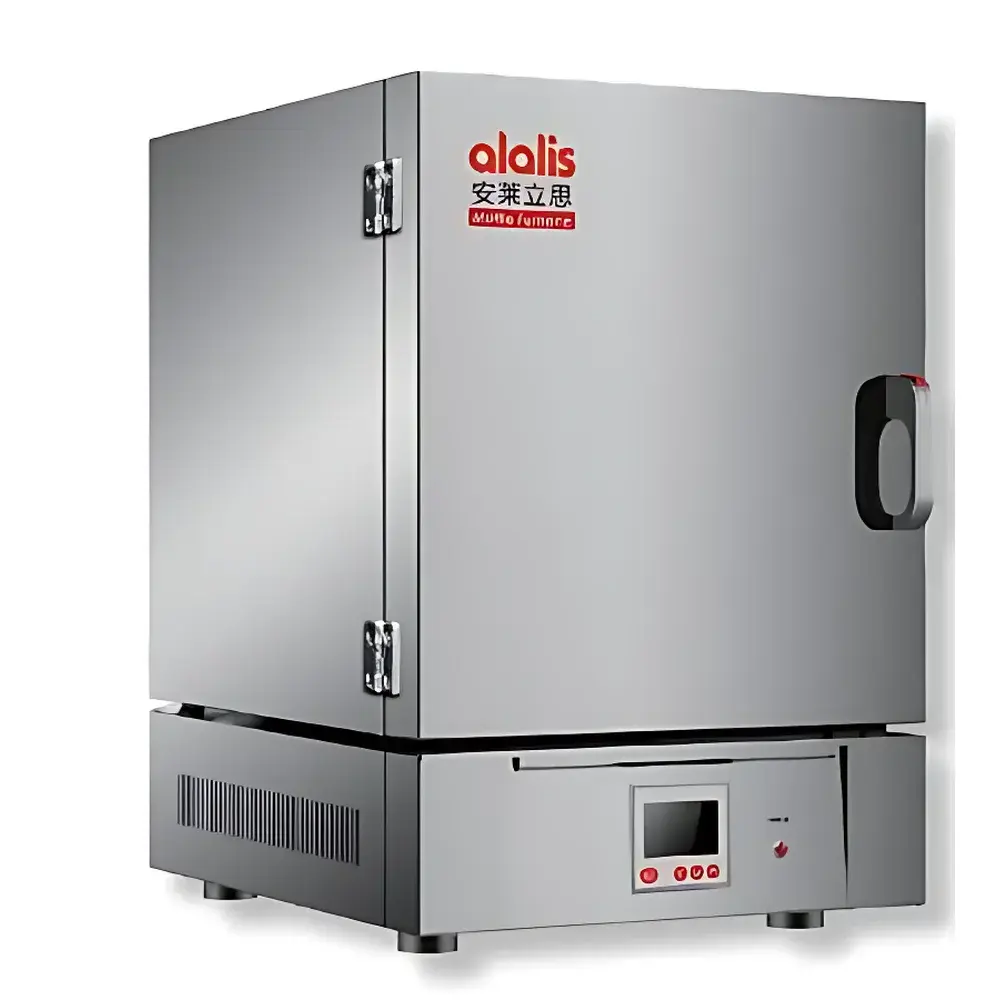
Alalis SX-1202 Professional Box-Type Muffle Furnace
| Brand | Alalis |
|---|---|
| Origin | USA |
| Model | SX-1202 |
| Instrument Type | Box-Type Muffle Furnace |
| Maximum Temperature | 1200 °C |
| Temperature Control Accuracy | ±3 °C |
| Rated Power | 1.5 kW |
| Heating Time to Max Temp | 30–52 min |
| Internal Dimensions | 120 × 200 × 80 mm (L×W×H) |
| External Dimensions | 380 × 495 × 584 mm (L×W×H) |
| Chamber Volume | 2 L |
| Heating Element | Fe-Cr-Al Alloy Wire |
| Insulation Material | Alumina Ceramic Fiber |
| Thermocouple Type | K-Type |
| Power Supply | 220 V, 50/60 Hz, Single Phase |
| Weight | 35 kg |
| Programmable Stages | Multi-segment |
| Data Storage | USB Interface (Optional) |
| Safety Features | Overtemperature Protection, Door Interlock, Current Overload Protection, Surface Cooling Fan, PID Auto-Tuning, Power Failure Memory, Scorch-Resistant Housing |
Overview
The Alalis SX-1202 Professional Box-Type Muffle Furnace is a precision-engineered thermal processing instrument designed for laboratories requiring repeatable, stable, and traceable high-temperature operation up to 1200 °C. Built upon the principles of resistive heating and passive thermal isolation, the furnace employs Fe-Cr-Al alloy heating elements embedded within a high-purity alumina ceramic fiber insulation matrix—offering low thermal mass, rapid heat-up kinetics, and minimal energy loss. Its box-type muffle architecture fully isolates the sample chamber from combustion byproducts and external air currents, ensuring inert, uniform ambient conditions critical for ashing, calcination, sintering, and heat-treatment protocols in metallurgy, ceramics, geology, and materials science. The unit complies with IEC 61000-6-3 (EMC) and IEC 61010-1 (Electrical Safety), and its structural integrity meets UL 61010-1 and EN 61010-1 requirements for laboratory electrical equipment.
Key Features
- Microprocessor-based PID temperature controller with auto-tuning capability, enabling stable setpoint maintenance within ±3 °C across the full operating range (room temperature to 1200 °C)
- Multi-segment programmable controller supporting up to 7 user-defined thermal profiles, each configurable with ramp rates, dwell times, and cooling parameters
- Alumina ceramic fiber chamber (120 × 200 × 80 mm internal volume) offering exceptional thermal stability, chemical resistance to common oxides and carbonates, and reduced thermal inertia versus refractory brick designs
- Integrated chimney and front-door air inlet system facilitating controlled convective exchange—enhancing volatile removal during ashing and minimizing cross-contamination risks
- Robust SUS304 stainless steel exterior housing with embossed finish, corrosion-resistant surface, and ergonomic low-effort door mechanism featuring mechanical interlock switch
- Comprehensive safety architecture including dual independent overtemperature cutoffs (electronic + mechanical), door-open shutdown logic, surface-cooling fan, overload circuit protection, and power-failure memory retention
- Optional USB data interface for time-stamped temperature logging, compatible with Windows-based lab management software for audit-ready recordkeeping
Sample Compatibility & Compliance
The SX-1202 accommodates crucibles, boats, and trays made from alumina, quartz, silicon carbide, or platinum—compatible with ASTM E1867 (ash content determination), ISO 1171 (determination of ash in coal and coke), and USP (residue on ignition). Its sealed muffle design prevents direct flame contact and suppresses oxidation-sensitive reactions, making it suitable for controlled atmosphere pre-treatments when used with purge gas adapters (N₂, Ar). All electrical and thermal performance specifications are validated per GLP-compliant calibration procedures, and the controller supports 21 CFR Part 11–ready audit trails when paired with validated software. CE marking confirms conformity with EU Machinery Directive 2006/42/EC and Low Voltage Directive 2014/35/EU.
Software & Data Management
While the furnace operates autonomously via its front-panel interface, optional PC connectivity enables integration into centralized laboratory informatics systems. The USB port supports raw CSV export of temperature vs. time datasets at user-selectable intervals (1–60 s resolution). Logged files include timestamp, setpoint, actual reading, program stage ID, and alarm event flags—structured to align with LIMS ingestion protocols. Firmware supports firmware update via USB and retains all stored programs and calibration offsets after power cycling. For regulated environments, optional validation documentation packages (IQ/OQ/PQ templates) are available upon request to support GMP and ISO/IEC 17025 accreditation workflows.
Applications
- Quantitative ash analysis in food, pharmaceutical, and environmental samples per AOAC 942.05 and EPA Method 2540E
- Heat treatment of small metallic components—including annealing, tempering, and stress-relief cycles under controlled ramp/dwell profiles
- Sintering of ceramic green bodies, ferrites, and battery electrode materials at ≤1200 °C
- Preparation of reference standards via high-temperature calcination of precipitates (e.g., BaSO₄, SiO₂)
- Thermogravimetric pre-conditioning prior to DSC or TGA analysis
- Ignition loss measurements in cement, fly ash, and geological matrices per ASTM C114 and ISO 622
FAQ
What is the maximum continuous operating temperature?
The SX-1202 is rated for continuous operation at 1100 °C; 1200 °C is specified as the absolute upper limit for short-duration (<30 min) thermal excursions.
Is the furnace suitable for use under inert gas purging?
Yes—gas inlet/outlet ports can be fitted using standard 6 mm compression fittings; recommended flow rate: 0.5–2 L/min for effective atmosphere displacement.
Does the controller support remote monitoring via Ethernet or RS485?
No—only USB host interface is provided; third-party serial-to-USB converters may enable RS232 emulation but are not factory validated.
How often does the K-type thermocouple require recalibration?
Annual verification against a NIST-traceable reference source is recommended; drift exceeding ±5 °C at 1000 °C warrants replacement.
Can the furnace be installed in a fume hood?
Not required—the integrated chimney and passive ventilation suffice for typical ashing loads; however, installation in ventilated enclosures is permissible if local safety policy mandates it.



