
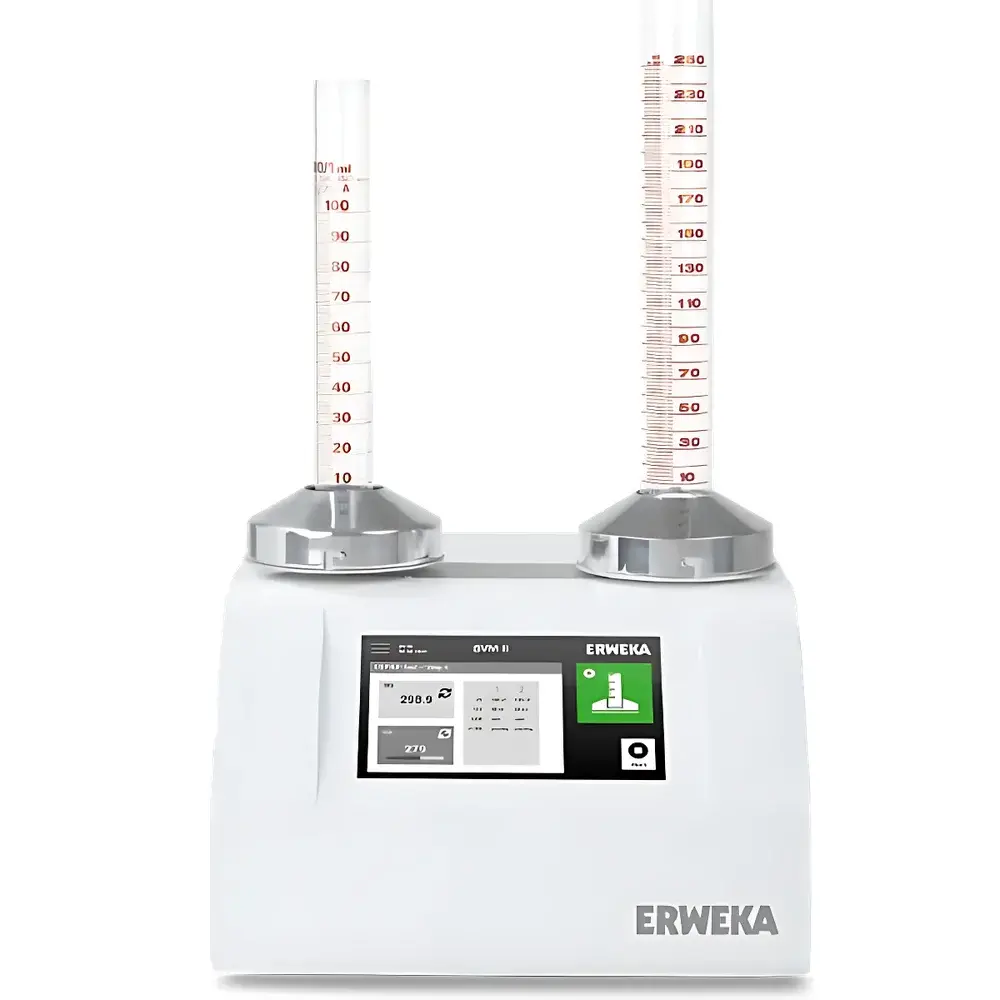
ERWEKA SVM II Tap Density Tester
| Brand | ERWEKA |
|---|---|
| Origin | Germany |
| Model | SVM II |
| Instrument Type | Tap Density Tester |
| Application | Powder Bulk & Tapped Density Measurement |
| Compliance | USP <616>, EP 2.9.34, USP <1174>, ASTM B527-15, DIN EN ISO 787-11:1995 |
| Temperature Range | +10 °C to +30 °C |
| Dimensions (H×W×D) | 196.5 × 300 × 326 mm |
| Weight | 17 kg |
| Power Supply | 115/230 V, 50/60 Hz |
| Protection Class | IP21 / IEC 60529, Class I / EN 61140 |
| Test Stations | 1 or 2 (configurable via SwitchPlate system) |
| Tap Frequency & Height | USP Method 1: 300 ±15 taps/min, 14 ±2 mm |
| USP Method 2 | 250 ±15 taps/min, 3 ±0.2 mm |
| Data Storage | Last 10 test reports (local) |
| Interfaces | USB-A, USB-B, RS232, Ethernet |
| Report Export | XML/PDF via Export Manager software |
Overview
The ERWEKA SVM II Tap Density Tester is a precision-engineered laboratory instrument designed for the standardized determination of bulk density and tapped density of pharmaceutical, chemical, food, and material science powders. Based on the mechanical tapping principle—where a graduated cylinder containing a powder sample undergoes controlled vertical impacts—the SVM II delivers repeatable, traceable, and regulatory-compliant results in accordance with globally recognized pharmacopoeial and industrial standards. Its core measurement methodology aligns with the fundamental principles defined in USP (Bulk Density and Tapped Density of Powders), European Pharmacopoeia chapter 2.9.34, and ASTM B527-15 (Standard Test Method for Tap Density of Metal Powders). Unlike generic densitometers, the SVM II is purpose-built for powder flow characterization, directly supporting critical derived parameters such as Carr’s Compressibility Index and Hausner Ratio—key indicators used in formulation development, quality control, and process validation.
Key Features
- Modular SwitchPlate system enabling field-upgradable configuration for USP Method 1, Method 2, Method 3, ASTM B527-15, or DIN EN ISO 787-11:1995—supporting single- or dual-test station operation;
- 7-inch high-resolution capacitive touchscreen with ERWEKA’s intuitive user interface, optimized for glove-compatible operation in cleanroom and QC lab environments;
- Integrated TestAssist workflow engine: guides users step-by-step through calibration, sample loading, tapping sequence, and data entry—minimizing operator-dependent variability;
- Real-time automated calculation of tapped density (g/mL), bulk density (g/mL), compressibility index (%), and Hausner ratio (dimensionless);
- DirectHelp context-sensitive assistance accessible via dedicated on-screen button—providing immediate procedural guidance without interrupting test execution;
- On-device report generation: auto-generates and stores the last 10 test reports; supports reprinting and export via USB or Ethernet to external systems using ERWEKA Export Manager (XML/PDF format);
- Regulatory-ready qualification support: built-in Qualification function streamlines IQ/OQ execution per GMP/GLP requirements, with audit-trail-capable firmware logging;
- Comprehensive service access menu: displays firmware version, serial number, and hardware diagnostics—accelerating technical support response and preventive maintenance scheduling.
Sample Compatibility & Compliance
The SVM II accommodates standard USP/Ph. Eur.-specified cylindrical vessels (e.g., 10 mL, 25 mL, 100 mL calibrated glass cylinders) and accepts free-flowing to marginally cohesive powders across industries including active pharmaceutical ingredients (APIs), excipients, catalysts, pigments, and metal powders. It is validated for use under controlled ambient conditions (+10 °C to +30 °C, non-condensing humidity 25–80% RH), ensuring thermal stability during extended testing sessions. Regulatory alignment extends beyond method execution: firmware architecture supports 21 CFR Part 11-compliant electronic records when paired with validated ERWEKA software suites; raw data integrity is preserved via timestamped, non-editable local storage. All mechanical tolerances—including tap frequency (±15 taps/min), drop height (±0.2 mm), and stroke repeatability—are factory-verified and documented per ISO/IEC 17025-accredited procedures.
Software & Data Management
Data handling is structured around traceability and interoperability. Each test session generates a timestamped report containing operator ID, date/time, vessel ID, initial and final mass/volume readings, calculated densities, and derived indices. Reports are stored locally (volatile memory for latest 10 runs) and may be exported externally via USB-A (to flash drive), USB-B (to PC), RS232 (legacy LIMS integration), or Ethernet (networked lab infrastructure). The optional Export Manager software enables batch export to XML (for LIMS ingestion) or PDF (for audit documentation), with configurable templates compliant with internal SOPs. Firmware updates are delivered via signed packages and installed through the device’s secure update interface—maintaining version control and change history per ALCOA+ principles.
Applications
- Pharmaceutical solid dosage development: assessing powder blend uniformity, capsule fill weight consistency, and tablet compression behavior;
- QC release testing of excipients (e.g., microcrystalline cellulose, lactose monohydrate) against USP monograph specifications;
- Characterization of metal powders for additive manufacturing (AM), per ASTM B527-15 and ISO/ASTM 52900;
- Quality assurance of pigments, fillers, and catalysts in coatings and polymer composites per DIN EN ISO 787-11;
- Stability studies tracking density shifts during accelerated aging or moisture exposure;
- Method transfer between R&D, pilot plant, and commercial manufacturing sites—ensuring analytical equivalence across platforms.
FAQ
Does the SVM II comply with 21 CFR Part 11 requirements?
Yes—when operated with ERWEKA’s validated Export Manager software and configured with user authentication, electronic signatures, and audit trail logging, the system meets predicate rule requirements for electronic records and signatures.
Can existing SVM I instruments be upgraded to SVM II functionality?
No—SVM II is a new platform with redesigned mechanics, electronics, and firmware; retrofitting is not supported. However, legacy SVM I users benefit from seamless method continuity and training transfer.
What calibration standards are recommended for routine verification?
ERWEKA recommends certified reference materials traceable to NIST or PTB, including stainless steel calibration cylinders and certified density standards (e.g., glass spheres of known density). Daily performance checks using reference powders are advised per internal SOPs.
Is temperature control integrated into the SVM II unit?
No—the SVM II does not include active temperature regulation. It must be operated within its specified ambient range (+10 °C to +30 °C) as defined in USP . Lab HVAC systems should maintain stable environmental conditions.
How is mechanical wear monitored over time?
Firmware logs cumulative tap cycles per test station and triggers service alerts at predefined thresholds. ERWEKA’s Preventive Maintenance Kit includes wear gauges and replacement components for drop mechanisms and cylinder holders.



