
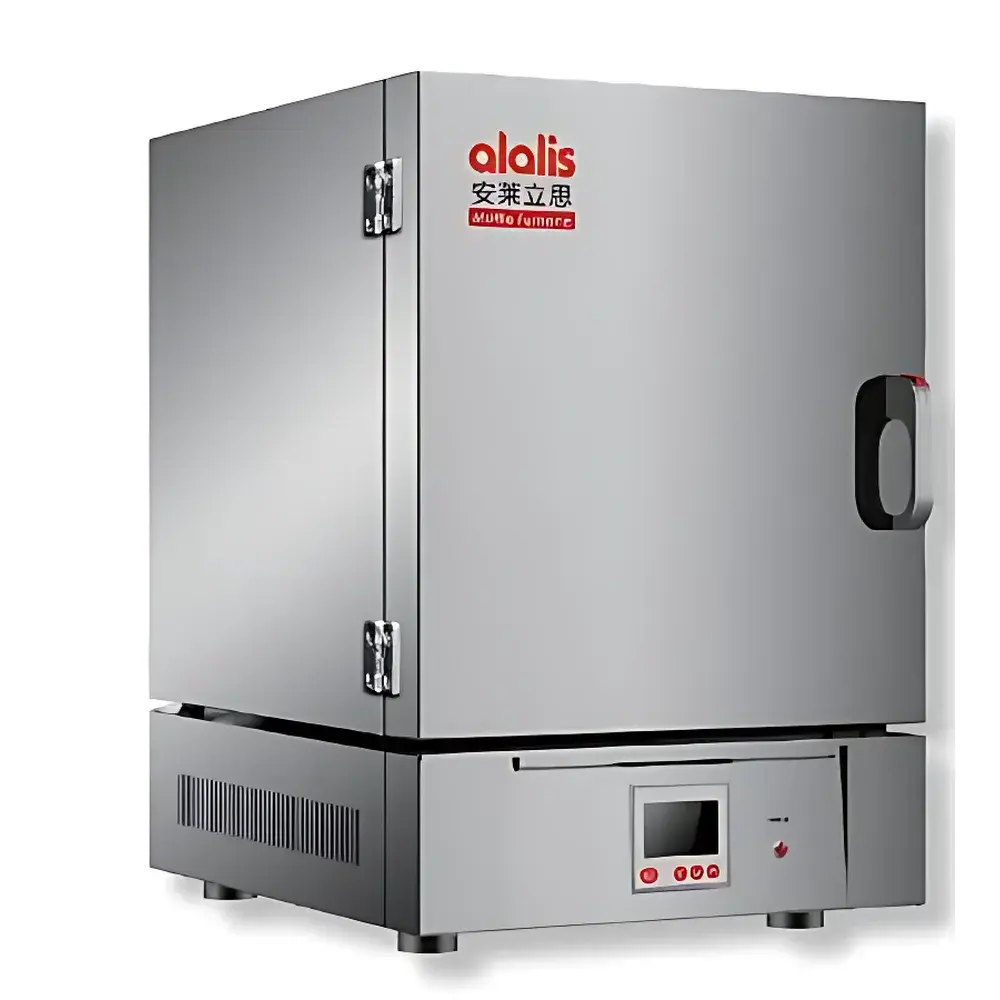
Alalis SX-1112 Professional Box-Type Muffle Furnace
| Brand | Alalis |
|---|---|
| Origin | USA |
| Model | SX-1112 |
| Instrument Type | Box-Type Muffle Furnace |
| Maximum Temperature | 1100 °C |
| Temperature Control Accuracy | ±3 °C |
| Rated Power | 4 kW |
| Heating Time to Max Temp | 35–65 min |
| Internal Dimensions | 300 × 200 × 200 mm (L × W × H) |
| External Dimensions | 490 × 690 × 730 mm (L × W × H) |
| Chamber Volume | 12 L |
| Heating Element | Fe-Cr-Al Alloy Wire |
| Insulation Material | Alumina Ceramic Fiber |
| Thermocouple Type | K-Type |
| Power Supply | 220 V, 50/60 Hz, Single Phase |
| Weight | 67 kg |
| Programmable Stages | Multi-segment (up to 7 user-storable profiles) |
| Safety Features | Overtemperature protection, door interlock, overcurrent/overload protection, surface cooling fan, thermal runaway alarm |
| Optional | USB data logging interface |
Overview
The Alalis SX-1112 Professional Box-Type Muffle Furnace is a rigorously engineered high-temperature thermal processing instrument designed for precision laboratory applications requiring stable, repeatable, and contamination-free heating up to 1100 °C. Built upon the principles of resistive heating and radiant heat transfer within an insulated chamber, the SX-1112 employs a tightly controlled muffle architecture—where the heating elements are physically isolated from the process chamber by ceramic fiber insulation—to eliminate cross-contamination and ensure uniform temperature distribution. Its operational envelope (continuous use at ≤1000 °C, peak capability at 1100 °C) aligns with standard requirements for ash content determination (ASTM D3174, ISO 1171), gravimetric residue analysis (USP ), metal annealing, ceramic sintering, and pre-treatment of geological or biological samples prior to elemental analysis. The furnace complies with IEC 61000-6-3 (EMC) and IEC 61010-1 (electrical safety for laboratory equipment), and its structural integrity supports GLP-compliant workflows through traceable temperature control and documented thermal stability.
Key Features
- High-efficiency alumina ceramic fiber insulation—low thermal mass, rapid heat-up (35–65 min to 1100 °C), and superior thermal retention (surface temperature rise limited to <50 °C above ambient during operation)
- Precision microprocessor-based PID temperature controller with auto-tuning capability, real-time deviation compensation, and built-in overtemperature cutoff (independent of main controller)
- Fe-Cr-Al alloy heating elements—resistant to oxidation and thermal fatigue, delivering extended service life (>5,000 h at 1000 °C) versus conventional Ni-Cr wire
- Multi-segment programmable logic: stores up to seven distinct thermal profiles; supports ramp-hold sequences with adjustable rate (0.1–20 °C/min) and dwell time (1 min–99 h 59 min)
- Integrated chimney venting system with front-door air intake—enables passive convection-assisted atmosphere exchange, minimizing volatile condensate buildup and supporting combustion-sensitive protocols
- Robust SUS304 stainless steel exterior housing with embossed finish—corrosion-resistant, non-porous, and compatible with routine disinfection and ISO Class 5 cleanroom wiping protocols
- Dual-safety interlocks: mechanical door switch disables power upon opening; redundant thermal fuse triggers immediate cut-off if internal sensor fails or exceeds setpoint by >50 °C
Sample Compatibility & Compliance
The SX-1112 accommodates crucibles (alumina, quartz, platinum, or silicon carbide), porcelain boats, and refractory sample holders up to 300 × 200 × 200 mm in volume. Its inert muffle environment ensures compatibility with oxidizing, mildly reducing, and air-atmosphere applications—including ASTM E119 (fire-resistance testing prep), ISO 5660-1 (heat release rate conditioning), and EPA Method 2540E (total solids ignition). The furnace meets electrical safety requirements per UL 61010-1 and CSA C22.2 No. 61010-1. For regulated environments, optional USB data export enables audit-ready temperature logs compliant with FDA 21 CFR Part 11 when paired with validated third-party software (e.g., LabArchives or Empower).
Software & Data Management
While the SX-1112 operates via embedded firmware without proprietary PC software, its controller supports ASCII-formatted temperature/time logging via optional USB interface (model SX-USB-KIT). Exported .csv files contain timestamped setpoint, actual temperature, ramp rate, and alarm status flags—structured for direct import into LIMS platforms or statistical process control tools (e.g., JMP, Minitab). The system retains all program parameters and last-run settings after power loss (non-volatile memory), and supports manual calibration offset entry for K-type thermocouples per NIST-traceable reference standards. Firmware updates are performed locally via USB without network dependency—ensuring cybersecurity compliance in air-gapped lab networks.
Applications
- Quantitative ash analysis in food, feed, pharmaceutical excipients, and environmental sludge (AOAC 942.05, ISO 2171)
- Pre-conditioning of catalyst supports and battery electrode materials prior to BET surface area measurement
- Thermal decomposition studies of polymers and composites under controlled oxidative atmospheres
- Heat treatment of small-scale metallurgical specimens (annealing, stress relieving, normalizing)
- Sintering of oxide ceramics (Al2O3, ZrO2) and low-shrinkage dental porcelains
- Calibration verification of thermogravimetric analyzers (TGA) using certified reference materials (e.g., NIST SRM 720)
FAQ
What is the maximum continuous operating temperature?
The SX-1112 is rated for continuous operation at ≤1000 °C; 1100 °C is a short-term limit (≤30 min per cycle) to preserve element longevity and insulation integrity.
Does the furnace support inert gas purging?
No integrated gas ports are provided; however, custom flange adapters can be fitted to the chimney port for low-flow nitrogen or argon blanket applications (max 0.5 L/min recommended).
Is the temperature controller NIST-traceable?
The K-type thermocouple input accepts external calibration signals; users may perform field verification using a calibrated dry-block calibrator (e.g., Fluke 9143) per ISO/IEC 17025 procedures.
Can the USB data logger record multiple channels?
No—the interface logs only the primary chamber temperature and setpoint. Dual-zone monitoring requires external data acquisition hardware.
What maintenance is required for long-term reliability?
Annual inspection of heating element continuity, thermocouple junction integrity, and ceramic fiber compression (repacking recommended after ~2,000 h at >900 °C); no lubrication or filter replacement needed.



