
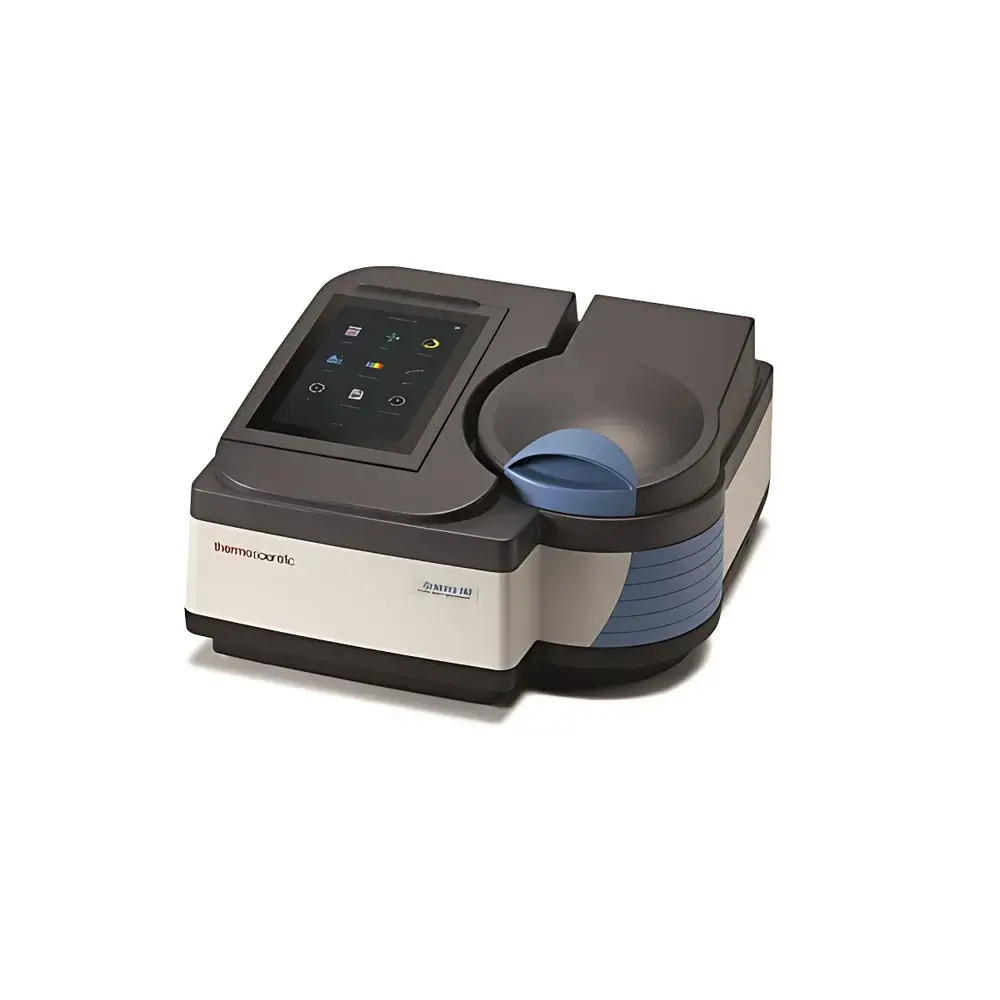
Thermo Fisher GENESYS 140 UV-Visible Spectrophotometer
| Brand | Thermo Fisher |
|---|---|
| Origin | USA |
| Manufacturer | Thermo Fisher Scientific |
| Instrument Type | Imported |
| Model | GENESYS™ 140 |
| Optical Design | Double-beam |
| Detector | Photodiode Array (PDA) |
| Wavelength Range | 325–1100 nm |
| Wavelength Scanning | Automatic |
| Spectral Bandwidth | 5 nm |
| Wavelength Accuracy | ±0.5 nm |
| Stray Light | <0.05% T at 340 nm and 400 nm |
Overview
The Thermo Fisher GENESYS 140 UV-Visible Spectrophotometer is a double-beam, photodiode array (PDA)-based spectrophotometer engineered for precision quantitative and qualitative analysis in regulated and non-regulated laboratory environments. Operating across a wavelength range of 325–1100 nm with a fixed spectral bandwidth of 5 nm, the instrument employs a stable tungsten-halogen and deuterium lamp source combined with a holographic grating monochromator to deliver consistent spectral resolution and photometric accuracy. Its double-beam optical architecture continuously compensates for source drift and environmental fluctuations by splitting the light path into sample and reference beams—enabling high reproducibility in absorbance, transmittance, and concentration measurements. Designed for long-term operational reliability, the GENESYS 140 supports routine QA/QC workflows in pharmaceutical, chemical, food & beverage, and academic laboratories where traceable performance and compliance-ready operation are essential.
Key Features
- Double-beam optical design with real-time background correction for enhanced baseline stability and measurement repeatability
- Photodiode array (PDA) detector enabling full-spectrum acquisition in under one second without mechanical scanning
- Automated wavelength selection and calibration routines, including self-diagnostic checks for lamp intensity, alignment, and optical integrity
- Integrated GLP-compliant instrument performance verification (IPV) suite, supporting user-defined qualification protocols aligned with ASTM E275, ISO 6060, and USP
- Onboard data storage with timestamped results, audit-trail-enabled method recall, and password-protected user accounts
- Flexible sample handling: compatible with standard 10-mm square cuvettes, round test tubes (up to 16 mm diameter), and Thermo Fisher Smart 8-cell rotating carousel for unattended multi-sample analysis
- Wi-Fi-enabled data export to LIMS or network drives via secure FTP or HTTPS; no proprietary software installation required for basic file transfer
Sample Compatibility & Compliance
The GENESYS 140 accommodates a broad range of liquid and solution-based samples in standard quartz, glass, or plastic cuvettes. Its optical path length tolerance (±0.1 mm) and low stray light (<0.05% T at 340 nm and 400 nm) ensure reliable quantitation of highly absorbing or turbid matrices—including colored dyes, protein solutions, and nanoparticle dispersions. The system meets key regulatory expectations for analytical instrumentation: it supports 21 CFR Part 11–compliant electronic records when used with Thermo Fisher’s optional INSIGHT software (v3.0+), provides configurable audit trails for method edits and result modifications, and includes factory-installed calibration certificates traceable to NIST standards. Routine operational qualification (OQ) and periodic performance verification (PPV) procedures are fully documented in the instrument’s IQ/OQ/PQ support package, facilitating GMP/GLP audits.
Software & Data Management
Control and data processing are managed through Thermo Fisher’s INSIGHT software (sold separately), a Windows-based application offering intuitive method development, kinetic and multi-wavelength scanning, spectral subtraction, and Beer-Lambert curve fitting. Raw absorbance spectra and processed reports can be exported in CSV, PDF, or XML formats—ensuring compatibility with enterprise data systems. For labs requiring minimal software dependency, the GENESYS 140 operates autonomously via its embedded touchscreen interface, supporting direct printing of GLP-formatted reports on USB-connected thermal printers. All data—including calibration logs, diagnostic outputs, and measurement history—are stored locally with SHA-256 hashing for integrity verification. Wi-Fi connectivity enables encrypted data push to cloud storage or local servers without exposing the instrument to open network vulnerabilities.
Applications
- Pharmaceutical QC: assay of active pharmaceutical ingredients (APIs), excipient purity screening, and dissolution profile monitoring per USP
- Environmental testing: nitrate, phosphate, and heavy metal ion quantification in water samples using EPA-approved colorimetric methods
- Life sciences: nucleic acid and protein concentration determination (A260/A280), enzyme kinetics (e.g., LDH, ALP), and cell culture density estimation
- Materials science: characterization of semiconductor thin films, quantum dot absorption edges, and dye-sensitized solar cell electrolyte transparency
- Food & agriculture: vitamin C (ascorbic acid), anthocyanin, and chlorophyll content analysis in fruits, vegetables, and beverages
FAQ
Does the GENESYS 140 require external PC connectivity for basic operation?
No—the instrument features a built-in 7-inch capacitive touchscreen with full standalone functionality, including method setup, measurement execution, and report generation.
Is the photodiode array detector cooled or thermally stabilized?
The PDA detector operates at ambient temperature with integrated dark-current compensation algorithms; no active cooling is employed, as thermal drift is mitigated through hardware-level offset correction and frequent zeroing routines.
Can the GENESYS 140 perform kinetic measurements?
Yes—when paired with INSIGHT software, it supports time-resolved absorbance monitoring at user-defined intervals (100 ms to 60 s), with up to 10,000 data points per run.
What validation documentation is included with shipment?
Each unit ships with a Certificate of Conformance, NIST-traceable wavelength and photometric accuracy verification report, and a complete IQ/OQ protocol template compliant with ISO/IEC 17025 requirements.
How often must the instrument be recalibrated?
Annual performance verification is recommended; however, daily user verification using supplied neutral density filters and holmium oxide reference standards satisfies most internal QA policies and regulatory inspection expectations.





