
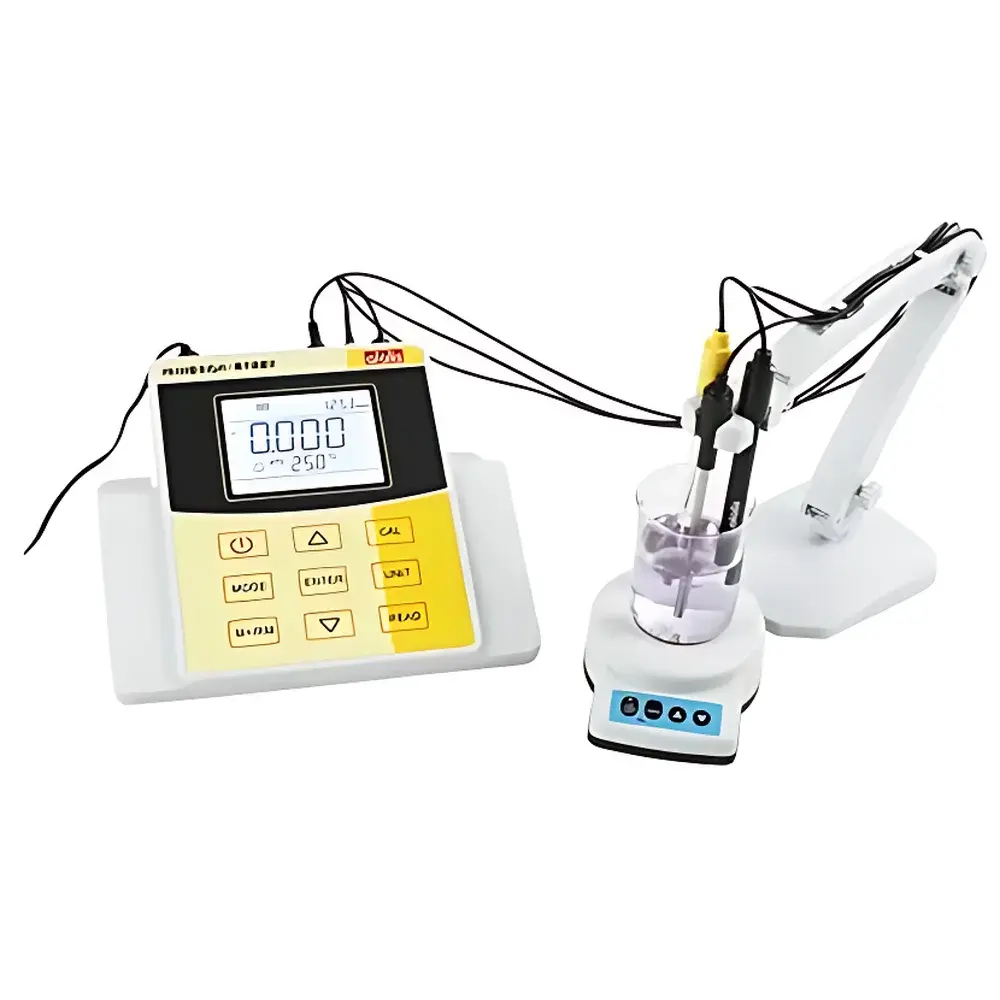
Alalis PI5100-I Benchtop Iodide Ion Concentration Meter
| Brand | Alalis |
|---|---|
| Origin | Shanghai, China |
| Model | PI5100-I |
| Instrument Type | Benchtop Multi-Ion Analyzer |
| Measurement Range | 0.00–14.00 pX |
| Detection Limit | 0.01 ppm |
| Response Time | 1 s |
| Accuracy | ±0.01 pX (for monovalent ions) |
| Temperature Range | −10 to 110 °C |
| Resolution | 0.01 pX / 0.01 mol/L / 0.01 mg/L / 0.01 ppm |
| pH Range | −2.000 to 19.999 pH |
| mV Range | −1999.9 to +1999.9 mV |
| Temperature Compensation | Automatic/manual (0–60.0 °C for ion mode |
| Data Storage | 1000 sets (manual & auto) |
| Interface | USB |
| Display | 90 × 68 mm LCD with white backlight and real-time clock |
| IP Rating | IP54 |
| Compliance | GLP-compliant data management |
Overview
The Alalis PI5100-I Benchtop Iodide Ion Concentration Meter is a high-precision potentiometric analyzer engineered for reliable, trace-level iodide (I⁻) quantification in environmental water matrices—including drinking water, wastewater, seawater, and industrial effluents. It operates on the principle of selective ion electrode (SIE) potentiometry, where the iodide-selective electrode generates a Nernstian potential response proportional to the logarithm of free iodide activity in solution. The instrument integrates dual-electrode measurement architecture (iodide-selective membrane electrode paired with a stable Ag/AgCl reference electrode) and supports rigorous temperature compensation algorithms compliant with ISO 7870-2 and ASTM D2777 guidelines for ion-selective electrode performance validation. Designed for routine laboratory use in municipal water utilities, environmental testing labs, and regulatory compliance facilities, the PI5100-I delivers metrological traceability, reproducible calibration stability, and full auditability under GLP frameworks.
Key Features
- Potentiometric iodide detection with Nernstian slope verification (−59.2 ± 1.5 mV/decade at 25 °C) and automatic electrode slope calculation during calibration.
- Multi-point ion calibration (2–5 points) with built-in calibration validation—rejects out-of-tolerance calibrants and flags drift exceeding ±2 mV per point.
- Simultaneous dual-parameter operation: concurrent iodide concentration (pX), pH, redox potential (EH), and temperature measurement.
- Four selectable concentration units: pX, mol/L, mg/L, and ppm—automatically interconverted using stoichiometric molecular weight (126.90 g/mol for I⁻) and activity coefficient estimation via Debye-Hückel approximation.
- GLP-compliant data management: time-stamped records (YYYY-MM-DD HH:MM:SS), operator ID entry, electrode history tracking, and calibration certificate export via USB.
- Rugged benchtop architecture with IP54-rated enclosure; all electrical ports sealed with silicone rubber caps to prevent electrolyte ingress during field-deployable lab use.
- Integrated temperature compensation across two independent ranges: −10 to 110 °C (for general temperature logging) and 0 to 60.0 °C (optimized for ion-selective electrode thermodynamic correction).
Sample Compatibility & Compliance
The PI5100-I is validated for aqueous samples with total dissolved solids (TDS) ≤ 5000 mg/L and ionic strength adjusted using proprietary iodide ionic strength adjuster (ISA). It meets EPA Method 300.1 requirements for halide anion analysis when operated with R2223 double-junction reference electrode and S2211T pH combination electrode. All firmware and data handling routines conform to FDA 21 CFR Part 11 principles for electronic records and signatures—supporting user-defined roles, audit trail logging (including parameter changes, calibration events, and data deletions), and password-protected configuration access. Instrument-level certification includes ISO/IEC 17025 traceable calibration reports for pH, mV, and temperature modules.
Software & Data Management
Data acquisition and reporting are enabled through Alalis LabLink™ PC software (included on optical disc), which supports real-time graphing, statistical summary (mean, SD, RSD, confidence intervals), and export to CSV, PDF, or Excel-compatible XML formats. The USB interface enables bidirectional communication: instrument configuration upload/download, firmware updates, and batch calibration protocol deployment. All stored measurements (up to 1000 entries) retain metadata including ambient temperature, electrode ID, calibration date/time, and user annotation fields. Audit trails are immutable and timestamped to microsecond resolution—fully compatible with laboratory information management systems (LIMS) integration via standard COM port emulation.
Applications
- Regulatory monitoring of iodide in drinking water per WHO Guidelines for Drinking-water Quality (GDWQ) and EU Directive 98/83/EC.
- Process control in pharmaceutical manufacturing where iodide serves as catalyst residue or intermediate in API synthesis.
- Environmental fate studies assessing iodide mobility in groundwater systems and sediment porewater.
- Validation of iodine-based disinfectant residuals in cooling tower water and hospital sterilization circuits.
- Educational laboratories conducting potentiometric titration experiments and Nernst equation verification exercises.
FAQ
What electrode configuration is required for accurate iodide measurement?
The PI5100-I requires the dedicated iodide-selective electrode (R2223 reference + iodide membrane electrode) and must be used with 0.1 mol/L KNO₃-based ionic strength adjuster to minimize activity coefficient variation.
Does the instrument support direct calibration with solid-state iodide standards?
No—calibration must be performed using aqueous iodide standards (e.g., 0.1 mol/L KI solution); solid standards are not supported due to non-Nernstian dissolution kinetics.
Can the PI5100-I measure other halides such as chloride or bromide?
It is optimized for iodide selectivity (log Kpot(I⁻, Cl⁻) = −5.2; log Kpot(I⁻, Br⁻) = −2.8); cross-sensitivity to bromide may occur above 100× concentration ratio—use only for iodide-specific applications.
Is temperature compensation applied automatically during sample measurement?
Yes—when the T2132 temperature probe is connected, the instrument applies real-time thermodynamic correction to the measured EMF using the extended Nernst equation with temperature-dependent slope factor.
How is data integrity ensured during power interruption?
All measurements are written to non-volatile flash memory upon stabilization; no data loss occurs during unexpected shutdown, and the system resumes from last valid state on reboot.
Related Products







