
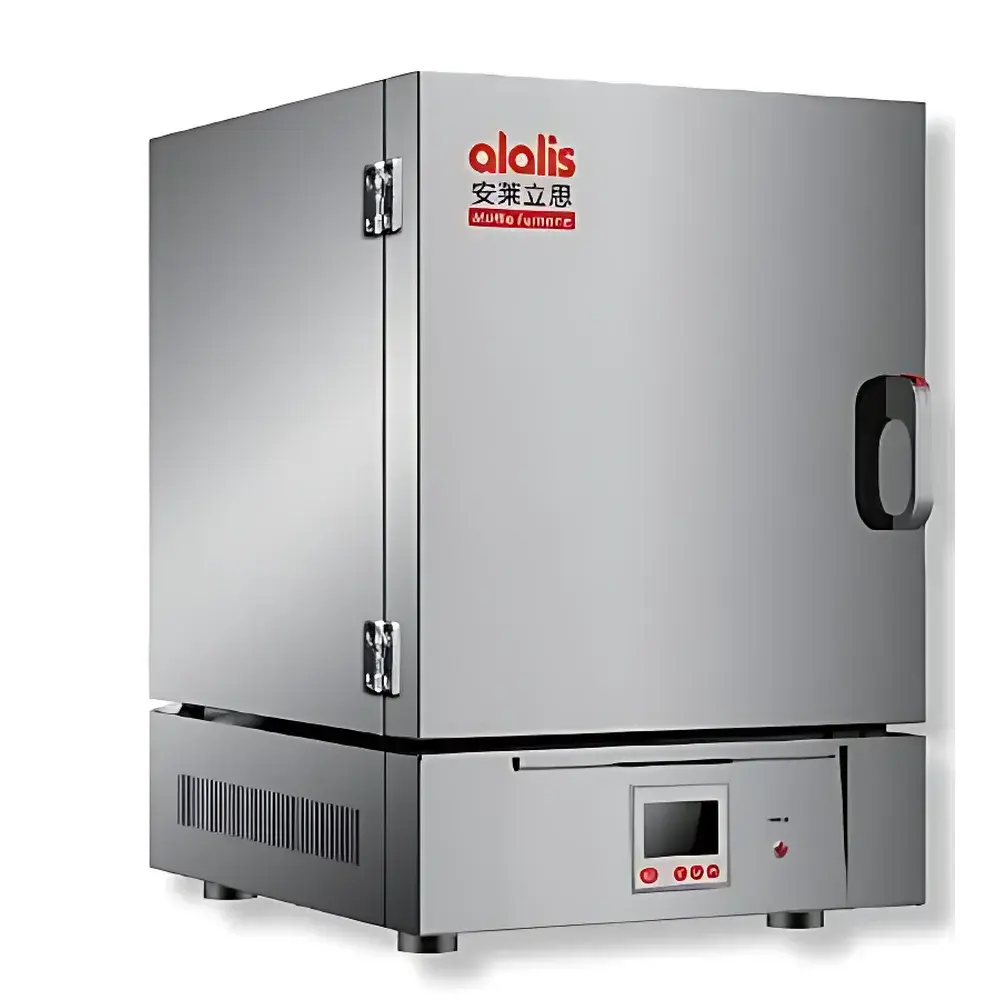
Alalis SX-1207 Professional Box-Type Muffle Furnace
| Brand | Alalis |
|---|---|
| Origin | USA |
| Model | SX-1207 |
| Instrument Type | Box-Type Muffle Furnace |
| Maximum Temperature | 1200 °C |
| Temperature Control Accuracy | ±3 °C |
| Rated Power | 3 kW |
| Heating Time to Max Temp | 30–52 min |
| Internal Dimensions | 200 × 300 × 120 mm (L × W × H) |
| External Dimensions | 460 × 650 × 674 mm (L × W × H) |
| Chamber Volume | 7 L |
| Heating Element | Fe-Cr-Al Alloy Wire (Grade 07) |
| Insulation Material | Alumina Ceramic Fiber |
| Thermocouple Type | K-Type |
| Power Supply | 220 V, 50/60 Hz, Single Phase |
| Weight | 45 kg |
| Chimney Port | Yes |
| Programmable Ramp/Soak | Yes (7 Presets) |
| USB Data Export (Optional) | Yes |
| Safety Features | Over-Temperature Protection, Door Interlock Switch, Overcurrent & Overload Protection, Surface Cooling Fan, Auto Memory on Power Loss |
Overview
The Alalis SX-1207 Professional Box-Type Muffle Furnace is an industrial-grade laboratory furnace engineered for precise, repeatable high-temperature thermal processing in research, quality control, and materials development environments. Operating on the principle of resistive heating via embedded Fe-Cr-Al alloy heating elements and insulated by high-purity alumina ceramic fiber, the SX-1207 delivers uniform temperature distribution across its 7 L chamber—critical for applications requiring strict thermal homogeneity, such as ashing, calcination, sintering, and heat treatment of small metallic or ceramic specimens. Designed to meet ISO/IEC 17025-aligned laboratory infrastructure requirements, the furnace supports continuous operation at up to 1100 °C and short-term exposure to 1200 °C, with thermal stability maintained within ±3 °C under steady-state conditions. Its robust mechanical architecture—including a SUS304 stainless steel outer casing, reinforced ceramic fiber-lined chamber, and integrated chimney venting system—ensures long-term reliability and compliance with general laboratory safety protocols.
Key Features
- Microprocessor-based P.I.D. temperature controller with auto-tuning capability and real-time deviation compensation for enhanced thermal reproducibility
- Seven programmable ramp-soak profiles stored in non-volatile memory; supports multi-stage heating sequences with user-defined rate limits and dwell times
- Integrated K-type thermocouple with cold-junction compensation and automatic sensor calibration function adaptable to ambient lab conditions
- Alumina ceramic fiber insulation (density ≥ 128 kg/m³) providing low thermal mass, rapid heating response, and surface temperature reduction of >40 °C vs. traditional brick-lined furnaces
- Dual-layer safety architecture: hardware-level overtemperature cutoff (independent of main controller), door interlock switch, and thermal cutout fuse rated at 1250 °C
- Front-access chimney port enabling controlled atmospheric exchange during volatile decomposition processes—supporting ASTM E171, ISO 1171, and USP <281> ash content methodology
- Optional USB interface for time-stamped temperature log export (CSV format), compatible with GLP-compliant data archiving workflows
Sample Compatibility & Compliance
The SX-1207 accommodates standard crucibles (alumina, platinum, silica, or nickel-based) and sample boats up to 200 mm in length. Its inert, sealed muffle design minimizes cross-contamination during ashing of organic matrices (e.g., food, pharmaceuticals, environmental filters) and prevents oxidation interference during annealing of ferrous alloys. The furnace conforms to IEC 61010-1:2010 for electrical safety and incorporates ventilation pathways compliant with NFPA 45 and local laboratory exhaust code requirements. While not certified to UL 746B or CE for standalone medical device manufacturing, it is routinely deployed in GMP-adjacent QC labs supporting ISO 9001 and ISO 13485 quality systems—particularly where thermal validation (IQ/OQ/PQ) of routine ashing or pre-sintering steps is required.
Software & Data Management
The embedded controller firmware supports full-cycle logging of setpoint, actual temperature, elapsed time, and alarm status. With optional USB module installed, users can export timestamped datasets directly to external storage for traceability under FDA 21 CFR Part 11 (when paired with validated electronic lab notebook systems). All program parameters—including ramp rates, soak durations, and safety thresholds—are password-protected and auditable. Firmware revision history and calibration event logs are retained in internal EEPROM, enabling retrospective verification per GLP Annex 11 and EU GMP Annex 11 guidelines.
Applications
- Ash content determination per AOAC 942.05, ASTM D2974, and EPA Method 2540E
- Thermal gravimetric analysis (TGA) pre-conditioning of catalysts, battery cathode precursors, and polymer composites
- Small-batch annealing, tempering, and stress-relieving of tool steels, tungsten carbide blanks, and dental alloys
- Sintering of technical ceramics (e.g., ZrO₂, Al₂O₃) and powder metallurgy compacts under air atmosphere
- Residue ignition testing for pharmaceutical excipients (USP <281>) and dietary supplement raw materials
- Calibration reference source for secondary thermocouple verification (within ±5 °C tolerance band)
FAQ
What is the maximum recommended continuous operating temperature?
The SX-1207 is rated for continuous operation at 1100 °C. Exposure to 1200 °C is permitted for ≤60 minutes per cycle to accommodate transient thermal profiling needs.
Does the furnace support inert or reducing atmospheres?
No. The SX-1207 is configured for ambient air operation only. For controlled-atmosphere applications, a dedicated tube furnace with gas manifold integration is recommended.
Is the USB data export function included by default?
USB connectivity is an optional accessory (Part No. SX-USB-KIT). When installed, it enables manual data dump but does not provide real-time PC communication or remote control.
How frequently should the thermocouple be recalibrated?
Annual verification against a NIST-traceable reference source is advised. Field calibration using the built-in auto-calibration routine may be performed after significant ambient temperature shifts or following extended high-temperature cycling.
Can the furnace be integrated into a central lab monitoring system?
The unit lacks Ethernet or RS-485 interfaces. Integration requires third-party analog signal converters (4–20 mA output) or discrete relay outputs for status alarms.



