
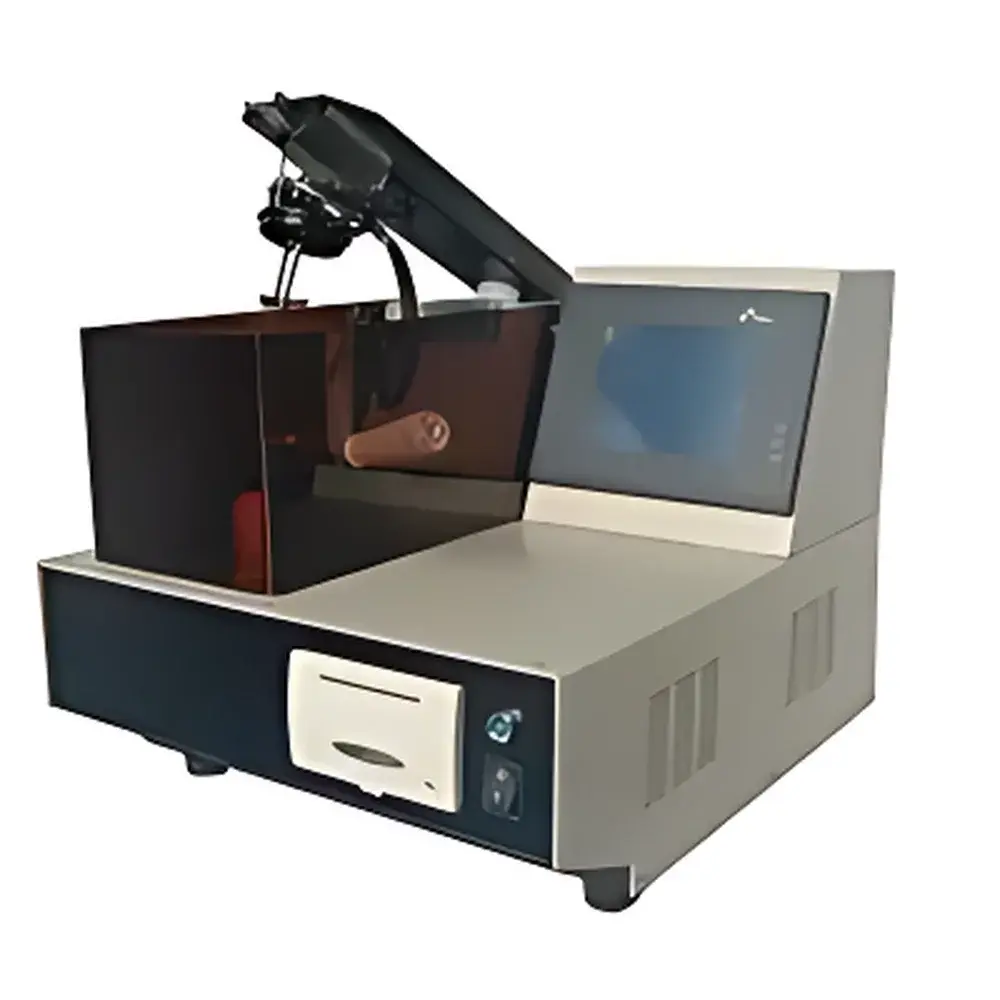
XuFeng XF-93 Pensky-Martens Automatic Closed-Cup Flash Point Tester
| Brand | XuFeng |
|---|---|
| Origin | Shanghai, China |
| Model | XF-93 |
| Detection Method | Closed-Cup Method (Pensky-Martens) |
| Standards Compliance | ASTM D93, GB/T 261–2008 |
| Temperature Range | 0–360 °C (Typical Test Range: 40–360 °C) |
| Temperature Control Accuracy | ±0.1 °C |
| Power Consumption | 2 × 800 W |
| Dimensions (W×D×H) | 400 × 380 × 350 mm |
| Weight | ~20 kg |
| Display | Full-touch LCD screen |
| Interface | RS-232C |
| Output | Integrated dot-matrix printer |
| Ignition | Automatic gas-fired or optional electronic ignition head |
Overview
The XuFeng XF-93 Pensky-Martens Automatic Closed-Cup Flash Point Tester is a precision-engineered benchtop instrument designed for reliable, repeatable flash point determination of petroleum products, lubricants, solvents, and other flammable liquids in accordance with internationally recognized closed-cup test protocols. It operates on the fundamental principle of the Pensky-Martens closed-cup method—where a sample is heated incrementally in a sealed test cup while an ignition source is periodically introduced above the vapor space; the lowest temperature at which the vapor-air mixture ignites momentarily under controlled conditions is recorded as the flash point. This thermodynamic endpoint serves as a critical safety parameter for transportation, storage, handling, and regulatory classification per OSHA, NFPA 30, CLP Regulation (EC) No. 1272/2008, and UN GHS criteria. The XF-93 implements rigorous thermal control and automated ignition sequencing to ensure full compliance with ASTM D93 (Standard Test Methods for Flash Point by Pensky-Martens Closed Cup Tester) and GB/T 261–2008 (Determination of Flash Point — Pensky-Martens Closed Cup Method), supporting both routine QC and GLP-compliant laboratory workflows.
Key Features
- Multi-standard programmability: User-selectable test modes for ASTM D93 and GB/T 261–2008, each with preconfigured heating ramps, stirrer speed profiles, and ignition timing sequences to match respective procedural requirements.
- High-precision temperature regulation: Dual-zone PID-controlled heating system with ±0.1 °C stability across 0–360 °C, enabling accurate endpoint detection even for high-boiling distillates and residual fuels.
- Full automation: One-touch start operation—after parameter entry via the intuitive full-touch LCD interface, the instrument autonomously executes cup preheating, sample introduction (manual loading), temperature ramping, vapor sampling, ignition cycles, and flash point identification.
- Robust hardware architecture: Stainless-steel enclosure ensures corrosion resistance and mechanical durability in industrial lab environments; key electrical components—including temperature sensors, ignition control modules, and power regulators—are sourced from certified international suppliers.
- Integrated diagnostics and safety logic: Real-time self-diagnostic routines monitor heater integrity, thermocouple continuity, gas supply pressure (for gas-fired models), and ignition circuit performance, triggering audible/visual alerts upon anomaly detection.
- Expandable configuration support: Compatible with optional multi-unit test modules (e.g., XF-2S/XF-4S dual- or quad-cup configurations) for parallel testing of identical or dissimilar samples under synchronized or independent protocols.
Sample Compatibility & Compliance
The XF-93 accommodates standard Pensky-Martens closed test cups (ASTM D93-compliant geometry) and is validated for use with crude oils, diesel fuels, kerosene, jet fuels, base oils, biodiesel blends, and organic solvents having initial boiling points above 40 °C and flash points up to 360 °C. It supports ambient atmospheric pressure correction via user-input barometric data, ensuring traceable results across varying elevation conditions. All operational firmware and calibration routines are documented to satisfy internal audit requirements under ISO/IEC 17025:2017 Clause 6.4 (Equipment) and support FDA 21 CFR Part 11 readiness when paired with validated LIMS integration via RS-232C. Routine verification includes reference material testing using certified NIST-traceable flash point standards (e.g., SRM 2721, SRM 2722).
Software & Data Management
While the XF-93 operates as a standalone instrument with embedded firmware, its RS-232C serial interface enables bidirectional communication with external laboratory information management systems (LIMS) or centralized QA databases. Raw test logs—including timestamped temperature curves, ignition event timestamps, detected flash point values, operator ID (if configured), and environmental pressure inputs—are exportable in ASCII-delimited format. The integrated dot-matrix printer provides immediate hardcopy output of final results, including test standard identifier, sample ID, ambient pressure, observed flash point, and pass/fail status against specification limits. Audit trail functionality is maintained through non-volatile memory storage of the last 100 test records, accessible via on-screen navigation without external software dependency.
Applications
- Refinery QC laboratories performing routine flash point verification of finished fuels per ASTM D93 and GB/T 261–2008.
- Petrochemical R&D facilities evaluating formulation stability and volatility profiles of new solvent blends and bio-based intermediates.
- Third-party testing labs accredited to ISO/IEC 17025 conducting contract analyses for regulatory submissions (e.g., REACH, EPA 40 CFR Part 79).
- Aviation fuel certification labs verifying flash point conformity for Jet A-1 and JP-8 specifications (minimum 38 °C).
- Manufacturing sites implementing IATF 16949 or API Q1 quality systems requiring documented flash point traceability for lubricant batch release.
FAQ
Does the XF-93 require external compressed air or fuel gas for ignition?
Yes—standard configuration uses a butane/propane micro-flame ignition source requiring connection to a regulated combustible gas supply. An optional electronic spark ignition module is available upon request, eliminating the need for external gas infrastructure.
Can the instrument be calibrated internally without external standards?
No—calibration requires traceable reference materials (e.g., NIST SRMs) and must be performed per manufacturer-recommended intervals (typically every 6 months or after 200 tests). Internal verification checks are supported via built-in diagnostic routines.
Is the XF-93 compliant with FDA 21 CFR Part 11 for electronic records?
The instrument itself does not provide electronic signature or audit trail features required for full Part 11 compliance; however, when integrated into a validated LIMS environment with appropriate access controls and record retention policies, it supports Part 11-aligned data capture workflows.
What maintenance is required for long-term reliability?
Routine maintenance includes cleaning of the test cup and lid assembly after each use, periodic inspection of the thermocouple sheath for oxidation, verification of stirrer motor torque, and replacement of printer ribbons and thermal paper rolls. Annual preventive maintenance by authorized service personnel is recommended.
How does the XF-93 handle low-flash-point samples below 40 °C?
The instrument’s specified operational range begins at 40 °C; for samples with expected flash points below this threshold, alternative methods such as ASTM D56 (Tag Closed Cup) or ASTM D3828 (Small Scale Closed Cup) are recommended, as the Pensky-Martens geometry and heating dynamics are optimized for mid-to-high volatility liquids.




