
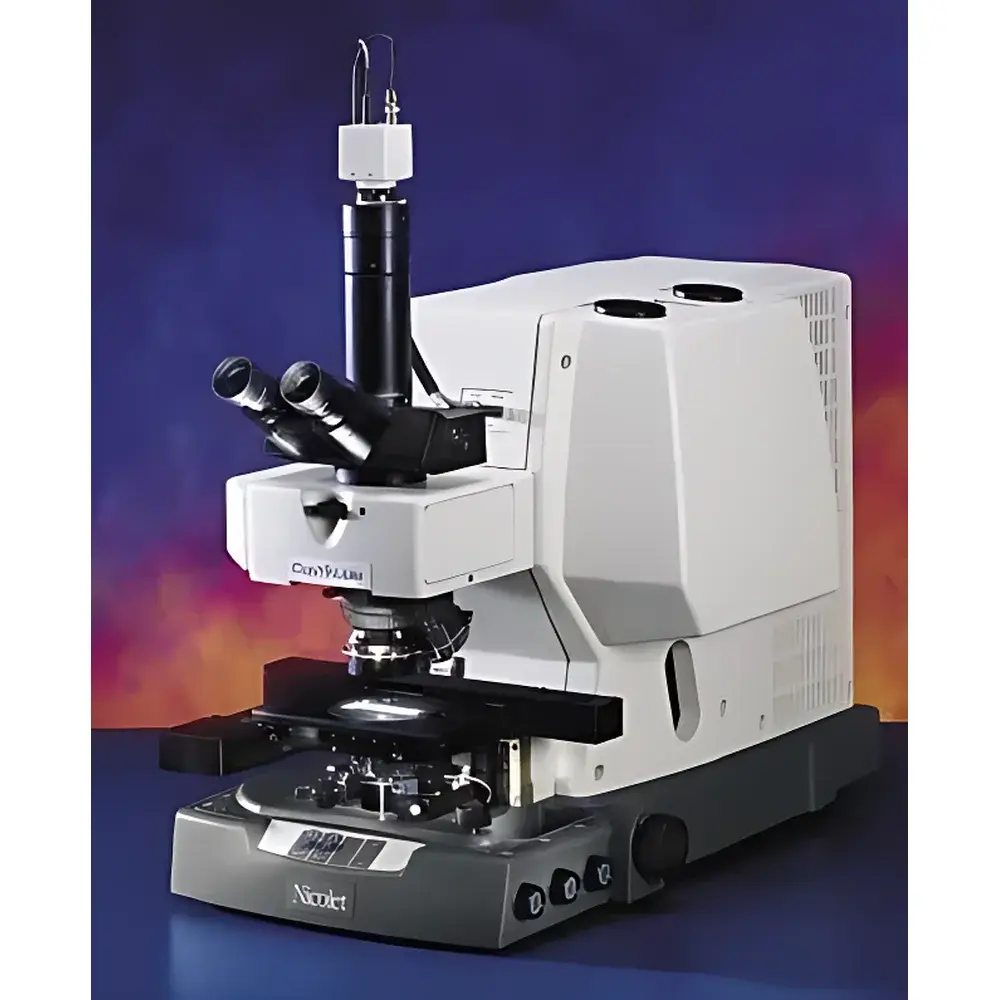
Thermo Fisher Nicolet Continuum Infrared Microscope
| Brand | Thermo Fisher |
|---|---|
| Origin | USA |
| Manufacturer Type | Original Equipment Manufacturer (OEM) |
| Import Status | Imported |
| Model | Continuum |
| Pricing | Available Upon Request |
Overview
The Thermo Fisher Nicolet Continuum Infrared Microscope is a high-performance, research-grade FTIR microspectroscopy platform engineered for spatially resolved chemical characterization at the micron scale. It integrates Fourier Transform Infrared (FTIR) spectroscopy with precision optical microscopy, enabling simultaneous acquisition of high-fidelity infrared spectra and diffraction-limited visible-light images from the same sample location. Unlike conventional IR microscopes relying on finite-conjugate optics, the Continuum employs infinity-corrected optical architecture—directing collimated light through the objective and intermediate optical path—thereby eliminating spherical and chromatic aberrations induced by auxiliary components such as polarizers or spectral filters. This design ensures consistent wavefront fidelity across the full mid-IR to near-IR range (typically 7500–600 cm⁻¹ for MCT detectors; up to 25,000 cm⁻¹ with Si-based NIR detectors), critical for quantitative mapping and spectral library matching under GLP-compliant workflows.
Key Features
- Infinity-corrected optical system with coaxial visible/IR illumination path, enabling real-time correlation between visual morphology and molecular absorption signatures
- Patented Reflex Aperture dual-diaphragm system that minimizes stray light, improves signal-to-noise ratio (SNR), and enhances spectral reproducibility across repeated measurements
- True View™ dichroic imaging technology: provides live, overlay-capable visible-light preview during IR mapping—no time lag or stage repositioning required
- Motorized quadruple objective turret accommodating objectives with magnifications from 4× to 75×, including variable-thickness compensation objectives for ATR and reflective sampling geometries
- Dual-detector capability: supports interchangeable mercury cadmium telluride (MCT) for mid-IR and extended-InGaAs or Si photodiode arrays for near-IR detection within a single instrument platform
- Triocular head configuration enables concurrent visual observation, digital imaging, and automated stage synchronization for hyperspectral data acquisition
Sample Compatibility & Compliance
The Continuum accommodates diverse solid and thin-film samples—including polymers, pharmaceutical tablets, biological tissue sections, semiconductor wafers, and forensic trace evidence—via three standardized sampling modalities: transmission, reflection (including specular and diffuse modes), and attenuated total reflectance (ATR) using diamond or Ge crystal objectives. Its mechanical stability, thermal drift compensation, and vibration-isolated optical bench meet ASTM E1252 and ISO 18389 requirements for micro-FTIR instrumentation. Data acquisition and processing comply with FDA 21 CFR Part 11 when deployed with Thermo Scientific OMNIC Paradigm software configured for electronic signatures, audit trails, and user-access controls—supporting GMP/GLP-regulated environments in pharma QC, materials R&D, and regulatory forensics labs.
Software & Data Management
Controlled exclusively via Thermo Scientific OMNIC Paradigm software, the Continuum delivers integrated spectral acquisition, multivariate analysis (PCA, cluster analysis), and chemical imaging (mapping) workflows. The software supports pixel-by-pixel spectral fitting against commercial libraries (e.g., Hummel Polymer, Sadtler, NIST), generates false-color chemical maps with sub-micron step resolution (down to 1 µm in mapping mode), and exports fully annotated datasets in HDF5 or JCAMP-DX formats for third-party analysis. All spectral metadata—including instrument configuration, detector gain, aperture settings, and stage coordinates—is embedded automatically, ensuring full traceability per ISO/IEC 17025 documentation standards.
Applications
- Pharmaceutical: Identification of API distribution, excipient compatibility, and coating uniformity in solid dosage forms
- Materials Science: Phase segregation analysis in polymer blends, filler dispersion in composites, and oxidation state mapping in battery electrodes
- Life Sciences: Label-free histopathological differentiation of tissue substructures (e.g., collagen vs. elastin) and lipid/protein localization in cryosections
- Forensics: Micro-spectral comparison of paint chips, fibers, and gunshot residue particles without destructive extraction
- Semiconductors: Contamination identification on wafer surfaces and interfacial chemistry assessment in thin-film stacks
FAQ
What spectral range does the Continuum support with standard detectors?
Mid-infrared operation (4000–600 cm⁻¹) is enabled with liquid-nitrogen-cooled MCT detectors; optional extended-range MCT or InGaAs detectors extend coverage into the near-IR (up to 12,500 cm⁻¹) or far-IR (down to 550 cm⁻¹) depending on configuration.
Can the Continuum perform ATR mapping on non-flat samples?
Yes—motorized ATR objectives with spring-loaded pressure control and auto-focus feedback allow reliable contact-based mapping on slightly curved or rough surfaces, provided sample height variation remains within ±15 µm across the field of view.
Is DIC (Differential Interference Contrast) imaging compatible with IR spectral acquisition?
DIC is implemented optically in the visible path only and does not interfere with IR beam transmission; it enhances contrast for morphological guidance but is decoupled from spectral collection to preserve photometric accuracy.
How is calibration verified for regulatory submissions?
The system includes NIST-traceable polystyrene film validation protocols, daily background acquisition routines, and automated linearity checks per ASTM E168—fully documented within OMNIC’s compliance reporting module.




