
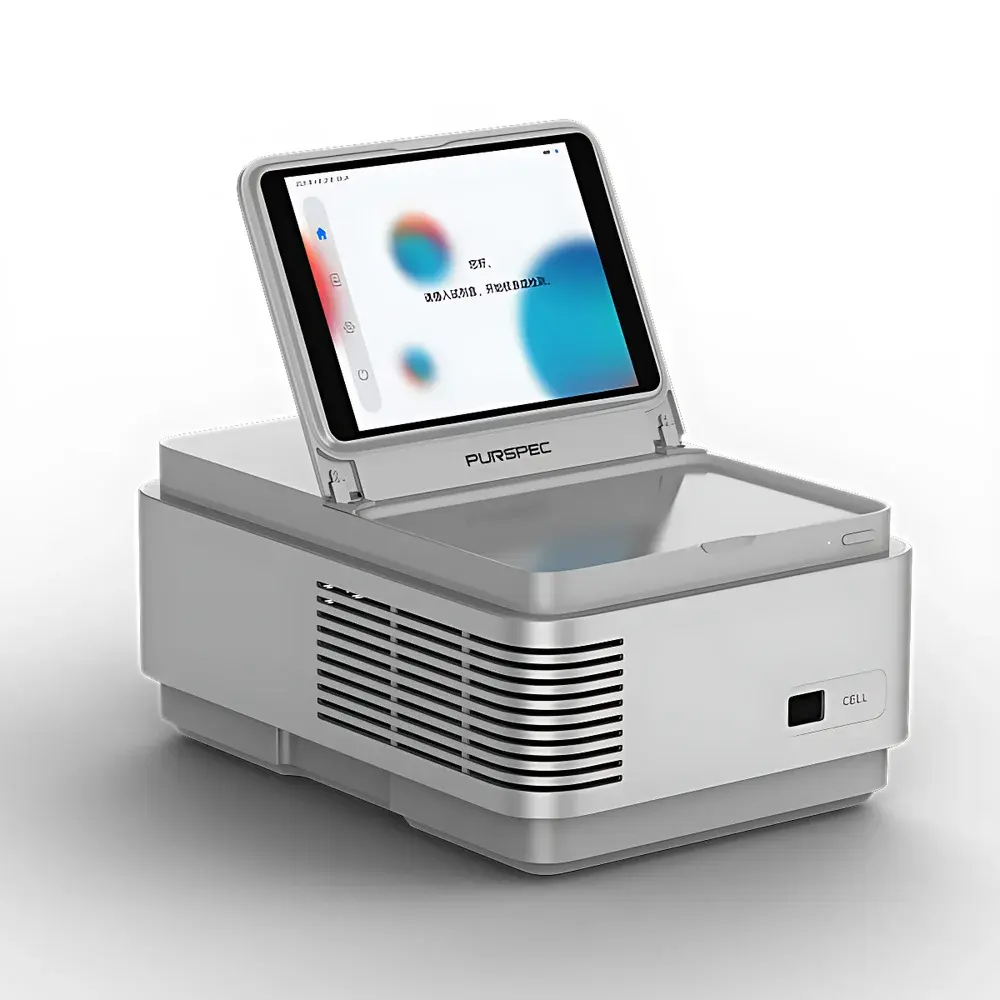
Cell Portable Mass Spectrometry System by PURSPEC Technologies
| Brand | PURSPEC Technologies |
|---|---|
| Origin | Beijing, China |
| Manufacturer Type | Authorized Distributor |
| Country of Origin | China |
| Model | Cell |
| Pricing | Available Upon Request |
Overview
The Cell Portable Mass Spectrometry System is a benchtop-to-field deployable ambient ionization mass spectrometer engineered for rapid, in situ chemical analysis without sample preparation. Utilizing direct analysis in real time (DART)-compatible thermal desorption coupled with low-temperature plasma-assisted ionization, the system enables soft ionization of volatile and semi-volatile compounds directly from solid, liquid, or surface-bound samples under ambient conditions. Designed for operational flexibility, the Cell integrates a compact quadrupole mass analyzer with a high-sensitivity electron multiplier detector, delivering unit-mass resolution across a mass range of m/z 10–500. Its architecture supports both qualitative identification and semi-quantitative profiling—making it suitable for field-deployed forensic screening, pharmaceutical raw material verification, environmental contaminant surveillance, and on-site food safety inspection.
Key Features
- True portable operation: Integrated rechargeable Li-ion battery provides ≥4 hours of continuous analysis; also supports AC/DC external power input (100–240 V, 50/60 Hz) for extended lab or mobile lab use.
- Rapid turnaround: End-to-end workflow—from direct sampling to spectral output and preliminary compound annotation—completed within ≤60 seconds per sample.
- Modular consumables: Interchangeable detection cartridges (pre-configured or user-loaded) accommodate diverse analyte classes, including pesticides, narcotics, adulterants, and residual solvents.
- Onboard spectral processing engine: Real-time peak deconvolution, background subtraction, and mass calibration using internal reference ions (e.g., H3O+, N2+, O2+) ensure analytical consistency across varying environmental conditions.
- Robust mechanical design: IP54-rated enclosure with shock-absorbing chassis and thermally stabilized ion source housing ensures reliable performance in non-climate-controlled environments (operating range: 5–40 °C, 20–80% RH non-condensing).
Sample Compatibility & Compliance
The Cell system accepts untreated solid swabs, liquid droplets (1–10 µL), thin-film residues, and aerosol-collected filters—eliminating derivatization, extraction, or chromatographic separation. It complies with ISO/IEC 17025:2017 general requirements for competence of testing and calibration laboratories, and its data acquisition firmware supports audit-ready metadata logging (operator ID, timestamp, GPS coordinates if enabled, instrument status flags). For regulated environments, raw spectral files (.raw) and processed reports (.pdf/.csv) are generated in formats compatible with FDA 21 CFR Part 11-compliant LIMS integration when deployed with validated third-party data management software.
Software & Data Management
The Cell is operated via the proprietary SpectraLink™ desktop and mobile application (Windows/macOS/iOS/Android), which provides intuitive method setup, live spectral visualization, and library matching against the embedded reference database (≥1,200 spectra). Users may import custom libraries in NIST MS Search-compatible format (.msp) or build project-specific spectral libraries using supervised training mode. All acquired data—including centroided peak lists, full-scan spectra, and annotation confidence scores—are automatically synced to the PURSPEC Cloud Platform. This secure, ISO 27001-certified infrastructure supports role-based access control, versioned data archiving, remote instrument health monitoring, and configurable risk alerting (e.g., threshold-based compound detection triggers, spectral drift notifications).
Applications
- Pharmaceutical QA/QC: Rapid identity confirmation of active pharmaceutical ingredients (APIs) and excipients at receiving docks or cleanroom entry points.
- Food safety field screening: Detection of melamine, Sudan dyes, veterinary drug residues, and mycotoxins in grains, dairy, and processed meats.
- Environmental forensics: On-site identification of polycyclic aromatic hydrocarbons (PAHs), organophosphate flame retardants, and per- and polyfluoroalkyl substances (PFAS) in soil and water wipes.
- Chemical threat response: Field identification of toxic industrial chemicals (TICs), chemical warfare agent degradation products, and illicit drug precursors during hazmat incidents.
- Academic research: Method development for novel ambient ionization strategies, reaction monitoring, and real-time metabolic profiling of plant volatiles or microbial headspace.
FAQ
What ionization techniques does the Cell system support?
The Cell utilizes a proprietary low-temperature plasma (LTP) source optimized for ambient desorption and ionization. It does not require lasers, heated probes, or solvent delivery systems.
Can the Cell be used for quantitative analysis?
It supports semi-quantitative assessment using internal standard normalization or relative peak intensity comparison against calibrated reference materials. Full quantification requires method validation per ISO 80000-9 or USP <621> guidelines.
Is spectral data export compliant with laboratory informatics systems?
Yes—raw data exports as vendor-neutral .mzML files; processed results are available in .csv and .pdf formats with embedded metadata for traceability.
How is instrument calibration maintained in field conditions?
Automatic daily calibration is performed using built-in tune compounds; manual recalibration is accessible via the SpectraLink™ interface and logs all calibration events with timestamps and operator credentials.
Does the system meet electromagnetic compatibility (EMC) standards for international deployment?
It conforms to IEC 61326-1:2013 for EMC in laboratory and industrial environments, and has passed CE, FCC Part 15 Subpart B, and RoHS 3 certification.
Related Products







