
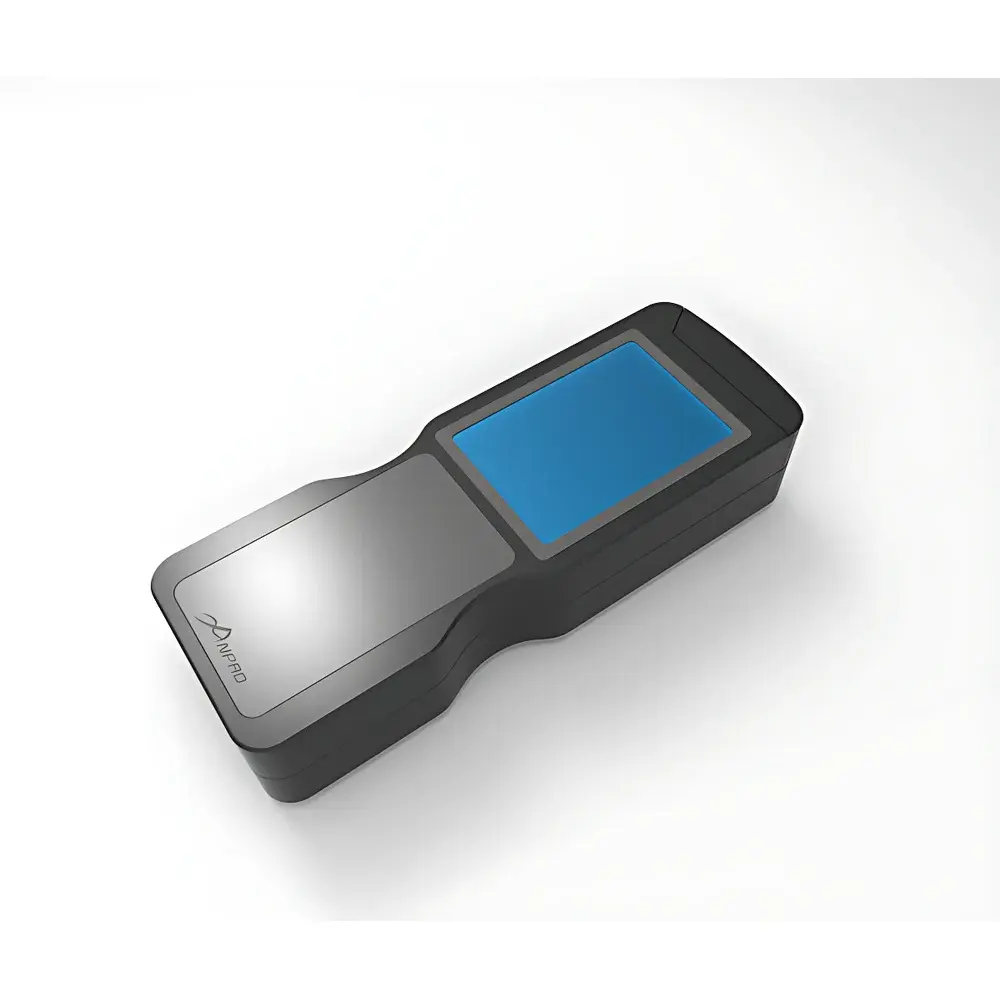
ANPRO APN-I ATP Bioluminescence Detector
| Brand | ANPRO |
|---|---|
| Origin | Sichuan, China |
| Manufacturer Type | Manufacturer |
| Regional Category | Domestic (China) |
| Model | APN-I |
| Price | USD 1,400 (approx.) |
Overview
The ANPRO APN-I ATP Bioluminescence Detector is a portable, field-deployable luminometer engineered for rapid, quantitative assessment of surface hygiene and microbial contamination in food production, pharmaceutical manufacturing, healthcare facilities, and environmental monitoring environments. It operates on the well-established firefly luciferase–luciferin bioluminescent reaction: in the presence of ATP, luciferase catalyzes oxidation of luciferin, emitting photons proportional to ATP concentration. The emitted light (peak ~560 nm) is captured by a high-sensitivity imported photomultiplier tube (PMT) or silicon photodiode sensor with optimized quantum efficiency in the visible range (400–650 nm). Results are reported in Relative Light Units (RLU), which correlate linearly with ATP molar concentration across the validated dynamic range. This principle enables trace-level detection down to 1 × 10⁻¹⁸ mol ATP per sample—sufficient to detect residual biological material from as few as 1–10 viable bacterial cells—making it suitable for routine verification of cleaning efficacy per ISO 22000, HACCP, and FDA Food Safety Modernization Act (FSMA) sanitation validation protocols.
Key Features
- Ultra-fast assay cycle: <15-second measurement time post-sample injection, with automatic zero calibration at power-on (full system readiness in ≤10 seconds)
- High-precision photodetection: Optimized optical path design and temperature-stabilized sensor electronics ensure repeatability ≤ ±5% RSD and accuracy error ≤ ±5% against NIST-traceable ATP standards
- Extended dynamic range: Factory-calibrated for 1–9999 RLU; optional firmware upgrade supports extended range up to 1–999999 RLU for high-biomass applications
- Robust data architecture: Internal non-volatile memory stores ≥20,000 test records with full metadata—including filename, unique ID, date/time stamp, sampling location code, operator ID, and pass/fail status based on user-defined RLU thresholds
- Field-ready ergonomics: Compact handheld form factor (185 × 82 × 45 mm), integrated rechargeable Li-ion battery providing ≥12 hours continuous operation and ≥360 hours standby life
- Multi-modal connectivity: USB 2.0 host/device interface, Bluetooth 5.0 (BLE), and IEEE 802.11 b/g/n Wi-Fi enable secure data export to LIMS, cloud platforms, or local PCs; compatible with thermal Bluetooth printers for on-site reporting
Sample Compatibility & Compliance
The APN-I accepts both integrated swab-luminometer cartridges and standard separated ATP swabs (e.g., 3M Clean-Trace, Hygiena SystemSURE Plus, or generic luminometer-compatible formats) without mechanical adaptation. Swab eluates are introduced via a precision metering port ensuring consistent 100 µL delivery volume. All firmware and data handling comply with ALCOA+ principles (Attributable, Legible, Contemporaneous, Original, Accurate, Complete, Consistent, Enduring, Available) for regulated environments. Audit trail functionality meets GLP and GMP documentation requirements; optional 21 CFR Part 11-compliant software module available for electronic signatures and role-based access control. Device performance adheres to ISO 22000:2018 Annex A.9 (Verification of cleaning procedures) and supports validation against ISO 17025-accredited reference methods.
Software & Data Management
The embedded operating system runs a deterministic real-time kernel, enabling fully automated assay execution—from reagent mixing simulation to photon integration and RLU conversion—without manual intervention. The companion PC software (Windows/macOS/Linux) provides configurable report templates (PDF/CSV/XLSX), statistical process control (SPC) charts, trend analysis across sampling points, and batch-level compliance summaries. User management supports unlimited operator profiles with password protection and permission tiers (e.g., technician, supervisor, QA auditor). All data transfers employ TLS 1.2 encryption; local database uses SQLite with WAL journaling for crash-resilient storage.
Applications
- Food processing: Post-clean verification of conveyor belts, fill nozzles, slicers, and packaging surfaces
- Hospitality & healthcare: Monitoring high-touch surfaces (bed rails, IV poles, OR tables) per CDC/EPA disinfection guidelines
- Pharmaceutical cleanrooms: Routine environmental monitoring of Grade A–D zones per EU GMP Annex 1
- Water treatment: Biofilm assessment in distribution systems and membrane filtration units
- Research laboratories: Rapid screening of antimicrobial surface coatings and sanitizer efficacy studies
FAQ
What ATP concentration does 1 RLU correspond to?
The RLU-to-ATP conversion is instrument- and reagent-specific. Calibration is performed using certified ATP standards; typical sensitivity yields ~1 RLU ≈ 1 × 10⁻²¹ mol ATP under standardized swab recovery conditions.
Can the APN-I be used for total ATP (intracellular + extracellular) quantification?
Yes—the assay detects all ATP present in the swab eluate, including both microbial and non-microbial (e.g., food residue, epithelial cells) sources. For selective microbial ATP estimation, use of ATP-free extraction buffers and background subtraction protocols is recommended.
Is firmware update supported remotely?
Yes—updates can be delivered via USB drive or over-the-air (OTA) through Wi-Fi, with SHA-256 signature verification to ensure integrity and authenticity.
Does the device support custom RLU pass/fail thresholds per sampling point?
Yes—up to 2000 predefined sampling locations can be assigned individual threshold values, with auto-flagging and color-coded visual feedback on the LCD display.
What is the recommended calibration frequency?
Daily verification with ATP standard is advised before first use; full recalibration using manufacturer-provided kit is required every 6 months or after 5000 measurements, whichever occurs first.
Related Products






