
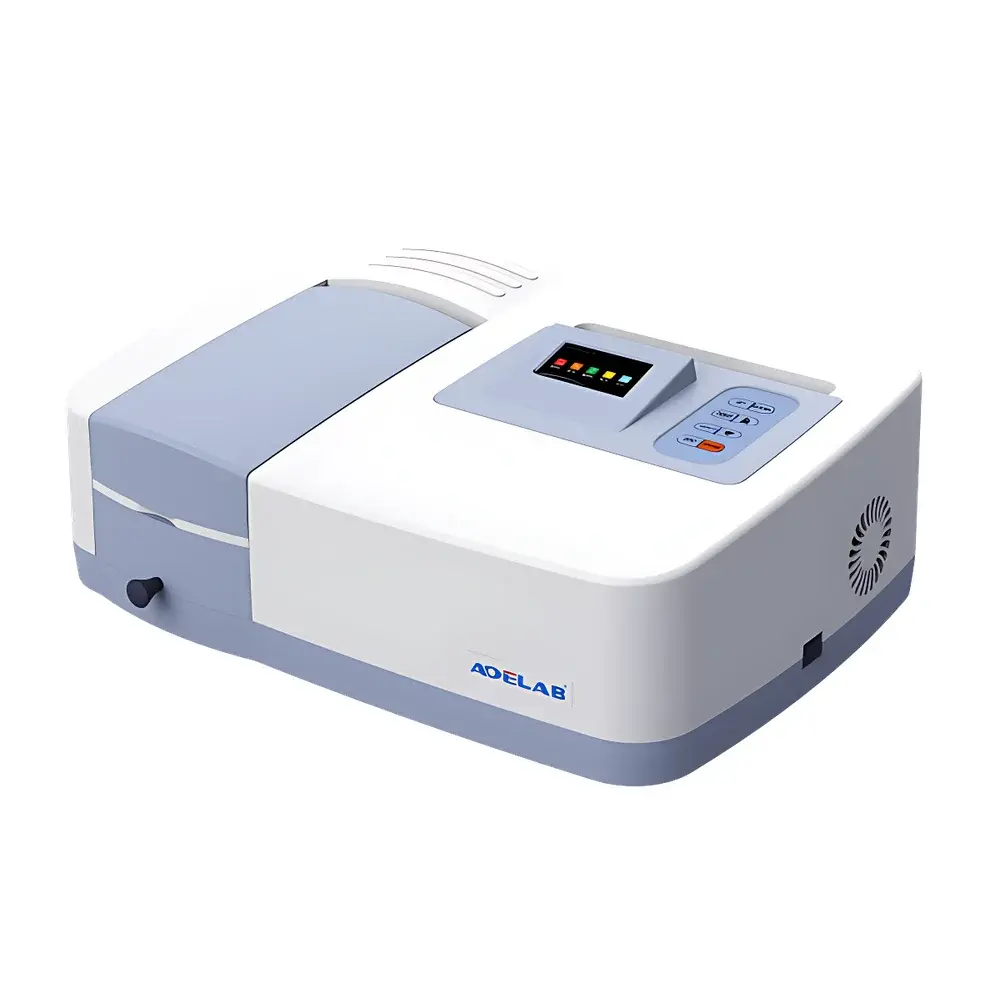
AOE T1v Smart UV-Vis Spectrophotometer
| Brand | AOE |
|---|---|
| Origin | Shanghai, China |
| Manufacturer Type | Authorized Distributor |
| Product Origin | Domestic (China) |
| Model | T1v |
| Optical System | Single-beam |
| Detector Type | Silicon Photocell |
| Wavelength Range | 325–1020 nm |
| Wavelength Scanning Mode | Motorized Automatic Wavelength Selection |
| Spectral Bandwidth | 4.0 nm |
| Wavelength Accuracy | ±1.5 nm |
| Wavelength Repeatability | ≤0.2 nm |
| Stray Light | ≤0.1%T at 360 nm |
| Noise Level | ±0.001 Abs |
| Display | 7-inch 480×272 TFT True-color Touchscreen |
| Data Output | USB flash drive export |
| Software Features | Audit Trail, GMP/GLP-compliant data logging |
| Supported Cuvette Pathlengths | 1–5 cm |
| Compliance | Meets pharmacopoeial requirements (ChP, USP <857>, EP 2.2.25) |
Overview
The AOE T1v Smart UV-Vis Spectrophotometer is a single-beam, microprocessor-controlled analytical instrument engineered for routine quantitative and qualitative analysis in pharmaceutical QC labs, academic research facilities, and industrial quality control environments. It operates on the principle of Beer–Lambert law-based absorbance measurement, utilizing a high-efficiency holographic grating (1200 lines/mm) to disperse polychromatic light across a defined spectral range. The optical path is fully sealed to prevent dust ingress and maintain long-term photometric stability—critical for reproducible measurements under variable laboratory conditions. Designed with mechanical robustness in mind, its reinforced sheet-metal chassis minimizes optical misalignment during transport or daily handling, ensuring consistent alignment between source, monochromator, sample compartment, and detector over extended service life.
Key Features
- Single-beam optical architecture with motorized automatic wavelength scanning—enabling rapid, repeatable spectral acquisition without manual adjustment.
- High-stability silicon photocell detector offering low-noise performance (±0.001 Abs baseline noise) and linear response across the full 325–1020 nm range.
- 7-inch 480×272 TFT true-color touchscreen interface with intuitive icon-driven navigation—supporting direct method setup, real-time spectrum display, and on-device data review.
- Full-sealed optical compartment—eliminating contamination risk from ambient particulates and humidity, thereby preserving grating efficiency and detector sensitivity.
- Universal cuvette holder accommodating standard pathlengths from 1 cm to 5 cm—facilitating both high-sensitivity trace analysis and low-absorbance dilute sample measurement.
- Integrated USB port for direct data export to flash drives—bypassing PC dependency for field use or regulated environments where network connectivity is restricted.
- Onboard firmware and PC software supported by lifetime free updates—ensuring continued compatibility with evolving regulatory expectations and computational standards.
Sample Compatibility & Compliance
The T1v accommodates standard rectangular quartz, glass, or plastic cuvettes (10 × 10 mm cross-section) with pathlengths of 10 mm (1 cm), 20 mm (2 cm), 30 mm (3 cm), 40 mm (4 cm), and 50 mm (5 cm). Its optical design maintains photometric linearity across this full range without recalibration. The instrument meets essential pharmacopoeial requirements outlined in Chinese Pharmacopoeia (ChP) General Chapter 0401, United States Pharmacopeia (USP) Spectrophotometry, and European Pharmacopoeia (EP) 2.2.25. Audit trail functionality—fully compliant with ALCOA+ principles—is embedded in both standalone firmware logs and PC-based software, supporting 21 CFR Part 11 readiness when deployed with validated system configurations.
Software & Data Management
The optional PC software provides comprehensive data acquisition, processing, and reporting capabilities—including kinetic scan, multi-wavelength quantitation, spectral overlay, and calibration curve generation (linear, quadratic, or cubic fit). All user actions—including method creation, parameter modification, measurement execution, and data export—are time-stamped and attributed to individual operator accounts. Audit trail records are immutable, encrypted, and exportable in PDF or CSV formats for internal review or regulatory submission. Data integrity is further reinforced through password-protected access levels, electronic signature prompts for critical operations, and automatic backup to designated network locations.
Applications
The T1v serves as a core tool in multiple regulated and non-regulated workflows: concentration determination of active pharmaceutical ingredients (APIs) and excipients; purity assessment via spectral peak shape analysis; dissolution testing per USP Apparatus II; enzyme kinetics monitoring at defined wavelengths; water quality analysis (e.g., nitrate, phosphate, COD); and educational spectroscopy instruction. Its 4.0 nm spectral bandwidth delivers sufficient resolution for most routine assays while maintaining high photon throughput—ideal for applications requiring speed and statistical reliability over ultra-high resolution.
FAQ
Does the T1v support GLP/GMP-compliant operation?
Yes—when used with validated software and documented procedures, its audit trail, user access controls, and electronic signature support align with GLP (OECD Principles) and GMP (ICH Q7, FDA guidance) expectations.
Is the instrument suitable for use with organic solvents?
Cuvette compatibility depends on material selection—quartz cuvettes are recommended for UV-range measurements involving common organic solvents such as acetonitrile, methanol, or chloroform.
Can the T1v perform time-based kinetic scans?
Yes—the PC software supports time-resolved absorbance monitoring at one or multiple user-defined wavelengths, with configurable interval and duration parameters.
What maintenance is required for long-term accuracy?
Routine verification using NIST-traceable neutral density filters and holmium oxide reference standards is recommended quarterly; optical alignment checks are unnecessary due to the sealed, rigid chassis design.
Is remote instrument control possible?
Remote operation is not natively supported; however, the USB data export and standardized ASCII output format enable integration into custom LIMS or lab automation frameworks via post-acquisition parsing.
Related Products





