
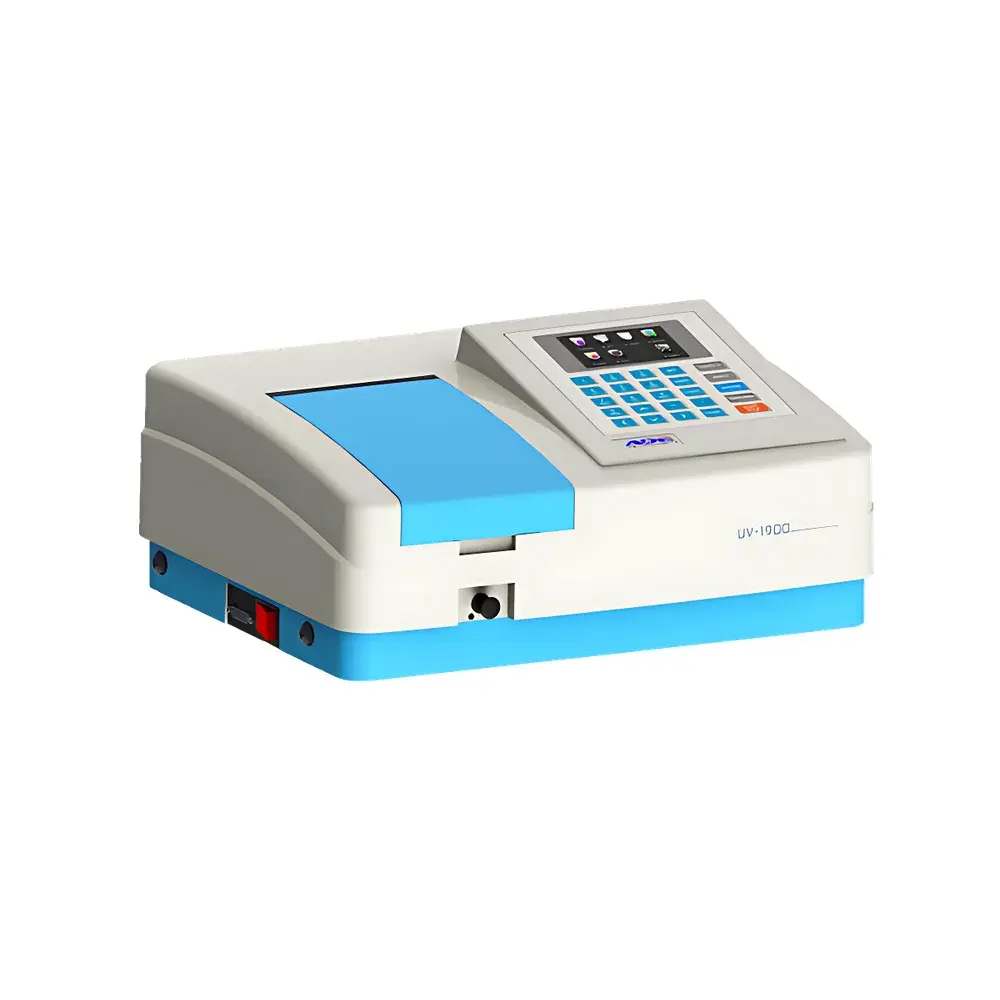
AOE UV-1900PC Scanning Ultraviolet-Visible Spectrophotometer
| Brand | AOE |
|---|---|
| Origin | Shanghai, China |
| Manufacturer Type | Authorized Distributor |
| Product Origin | Domestic (China) |
| Model | UV-1900PC |
| Price Range | USD 2,800–4,200 (FOB Shanghai) |
| Optical Design | Single-Beam with Dual-Beam Ratio Monitoring |
| Detector Type | Silicon Photocell |
| Wavelength Range | 190–1100 nm |
| Wavelength Scanning Mode | Motorized Auto-Scan |
| Spectral Bandwidth | 1.8 nm |
| Wavelength Accuracy | ±0.3 nm |
| Wavelength Repeatability | ≤0.2 nm |
| Stray Light | ≤0.04% T at 360 nm |
| Display | 480 × 272 pixel, 65K-color TFT LCD |
| Data Storage | Onboard memory for 240 calibration curves (240 data points per curve) |
| Data Export | USB 2.0 port for direct U-disk export |
| Printing Interface | PCL-compatible USB printer support (A4 format) |
| Firmware Upgrade | USB-based one-click update via AOE official website (instrument serial number required) |
| Certifications | ISO 9001:2015, CE (EN 61010-1, EN 61326-1), CMC (China Metrology Certification), RoHS Directive 2011/65/EU |
| Software Compliance | Basic Control Software registered with the National Copyright Administration of the People’s Republic of China (Certificate No. 2021SRXXXXXX) |
Overview
The AOE UV-1900PC Scanning Ultraviolet-Visible Spectrophotometer is a precision single-beam optical instrument engineered for quantitative and qualitative analysis across the ultraviolet, visible, and near-infrared spectral regions (190–1100 nm). It employs a high-efficiency holographic grating (1200 lines/mm) coupled with dual-beam ratio monitoring—a design that compensates for source intensity drift and detector sensitivity variation without requiring a physical reference beam path. This architecture delivers enhanced baseline stability and measurement reproducibility over extended acquisition periods. The instrument operates on Beer–Lambert law principles, enabling accurate determination of analyte concentration, molar absorptivity, and spectral profiles in solution-phase samples. Its motorized wavelength drive enables programmable scanning, peak detection, and kinetic time-course measurements—making it suitable for routine QC labs, academic teaching laboratories, and R&D environments where regulatory traceability and operational simplicity are essential.
Key Features
- High-resolution 480 × 272 pixel, 65K-color TFT LCD display with intuitive icon-driven interface—enabling real-time spectral visualization and parameter navigation without external PC dependency.
- Onboard data management: Stores up to 240 user-defined calibration curves, each accommodating 240 absorbance/transmittance data points—ideal for multi-analyte or multi-concentration workflows.
- Dual USB 2.0 ports: One dedicated to U-disk data export (CSV/TXT format), the other supporting PCL-compliant USB printers for immediate A4-format hardcopy reporting—fully compliant with GLP documentation requirements.
- Firmware upgradability via secure, serial-number-verified download from AOE’s official support portal—ensuring long-term compatibility with evolving analytical standards and cybersecurity protocols.
- Comprehensive regulatory conformance: Certified to ISO 9001:2015 (quality management), CE (safety & EMC per EN 61010-1 and EN 61326-1), CMC (national metrological verification in China), and RoHS (hazardous substance restriction)—validated through third-party accredited testing laboratories.
- Legally protected control software: “Basic” acquisition and analysis software holds a valid Computer Software Copyright Registration Certificate issued by the National Copyright Administration of China—guaranteeing authenticity, preventing unauthorized replication, and supporting audit-ready software licensing compliance.
Sample Compatibility & Compliance
The UV-1900PC accepts standard 10-mm rectangular quartz or glass cuvettes (pathlength: 10 mm) and supports optional accessories including variable-pathlength cells, micro-volume adapters, and temperature-controlled holders (Peltier-based, not included). It complies with internationally recognized test methodologies including ASTM E275 (standard practices for UV-Vis spectrophotometry), ISO 6425 (spectrophotometric performance verification), and USP (UV-Vis spectrophotometers in pharmaceutical analysis). While not inherently 21 CFR Part 11 compliant out-of-the-box, its firmware architecture supports audit-trail-enabled software extensions when deployed with validated PC-based LIMS integration—facilitating GMP-aligned deployment in regulated manufacturing settings.
Software & Data Management
The embedded “Basic” software provides core acquisition modes: Absorbance (A), Transmittance (%T), Concentration (C), and Energy (E). All measurements support wavelength scanning, fixed-wavelength kinetics, and multi-point quantitation. Raw spectral data and calibration parameters are stored in non-volatile memory and exportable in ASCII-compatible formats for downstream processing in MATLAB, Origin, or Excel. For advanced analysis—including spectral deconvolution, derivative spectroscopy, or method validation—the instrument interfaces seamlessly with AOE’s optional PC-based “SpectraLab Pro” suite (sold separately), which includes electronic signature capability, user role management, and full 21 CFR Part 11 audit trail functionality upon system qualification.
Applications
- Pharmaceutical QC: Assay of active pharmaceutical ingredients (APIs), excipient purity screening, and dissolution profile monitoring per USP monographs.
- Environmental testing: Quantification of nitrate, phosphate, heavy metals (via complexometric assays), and organic pollutants (e.g., phenols, PAHs) in water matrices.
- Food & beverage analysis: Measurement of colorants (E-numbers), antioxidant capacity (FRAP/DPPH), and protein/nucleic acid concentration using standard extinction coefficients.
- Academic instruction: Teaching fundamental spectroscopic concepts—including electronic transitions, conjugation effects, and solvent polarity impacts—across undergraduate chemistry and biochemistry curricula.
- Materials science: Characterization of semiconductor nanomaterials, dye-sensitized solar cell components, and polymer film transparency/absorption edge determination.
FAQ
Is the UV-1900PC compatible with Windows 11 and macOS?
Yes—when connected via USB to a host computer, the instrument is recognized as a CDC-class HID device; no proprietary drivers are required for basic data streaming. Full software functionality requires Windows 10/11 (64-bit) for SpectraLab Pro.
What is the typical warm-up time before photometric measurements achieve specified accuracy?
The tungsten-halogen and deuterium lamp system stabilizes within 20 minutes under ambient conditions (20–25°C, <60% RH); automatic zeroing and baseline correction are recommended prior to each measurement session.
Can the instrument perform spectral scanning at variable scan speeds?
No—the UV-1900PC executes scanning at a fixed rate of 300 nm/min, optimized for signal-to-noise ratio and mechanical longevity. Kinetic and time-scan modes operate at user-selectable intervals (0.1–999.9 s), not continuous scanning.
Does the photometric accuracy meet NIST-traceable calibration requirements?
Yes—factory calibration uses NIST-traceable holmium oxide and didymium filters; users may perform periodic verification using certified reference materials (e.g., SRM 930e) in accordance with ISO/IEC 17025 internal calibration procedures.
Is service and technical support available outside mainland China?
AOE maintains authorized service partners in Southeast Asia, the Middle East, and Latin America; spare parts and firmware updates are distributed globally through its ISO 9001-certified logistics network. Remote diagnostics and application support are provided in English, Spanish, and Arabic.
Related Products






