
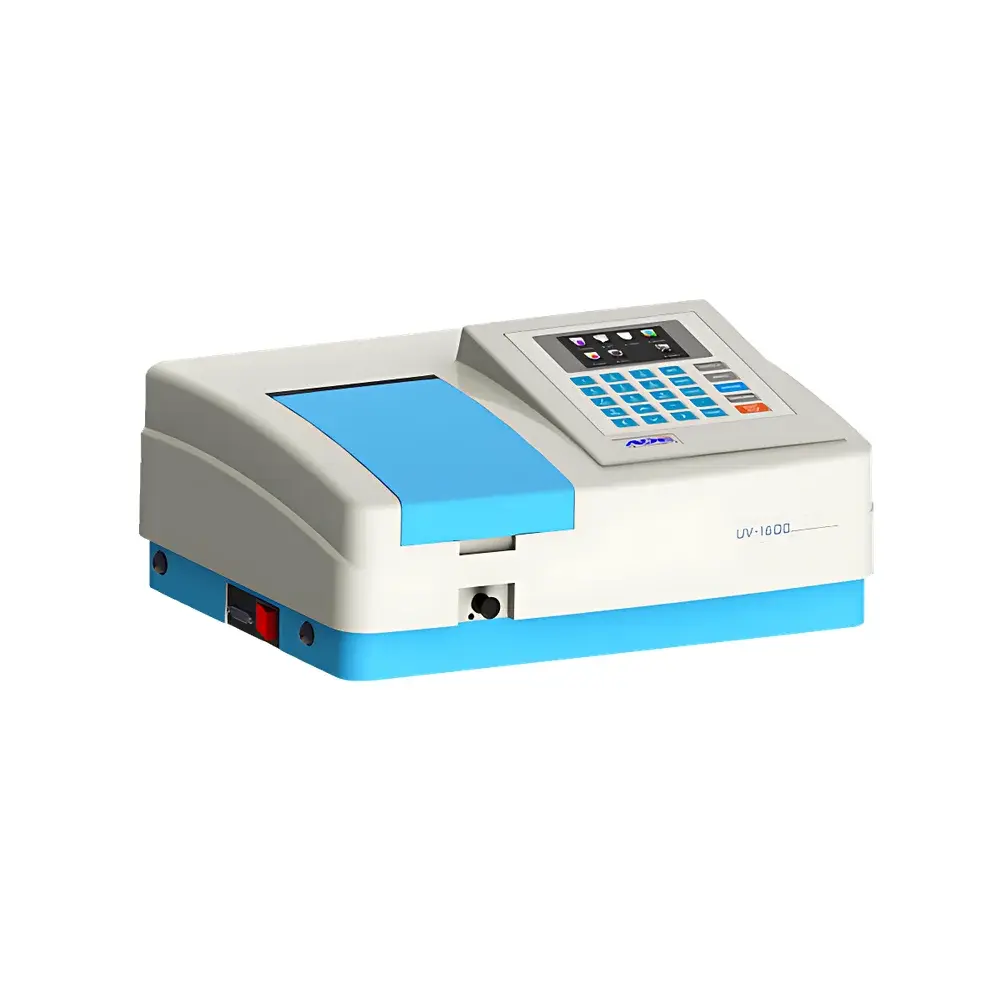
AOE UV-1600 Ultraviolet-Visible Spectrophotometer
| Brand | AOE |
|---|---|
| Origin | Shanghai, China |
| Manufacturer Type | Authorized Distributor |
| Product Origin | Domestic (China) |
| Model | UV-1600 |
| Optical System | Pseudo-Double-Beam |
| Detector Type | Silicon Photocell |
| Wavelength Range | 190–1100 nm |
| Wavelength Scanning | Motorized Auto-Scanning |
| Spectral Bandwidth | 4 nm |
| Wavelength Accuracy | ±0.4 nm |
| Stray Light | ≤0.04% T at 360 nm |
Overview
The AOE UV-1600 Ultraviolet-Visible Spectrophotometer is a precision optical instrument engineered for quantitative and qualitative analysis across the ultraviolet and visible spectral regions (190–1100 nm). Based on a pseudo-double-beam optical architecture with a high-efficiency holographic grating (1200 lines/mm), it compensates for source intensity drift and detector sensitivity fluctuations by continuously monitoring reference and sample beam ratios—enhancing measurement stability without requiring mechanical beam switching. This design delivers high photometric reproducibility and long-term baseline integrity, making it suitable for routine QC testing in pharmaceutical, environmental, food & beverage, and academic laboratories where regulatory compliance and data traceability are essential.
Key Features
- Pseudo-double-beam optical path with real-time reference beam monitoring for improved photometric accuracy and reduced baseline drift.
- High-resolution 480 × 272 pixel TFT color LCD display (65K colors) enabling intuitive menu navigation, real-time spectrum visualization, and on-device data review.
- Onboard data storage capacity for up to 240 calibration curves, each supporting 240 absorbance/transmittance measurements—eliminating dependency on external PCs during field or teaching lab use.
- Dual USB 2.0 ports: one dedicated to U-disk data export (CSV format), the other for direct connection to PCL-compatible printers supporting A4-size reports—ensuring full audit trail generation per GLP requirements.
- Firmware upgrade capability via encrypted USB flash drive using instrument-specific serial-number-validated packages downloaded from the official AOE support portal—ensuring version control and cybersecurity compliance.
- Certified to ISO 9001:2015 (Quality Management Systems), CE (EU Machinery Directive 2006/42/EC and EMC Directive 2014/30/EU), CMC (China Metrology Certification), and RoHS 2011/65/EU—validating metrological reliability and environmental safety.
Sample Compatibility & Compliance
The UV-1600 accommodates standard 10 mm square quartz or glass cuvettes (pathlength: 10 mm), compatible with aqueous, organic, and mildly corrosive solvents. It supports common sample formats including liquid solutions, diluted suspensions, and transparent thin films. All photometric measurements adhere to fundamental spectrophotometric principles defined in ISO 6059 (water quality analysis), ASTM E275 (description of ultraviolet and visible absorption spectra), and USP (Spectrophotometry and Light-Scattering). The instrument’s wavelength accuracy (±0.4 nm) and stray light performance (≤0.04% T at 360 nm) meet minimum specifications required for Class B spectrophotometers under ISO/IEC 17025-accredited testing environments.
Software & Data Management
The embedded Basic Spectroscopy Software (registered under China Copyright Protection Center, Certificate No. 2021SRXXXXXX) provides four operational modes: Absorbance (A), Transmittance (%T), Concentration (C), and Energy (E). All measurements include timestamped metadata (date, time, operator ID if configured, wavelength, slit width, and integration time). Exported CSV files contain full spectral scan data points (wavelength vs. absorbance), enabling post-acquisition processing in third-party tools such as OriginLab or MATLAB. Audit trails—including method changes, calibration events, and firmware updates—are automatically logged and stored onboard, satisfying FDA 21 CFR Part 11 requirements for electronic records when deployed in regulated GMP/QbD workflows.
Applications
- Pharmaceutical QA/QC: Active pharmaceutical ingredient (API) assay, excipient compatibility screening, dissolution profile analysis per USP .
- Environmental monitoring: Nitrate, phosphate, and COD quantification in surface water per EPA Method 353.2 and ISO 15681-1.
- Food & beverage: Color index determination (e.g., AOAC 993.02 for honey), caffeine content in soft drinks, and antioxidant capacity assays (e.g., DPPH radical scavenging).
- Academic research: Enzyme kinetics (e.g., NADH/NADPH oxidation at 340 nm), protein quantification (Bradford/Lowry at 595/750 nm), and nanoparticle size estimation via surface plasmon resonance (SPR) band analysis.
- Chemical education: Teaching Beer-Lambert law validation, spectral deconvolution, and multi-component analysis using linear regression algorithms.
FAQ
What optical configuration does the UV-1600 employ, and how does it differ from true double-beam systems?
It uses a pseudo-double-beam design with a single detector and time-shared reference/sample beam routing via a rotating mirror—offering cost-effective stability without the complexity of dual-detector alignment.
Is the instrument compliant with FDA 21 CFR Part 11 for electronic signatures and records?
While the hardware supports secure audit trails and electronic record export, full Part 11 compliance requires implementation of organizational SOPs, user access controls, and electronic signature validation—features supported through optional networked software modules.
Can the UV-1600 perform kinetic or time-scan measurements?
No—this model supports only fixed-wavelength, multi-point, and full-spectrum scanning modes; kinetic functionality requires the higher-tier UV-1800 series with programmable time-based acquisition.
What is the maximum sampling rate during full-spectrum scanning?
At 4 nm bandwidth and 1 nm step interval across 190–1100 nm, typical scan time is approximately 12 seconds—optimized for balance between signal-to-noise ratio and throughput.
Does the system support external PC control via RS232 or Ethernet?
No—communication is limited to USB 2.0 host/device interfaces; remote operation requires third-party USB-to-serial adapters with custom driver integration.
Related Products






