
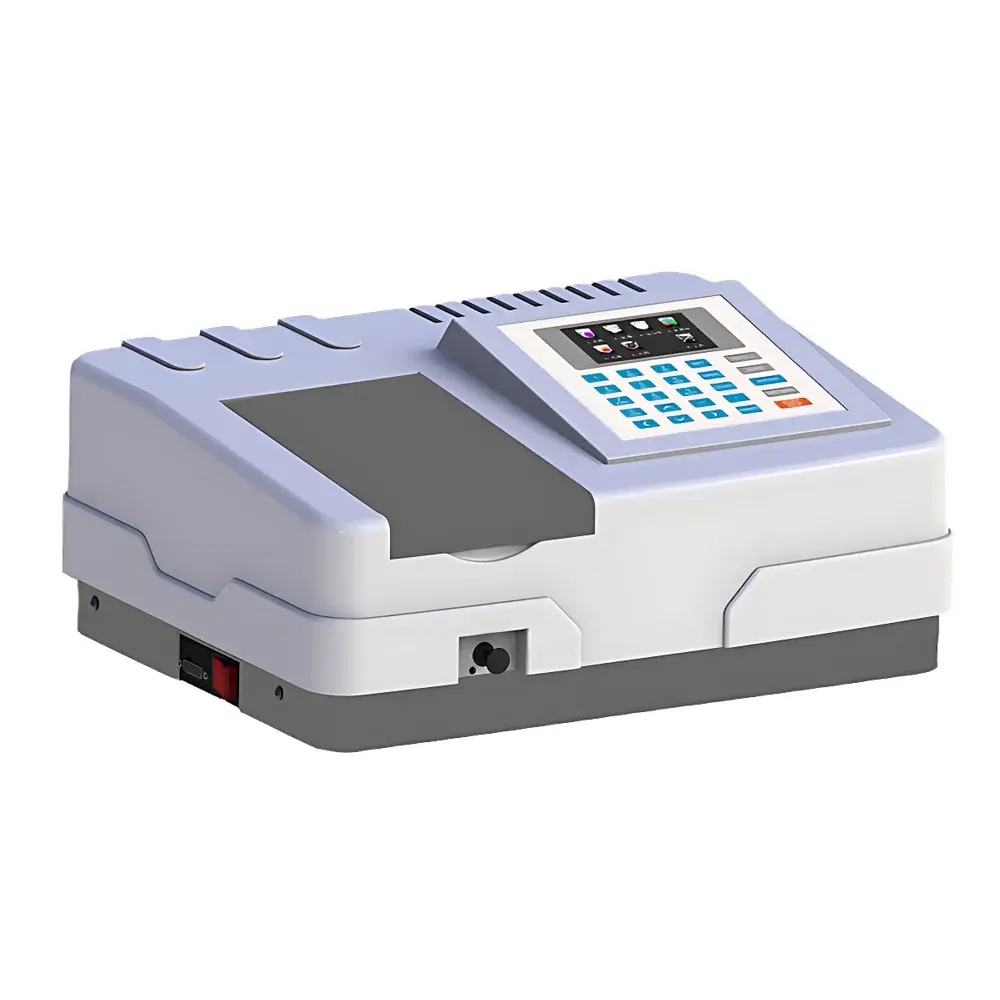
AOE A560 Dual-Beam Ultraviolet-Visible Spectrophotometer
| Brand | AOE |
|---|---|
| Origin | Shanghai, China |
| Model | A560 |
| Optical System | Dual-beam ratio-monitoring |
| Detector Type | Silicon photodiode |
| Wavelength Range | 190–1100 nm |
| Wavelength Accuracy | ±0.3 nm |
| Spectral Bandwidth | 1.8 nm |
| Stray Light | ≤0.02% T at 360 nm |
| Wavelength Scanning | Automatic |
| Display | 800 × 480 pixel, 65K-color TFT LCD |
| Data Storage | 240 curves (240 data points each) onboard |
| Interface | Dual USB 2.0 ports (data export & printer), USB 1.0 for PC connectivity |
| Software | AOE Basic Spectroscopy Software (certified under PRC Copyright Registration No. 2021SRXXXXXX) |
| Compliance | ISO 9001, CE, CMC, RoHS |
Overview
The AOE A560 Dual-Beam Ultraviolet-Visible Spectrophotometer is an entry-level analytical instrument engineered for routine quantitative and qualitative analysis in academic laboratories, quality control environments, and industrial R&D settings. It operates on the principle of dual-beam ratio-monitoring absorption spectroscopy: a high-efficiency holographic grating (1200 lines/mm) disperses polychromatic light, which is then split into sample and reference beams using a rotating mirror assembly. Real-time comparison of transmitted intensities enables compensation for source drift, lamp aging, and electronic fluctuations—delivering enhanced photometric stability and measurement reproducibility over extended acquisition periods.
Designed for compliance with fundamental regulatory expectations in chemical testing, the A560 supports absorbance (A), transmittance (%T), concentration (C), and energy (E) measurement modes across a broad spectral range (190–1100 nm). Its 1.8 nm spectral bandwidth ensures adequate resolution for standard organic and inorganic assays—including nucleic acid quantification, enzyme kinetics, dye concentration calibration, and pharmaceutical dissolution profiling—while maintaining sufficient throughput for high-volume sample screening.
Key Features
- Dual-beam optical architecture with real-time reference beam correction for improved baseline stability and long-term photometric repeatability
- High-efficiency 1200-line/mm holographic grating optimized for UV–Vis throughput and stray light suppression
- Integrated 800 × 480 pixel, 65K-color TFT LCD display enabling full-spectrum visualization, curve overlay, and interactive peak analysis without external PC dependency
- Onboard memory storing up to 240 calibration curves, each supporting 240 discrete data points—ideal for multi-standard batch validation
- Dual USB 2.0 interfaces: one dedicated to U-disk data export (CSV/ASCII format), the other compatible with PCL-class printers for direct A4 report generation
- Firmware-upgradable architecture: verified firmware updates downloadable from AOE’s official support portal via instrument serial number; applied via USB flash drive with zero configuration required
- Pre-installed AOE Basic Spectroscopy Software, certified under the People’s Republic of China National Copyright Administration (Registration No. 2021SRXXXXXX), ensuring legal compliance and traceable software lineage
Sample Compatibility & Compliance
The A560 accommodates standard 10 mm pathlength quartz, glass, or plastic cuvettes (including matched pairs for rigorous ratio monitoring), as well as optional microvolume adapters and flow cells for specialized applications. It meets essential international conformance requirements including ISO 9001:2015 (quality management systems), CE marking per Directive 2014/30/EU (EMC) and 2014/35/EU (LVD), China Metrology Certification (CMC), and RoHS 2011/65/EU for hazardous substance restriction. While not validated for 21 CFR Part 11 compliance out-of-the-box, its audit-ready data logging—timestamped, user-ID-tagged, and exportable in unalterable CSV format—provides foundational traceability aligned with GLP and basic GMP documentation practices.
Software & Data Management
The embedded AOE Basic Spectroscopy Software provides intuitive control of scan parameters (scan speed, point interval, averaging), automatic peak detection, wavelength calibration verification, and linear/nonlinear regression for Beer–Lambert law-based quantitation. All spectra and results are stored locally with metadata (date/time, operator ID if configured, instrument serial number). Exported datasets include raw intensity values, processed absorbance/transmittance, and calibration coefficients—structured for seamless import into LIMS platforms, Excel, or third-party chemometrics tools. The system logs firmware version, calibration history, and error events for internal QA review and technical support diagnostics.
Applications
- Quantitative analysis of nucleic acids (A260/A280 ratios) and proteins (Bradford/Lowry assays)
- Pharmaceutical QC: assay of active pharmaceutical ingredients (APIs) per USP <731> and EP 2.2.25 guidelines
- Environmental monitoring: nitrate, phosphate, and heavy metal ion determination in water samples
- Food & beverage: colorimetric assessment of additives, antioxidants, and pigment stability
- Academic teaching labs: demonstration of Beer–Lambert law, spectral deconvolution, and kinetic reaction monitoring
- Industrial process support: dye concentration tracking in textile effluent and polymer additive screening
FAQ
Is the A560 compliant with FDA 21 CFR Part 11 for electronic records?
The A560 does not include built-in electronic signature, role-based access control, or audit trail encryption required for full Part 11 compliance. However, its timestamped, immutable CSV exports serve as auditable raw data archives when integrated into validated laboratory information management systems (LIMS).
Can the instrument perform kinetic measurements?
Yes—the A560 supports time-scan mode with user-defined intervals (1–999 seconds), enabling monitoring of enzymatic reactions, oxidation processes, or photochemical degradation over time.
What cuvette materials are supported across the full 190–1100 nm range?
Quartz cuvettes are mandatory for measurements below 340 nm; fused silica or UV-grade quartz is recommended for extended UV performance. Standard optical glass is suitable above ~350 nm; polystyrene or PMMA may be used for visible-range screening only.
Does the software support multi-point calibration with polynomial fitting?
AOE Basic supports linear and quadratic (2nd-order) calibration curves with correlation coefficient (R²) reporting and residual analysis—sufficient for most routine concentration determinations per ISO/IEC 17025 Clause 7.7.
How often should wavelength calibration be performed?
Wavelength accuracy (±0.3 nm) is factory-verified using holmium oxide and didymium filters. Users are advised to verify calibration quarterly using NIST-traceable standards or before critical validation runs, following ASTM E275 and ISO 6323 protocols.





