
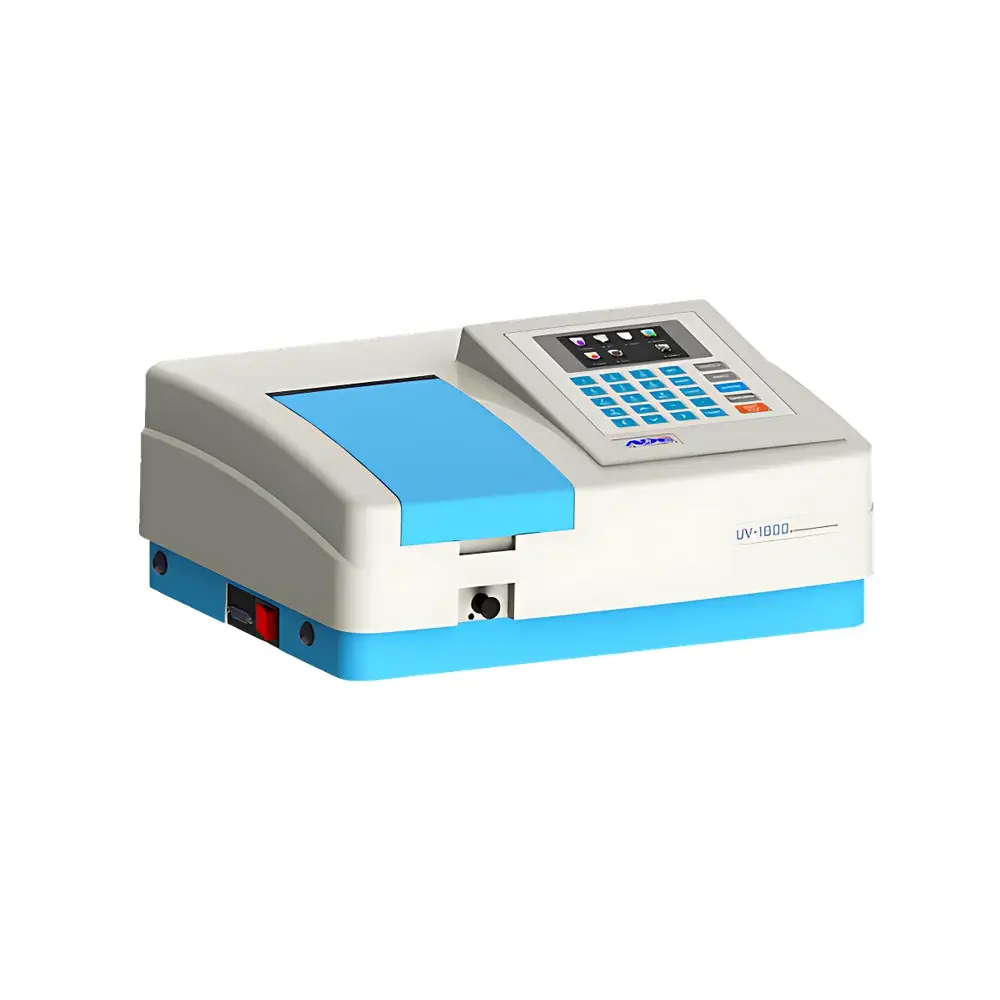
AOE UV-1800PC Ultraviolet-Visible Spectrophotometer
| Brand | AOE |
|---|---|
| Origin | Shanghai, China |
| Manufacturer Type | Authorized Distributor |
| Product Origin | Domestic (China) |
| Model | UV-1800PC |
| Price Range | USD 2,800–4,200 (FOB Shanghai) |
| Optical Design | Pseudo-Double-Beam |
| Detector Type | Silicon Photocell |
| Wavelength Range | 190–1100 nm |
| Wavelength Scanning | Motorized Automatic |
| Spectral Bandwidth | 1.8 nm |
| Wavelength Accuracy | ±0.4 nm |
| Stray Light | ≤0.04% T at 360 nm |
Overview
The AOE UV-1800PC Ultraviolet-Visible Spectrophotometer is a precision optical instrument engineered for quantitative and qualitative analysis across research laboratories, quality control departments, and educational institutions. Based on the fundamental principle of Beer–Lambert law absorption spectroscopy, it measures the intensity of light transmitted through or reflected from a sample as a function of wavelength in the ultraviolet (190–400 nm), visible (400–700 nm), and near-infrared (700–1100 nm) spectral regions. Its pseudo-double-beam architecture—comprising a high-efficiency 1200-line/mm holographic grating and real-time reference beam monitoring—minimizes photometric drift and enhances baseline stability during extended measurements. Designed for routine compliance with ISO/IEC 17025 requirements, the UV-1800PC delivers reproducible absorbance, transmittance, concentration, and energy (E) mode outputs under controlled environmental conditions (20–25 °C, <70% RH).
Key Features
- High-resolution 480 × 272 pixel TFT color display (65,536 colors) enabling intuitive navigation, real-time spectral visualization, and on-screen calibration verification.
- Onboard data storage supporting up to 240 user-defined calibration curves, each accommodating 240 individual measurement points—eliminating dependency on external PCs for basic operation.
- Dual USB 2.0 ports: one dedicated to U-disk data export (CSV format), the other for direct connection to PCL-compatible printers for A4-size report generation—including spectral plots, numerical tables, and metadata (date/time, operator ID, method name).
- Firmware upgrade capability via USB flash drive using official AOE-signed packages; version control enforced by instrument serial number validation against AOE’s secure download portal.
- Compliance-certified optical train featuring thermally stabilized grating mount and low-noise analog-to-digital conversion (16-bit ADC), ensuring long-term photometric repeatability (wavelength repeatability ≤0.2 nm).
Sample Compatibility & Compliance
The UV-1800PC accommodates standard 10-mm rectangular quartz or glass cuvettes (pathlength 10 mm, volume 3.5 mL), as well as optional accessories including micro-volume holders (down to 50 µL), fiber-optic probes, and solid-sample reflectance attachments. It supports liquid, solution-phase, and thin-film samples compliant with ASTM E275, ISO 6223, and USP spectrophotometric validation protocols. All firmware and embedded Basic software are certified per ISO 9001:2015 (QMS), CE Directive 2014/30/EU (EMC), RoHS 2011/65/EU (hazardous substances), and CMC (China Metrology Certification). The proprietary Basic software holds a valid Computer Software Copyright Registration Certificate issued by the National Copyright Administration of China (Registration No.: 2021SRXXXXXX), guaranteeing legal traceability and protection against unauthorized replication.
Software & Data Management
The embedded Basic software provides full operational autonomy without PC dependency, supporting four primary measurement modes: Absorbance (A), Transmittance (%T), Concentration (C), and Energy (E). Data files include embedded metadata—timestamp, operator code, wavelength range, slit width, and calibration status—for audit-ready documentation. Exported CSV files are compatible with LIMS integration, Microsoft Excel, and statistical analysis platforms (e.g., JMP, OriginLab). While the instrument does not natively support FDA 21 CFR Part 11 electronic signatures, its audit trail functionality—including immutable event logs of calibration, method changes, and firmware updates—aligns with GLP/GMP documentation expectations when deployed within validated laboratory workflows.
Applications
- Pharmaceutical QC: Assay of active pharmaceutical ingredients (APIs) per USP monographs; excipient compatibility screening; dissolution profile analysis.
- Environmental testing: Quantification of nitrate, phosphate, COD, and heavy metal complexes (e.g., Cr(VI) via diphenylcarbazide method) in water matrices.
- Food & beverage: Color index determination (e.g., AOAC 993.02 for honey), preservative (sorbate/benzoate) quantitation, and antioxidant capacity (FRAP assay).
- Academic research: Kinetic studies of enzyme-catalyzed reactions (e.g., NADH oxidation at 340 nm); polymer degradation monitoring; nanoparticle size estimation via surface plasmon resonance.
- Chemical synthesis: Reaction progress tracking, purity assessment, and molar absorptivity (ε) determination for new compounds.
FAQ
What is the minimum detectable absorbance for the UV-1800PC?
The instrument achieves a photometric noise level of ≤0.001 Abs (RMS) at 500 nm with a 1.0 nm bandwidth, corresponding to a practical lower detection limit of ~0.003 Abs under standard conditions.
Does the UV-1800PC support kinetic or scanning modes?
Yes—it offers time-scan (kinetic) mode with user-defined intervals (0.1–999.9 s) and full-wavelength scan (190–1100 nm) with adjustable speed (10–3000 nm/min) and data point density (0.1–5.0 nm resolution).
Can the instrument be connected to a network or LIS system?
No native Ethernet or TCP/IP interface is provided; however, exported CSV files may be ingested into LIS/LIMS via automated folder watchers or manual upload.
Is a PC required for method development or calibration?
Not required—the Basic software enables full method creation, multi-point calibration, and validation directly on the instrument display.
What maintenance is recommended for long-term optical performance?
Annual verification of wavelength accuracy (using holmium oxide or didymium filters) and photometric linearity (neutral density filters) is advised per ISO/IEC 17025 Clause 6.4.1; lamp replacement (deuterium + tungsten-halogen) is typically required every 1,000–2,000 operating hours.






