
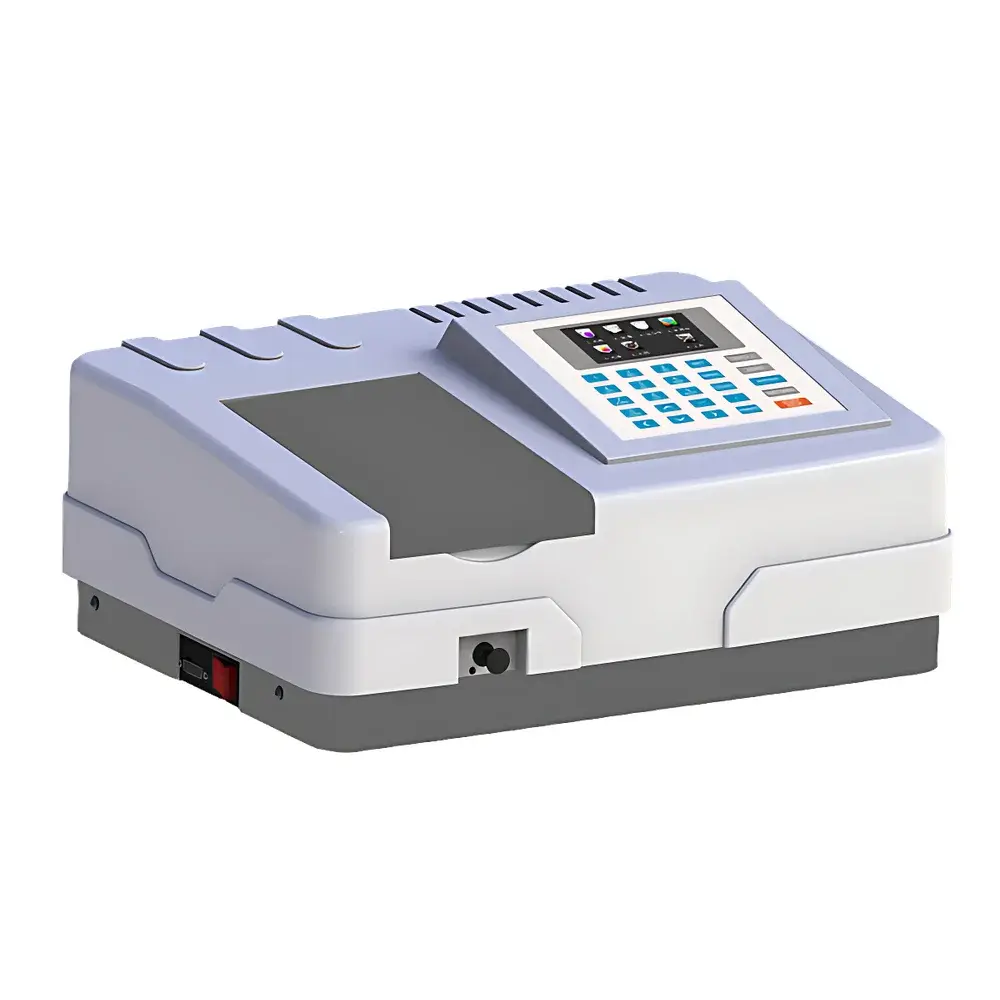
AOE A590 Dual-Beam Ultraviolet-Visible Spectrophotometer
| Brand | AOE |
|---|---|
| Origin | Shanghai, China |
| Model | A590 |
| Optical System | Dual-Beam Ratio-Monitoring |
| Detector Type | Silicon Photocell |
| Wavelength Range | 190–1100 nm |
| Wavelength Accuracy | ±0.2 nm |
| Spectral Bandwidth | 0.5 / 1.0 / 2.0 / 4.0 / 5.0 nm |
| Stray Light | ≤0.02% T @ 360 nm |
| Display | 800 × 480 TFT color LCD (65K colors) |
| Data Storage | 240 curves × 240 data points onboard |
| Interface | Dual USB 2.0 ports (data export & printer), USB 1.0 for PC connectivity |
| Software | AOE Basic Spectroscopy Suite (certified under PRC Software Copyright Registration) |
| Compliance | ISO 9001, CE, CMC, RoHS |
Overview
The AOE A590 Dual-Beam Ultraviolet-Visible Spectrophotometer is a precision optical instrument engineered for quantitative and qualitative analysis across research laboratories, quality control environments, and educational institutions. It operates on the principle of dual-beam ratio-monitoring spectroscopy—splitting the light path into sample and reference beams to continuously compensate for source intensity drift and detector sensitivity fluctuations. This architecture ensures high photometric stability and measurement reproducibility over extended acquisition periods. The system employs a high-efficiency holographic grating (1200 lines/mm) to deliver consistent spectral resolution across its full 190–1100 nm wavelength range, covering deep UV through near-infrared regions. Its design supports compliance-critical workflows in pharmaceutical, environmental, and food testing applications where trace-level absorbance quantification and regulatory documentation integrity are essential.
Key Features
- Dual-beam optical configuration with real-time reference beam compensation for enhanced baseline stability and reduced drift during kinetic or temperature-dependent measurements.
- Five selectable spectral bandwidths (0.5, 1.0, 2.0, 4.0, and 5.0 nm) to balance resolution and signal-to-noise ratio based on analyte specificity and matrix complexity.
- High-resolution 800 × 480 TFT color display with intuitive graphical interface for direct method setup, spectrum visualization, and multi-curve overlay without external PC dependency.
- Onboard data storage capacity for up to 240 calibration curves, each containing 240 absorbance/transmittance data points—enabling offline operation in regulated lab settings with limited network access.
- Dual USB 2.0 ports supporting simultaneous connection to PCL-compatible A4 printers and USB mass storage devices for secure, audit-ready data export in CSV or native .spc format.
- Firmware upgrade capability via USB flash drive using authenticated firmware packages downloadable from AOE’s official support portal using instrument serial number—ensuring version traceability and cybersecurity alignment with IEC 62443 principles.
Sample Compatibility & Compliance
The A590 accommodates standard 10 mm square cuvettes (quartz for UV, glass or plastic for visible range) and supports optional accessories including variable-pathlength cells, micro-volume adapters, and thermostatted holders. It meets international metrological and safety requirements: certified to ISO 9001:2015 for quality management systems; CE-marked per Directive 2014/30/EU (EMC) and 2014/35/EU (LVD); registered under China’s CMC (China Metrology Certification); and compliant with RoHS Directive 2011/65/EU for hazardous substance restriction. While not preconfigured for 21 CFR Part 11 enforcement, the instrument’s software architecture—including timestamped audit logs, user-access levels, and immutable data export—supports integration into GLP/GMP-compliant validation protocols when deployed with validated IT infrastructure.
Software & Data Management
The AOE Basic Spectroscopy Software suite—officially registered with the China National Copyright Administration (Certificate No. 2022SRXXXXXX)—provides core functions including wavelength scanning, fixed-wavelength kinetics, concentration determination via single/multi-point calibration, and DNA/protein A260/A280 ratio calculation. All spectral acquisitions include embedded metadata: date/time stamp, operator ID, instrument serial number, and parameter configuration. Exported files retain full traceability and may be imported into third-party analytical platforms (e.g., OriginLab, MATLAB, or LIMS systems) without proprietary codec dependencies. Firmware updates preserve historical calibration records and do not overwrite user-defined methods, maintaining continuity during periodic requalification.
Applications
- Pharmaceutical QC: Assay of active pharmaceutical ingredients (APIs) per USP and EP 2.2.25; dissolution profile monitoring; excipient compatibility screening.
- Environmental analysis: Nitrate/nitrite quantification in water per EPA Method 353.2; COD estimation using dichromate oxidation; heavy metal chelation studies.
- Life sciences: Nucleic acid purity assessment (A260/A280 ≥ 1.8), protein concentration via Bradford/Lowry assays, enzyme kinetics (e.g., LDH, ALP) at defined λmax.
- Materials science: Thin-film transmittance/absorbance profiling; bandgap estimation of semiconductor nanomaterials; dye degradation kinetics under UV irradiation.
- Educational use: Teaching fundamental spectrophotometric principles including Beer-Lambert law verification, spectral deconvolution, and stray light impact assessment.
FAQ
Does the A590 support GLP-compliant electronic record keeping?
Yes—when operated within a validated network environment, its timestamped data export, user authentication, and immutable file structure meet foundational GLP documentation requirements per OECD Principles of Good Laboratory Practice.
Can the instrument perform spectral scanning below 200 nm?
Yes—the 190 nm lower limit enables detection of aromatic compounds, carbonyl groups, and nucleotide bases with sufficient signal-to-noise ratio using quartz cuvettes and proper lamp warm-up protocol.
Is the photometric accuracy verified traceable to NIST standards?
While the A590 itself is not supplied with NIST-traceable calibration certificates, it accepts NIST SRM 930e (neutral density filters) and SRM 2036 (UV transmission standards) for user-performed verification per ASTM E275 and ISO 6059.
What is the maximum sampling rate during kinetic mode?
The instrument supports up to 20 data points per second in time-scan mode with 1.0 nm bandwidth, suitable for rapid enzymatic reactions and photochemical processes.
How is wavelength accuracy maintained over time?
Internal holmium oxide and didymium oxide filters are used for automated wavelength calibration checks; recommended biannual verification aligns with ISO/IEC 17025 internal calibration guidelines.
Related Products





