
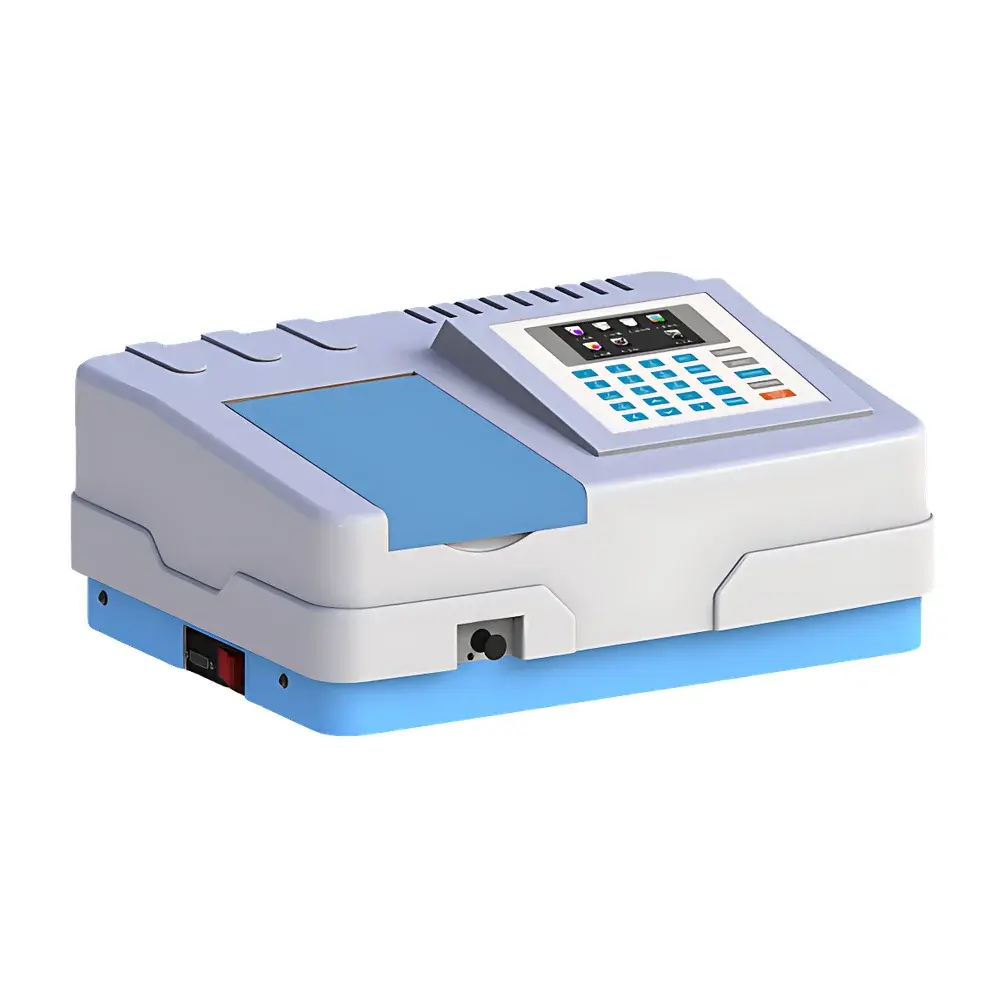
AOE A360 Scanning Ultraviolet-Visible Spectrophotometer
| Brand | AOE |
|---|---|
| Origin | Shanghai, China |
| Manufacturer Type | Authorized Distributor |
| Product Origin | Domestic (China) |
| Model | A360 |
| Price Range | USD 4,200 – 7,000 |
| Optical Design | Pseudo-Double-Beam |
| Detector Type | Silicon Photocell |
| Wavelength Range | 190–1100 nm |
| Wavelength Scanning | Motorized Auto-Scanning |
| Spectral Bandwidth | 1.8 nm |
| Wavelength Accuracy | ±0.3 nm |
| Stray Light | ≤0.03% T @ 360 nm |
Overview
The AOE A360 Scanning Ultraviolet-Visible Spectrophotometer is a precision optical instrument engineered for quantitative and qualitative analysis across the ultraviolet, visible, and near-infrared spectral regions (190–1100 nm). It operates on a pseudo-double-beam optical architecture—employing a high-efficiency holographic grating (1200 lines/mm) and real-time reference beam monitoring—to minimize photometric drift caused by source intensity fluctuations or detector response variability. This design ensures high baseline stability and photometric reproducibility essential for regulatory-compliant routine analysis in QC laboratories, academic research, and pharmaceutical development. The instrument supports fundamental photometric modes: Absorbance (A), Transmittance (T), Concentration (C), and Energy (E), enabling direct calibration curve generation and kinetic measurements without external software dependency.
Key Features
- Precision wavelength scanning driven by stepper motor with automated zero-order alignment and wavelength calibration routines.
- High-resolution 6.5K-color TFT display (800 × 480 pixels) providing intuitive graphical interface for spectrum visualization, peak identification, and multi-curve overlay.
- Onboard data storage supporting up to 240 calibration curves, each accommodating 240 measurement points—fully retained during power cycling.
- Dual USB 2.0 ports: one dedicated to U-disk data export (CSV/ASCII format), the other for direct connection to PCL-compatible printers for A4-size hardcopy reports.
- Firmware upgrade capability via encrypted firmware package downloaded from AOE’s official support portal using instrument serial number; installation executed via plug-and-play USB flash drive.
- Compliance with international electromagnetic compatibility and safety standards, including CE marking, RoHS Directive 2011/65/EU, and CMC certification issued by the China National Institute of Metrology.
Sample Compatibility & Compliance
The A360 accommodates standard 10 mm pathlength quartz or glass cuvettes (including matched pairs for dual-beam referencing), as well as micro-volume adapters (e.g., 50–500 µL capillary cells) compatible with optional accessories. Its optical path is optimized for liquid-phase transmission measurements; solid-sample reflectance mode is not supported. The system meets functional requirements outlined in ISO 6425:2022 (spectrophotometer performance verification), ASTM E275–22 (standard practices for UV-Vis spectrophotometry), and USP (Spectrophotometry and Light-Scattering). While not preconfigured for 21 CFR Part 11 compliance, audit-trail-capable third-party LIMS integration is achievable through its standardized USB HID protocol and ASCII-based data output structure.
Software & Data Management
The embedded Basic Spectroscopy Software—certified under China Copyright Protection Center registration No. 2021SR0824511—is preinstalled and fully localized for English-language operation. It provides real-time spectral acquisition, baseline correction (linear and polynomial), peak detection with λmax/λmin annotation, and multi-point calibration with error propagation reporting. Exported datasets conform to ANSI X3.4-1986 (ASCII) encoding and are directly importable into Microsoft Excel, OriginLab, or MATLAB. For regulated environments, raw data files include timestamped metadata (date/time, operator ID placeholder, lamp hours, wavelength range, slit width), supporting GLP documentation workflows. No cloud synchronization or remote access functionality is implemented—data sovereignty remains fully under user control.
Applications
- Pharmaceutical assay validation per ICH Q2(R2): determination of active pharmaceutical ingredient (API) concentration, excipient interference screening, and degradation product profiling.
- Environmental water quality testing: quantification of nitrate (220 nm), phosphate (880 nm via molybdenum blue method), and COD-related chromophores.
- Biochemical analysis: protein quantification via Bradford/Lowry assays, nucleic acid purity assessment (A260/A280 ratio), and enzyme kinetics (NADH/NADPH monitoring at 340 nm).
- Materials science: bandgap estimation of semiconductor thin films via Tauc plot construction from absorbance onset data.
- Educational use: undergraduate laboratory instruction in Beer–Lambert law validation, spectral deconvolution, and instrumental error analysis.
FAQ
Does the A360 support spectral scanning in kinetic mode?
Yes—it enables time-resolved spectral acquisition at user-defined intervals (minimum 0.5 s/scan), with up to 999 sequential scans stored internally.
Is the photometric accuracy traceable to NIST standards?
While the instrument itself is not supplied with NIST-traceable calibration certificates, it accepts NIST SRM 930e (neutral density filters) and SRM 2035 (UV transmission standards) for user-performed verification per ISO/IEC 17025 protocols.
Can the A360 be integrated into a laboratory network?
It lacks built-in Ethernet or Wi-Fi; however, USB-to-Ethernet adapters compliant with CDC ACM class drivers enable indirect network file transfer when paired with host PC automation scripts.
What maintenance is required for long-term wavelength accuracy?
Annual verification using holmium oxide (Ho₂O₃) and didymium glass filters is recommended; no user-serviceable optical alignment mechanisms are provided.
Is GMP-compliant electronic signature support available?
No—the onboard software does not implement role-based access control or digital signature capture. Such functionality must be implemented externally via validated LIMS or ELN platforms interfacing via exported ASCII data.





