
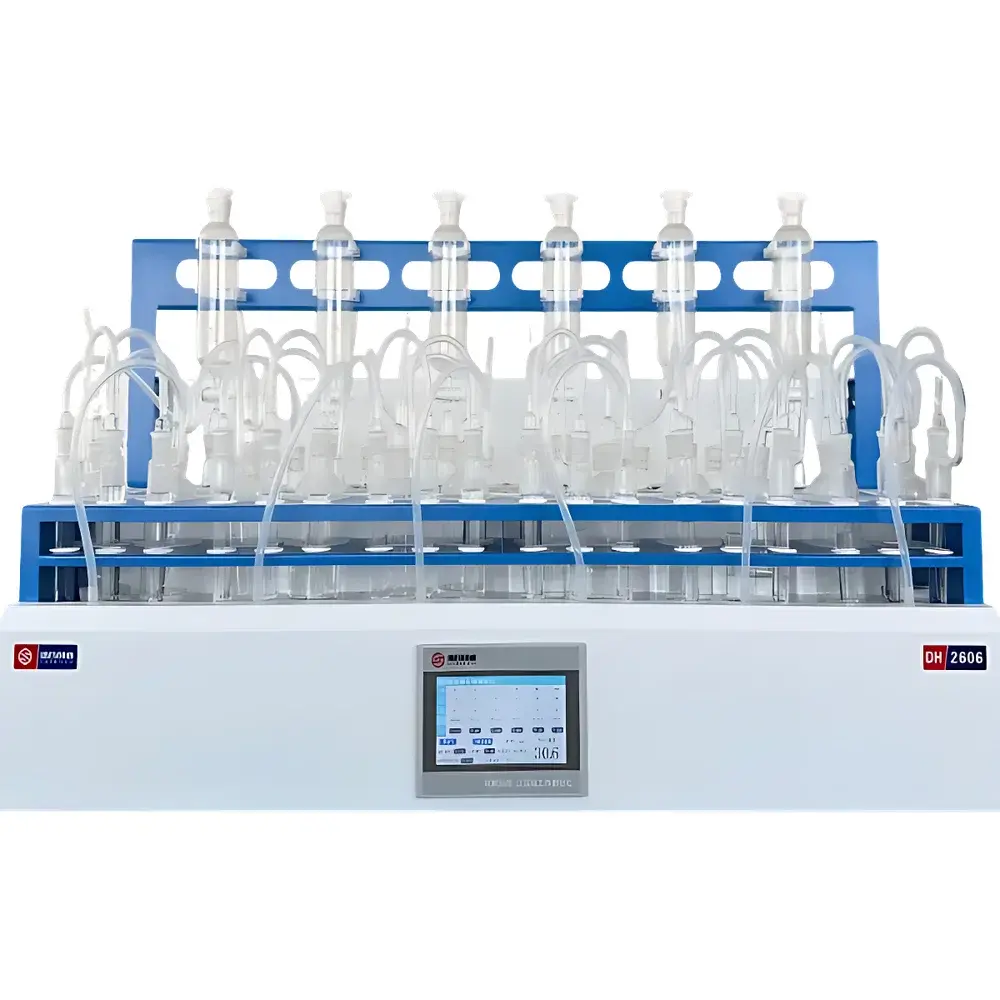
Dehoo Chuangrui DH2606 Food & Grain Phosphine Residue Analyzer
| Brand | Dehoo Chuangrui |
|---|---|
| Origin | Shandong, China |
| Manufacturer Type | Authorized Distributor |
| Country of Origin | China |
| Model | DH2606 |
| Instrument Type | Benchtop Laboratory Analyzer |
| Sample Capacity | 6 positions |
| Heating Method | Water Bath |
| Temperature Control Accuracy | ±1 °C |
| Control Interface | 7-inch Touchscreen |
| Temperature Regulation | PID Auto-Control |
| Automatic Water Fill/Drain | Yes |
| Power Supply | AC 220 V, 50/60 Hz, 3000 W |
| Dimensions | 1200 mm × 550 mm × 720 mm |
Overview
The Dehoo Chuangrui DH2606 Food & Grain Phosphine Residue Analyzer is a dedicated benchtop sample preparation system engineered for the quantitative determination of phosphine (PH₃) residues in cereals, oilseeds, and processed grain commodities. It implements the standardized wet-chemical distillation–absorption–colorimetric methodology specified in GB/T 25222–2010, “Grain and Oil Inspection — Determination of Phosphine Residues in Cereals — Spectrophotometric Method.” The instrument automates the critical pre-analytical steps—including acid-induced phosphine liberation, controlled thermal distillation, gas-phase transfer, and absorption into alkaline silver nitrate or copper sulfate solution—thereby eliminating manual variability and enhancing inter-laboratory reproducibility. Unlike generic fume hoods or standalone heating blocks, the DH2606 integrates fluidic, thermal, and pneumatic control subsystems within a single robust architecture to ensure stoichiometric completeness of phosphine evolution and quantitative capture under defined flow and temperature conditions.
Key Features
- Six independent reaction channels with individual, digitally adjustable vacuum pumps (flow range: 0–500 mL/min), enabling parallel processing without cross-contamination or flow interference.
- Automated water bath system with level sensing, programmable fill/drain cycles, and real-time temperature feedback; maintains setpoint stability within ±1 °C across all six positions via PID-regulated immersion heaters.
- Integrated gas-tightness verification protocol: users initiate an automated pressure-hold test to validate seal integrity of glassware joints (e.g., digestion flasks, absorption traps, connecting tubing) prior to assay commencement.
- Dedicated exhaust routing with chemical-resistant tubing; directs liberated phosphine and acidic vapors directly to a fume hood duct or external scrubber—complying with OSHA permissible exposure limits (PEL) and local occupational hygiene requirements.
- Optional reagent dispensing module supports automated addition of hydrochloric acid (HCl) or sulfuric acid (H₂SO₄) at user-defined volumes and timing, synchronized with heating and抽气 initiation.
- 7-inch industrial-grade touchscreen HMI with embedded logic for method storage, step-by-step workflow guidance, event logging (start/stop times, temperature profiles, pump status), and password-protected administrator access.
Sample Compatibility & Compliance
The DH2606 is validated for use with intact grains (e.g., wheat, rice, maize, barley), milled flour, legumes, and oilseed cakes. Sample mass ranges from 5 g to 50 g, compatible with standard GB/T 25222–2010 protocols. All wetted components—including borosilicate glass reaction vessels, PTFE-coated valves, and silicone-free gaskets—are inert to strong mineral acids and phosphine gas, minimizing adsorption losses and background interference. The system supports GLP-aligned operation: audit trails (timestamped parameter changes, operator ID, calibration records) are stored locally and exportable via USB. While not FDA 21 CFR Part 11–certified out-of-the-box, its event log structure facilitates validation documentation for regulated food safety laboratories operating under ISO/IEC 17025 or China’s CNAS accreditation framework.
Software & Data Management
No proprietary PC software is required for basic operation; all configuration, monitoring, and method execution occur via the onboard touchscreen interface. However, the DH2606 provides a USB-C port for exporting CSV-formatted logs containing temperature history per channel, cumulative pump runtime, water level events, and pass/fail results from gas-tightness tests. These logs integrate seamlessly with LIMS platforms or Excel-based QA/QC review workflows. Firmware updates are delivered via encrypted firmware image files loaded from USB drive, ensuring traceability and version control. Optional RS-485 Modbus RTU output enables integration into centralized lab automation systems for remote status polling and alarm signaling.
Applications
- Regulatory testing of imported/exported cereal commodities for compliance with China’s GB 2763–2021 maximum residue limits (MRLs) for phosphine.
- Quality assurance in grain storage facilities utilizing aluminum phosphide (AlP) or magnesium phosphide (Mg₃P₂) fumigants.
- Method validation studies comparing distillation efficiency across grain matrices and moisture contents.
- Reference laboratory participation in proficiency testing schemes (e.g., FAPAS, QUASIMEME) for phosphine residue analysis.
- Research on phosphine degradation kinetics in stored products under varying temperature/humidity conditions.
FAQ
Does the DH2606 perform spectrophotometric detection itself?
No. It is a dedicated sample preparation unit that carries out distillation and absorption only. Final colorimetric quantification requires transfer of the absorbed solution to a UV-Vis spectrophotometer (e.g., at 420 nm for silver phosphomolybdate complex or 600 nm for copper phosphide complex).
Can the instrument be used for sulfide analysis?
While the core fluidic and thermal architecture is adaptable, the DH2606 is calibrated and validated exclusively for phosphine per GB/T 25222–2010. Sulfide (H₂S) analysis requires different absorption chemistry (e.g., zinc acetate), lower distillation temperatures, and modified gas-flow optimization—not supported without hardware modification and revalidation.
Is external ventilation mandatory?
Yes. Phosphine is highly toxic (IDLH = 3 ppm) and flammable. Exhaust must be ducted to a certified fume hood or external air-pollution control system meeting local environmental regulations (e.g., EPA Method 18, EN 13649).
What maintenance intervals are recommended?
Water bath descaling every 3 months (using 5% citric acid), pump filter inspection biweekly, and annual verification of temperature sensor accuracy against NIST-traceable reference thermometer.
Is the system compatible with ISO/IEC 17025 documentation requirements?
Yes. Its built-in event logging, method storage, and operator authentication features support essential elements of method validation, equipment qualification (IQ/OQ), and ongoing performance monitoring required under Clause 6.4 and Annex A of ISO/IEC 17025:2017.
Related Products







