
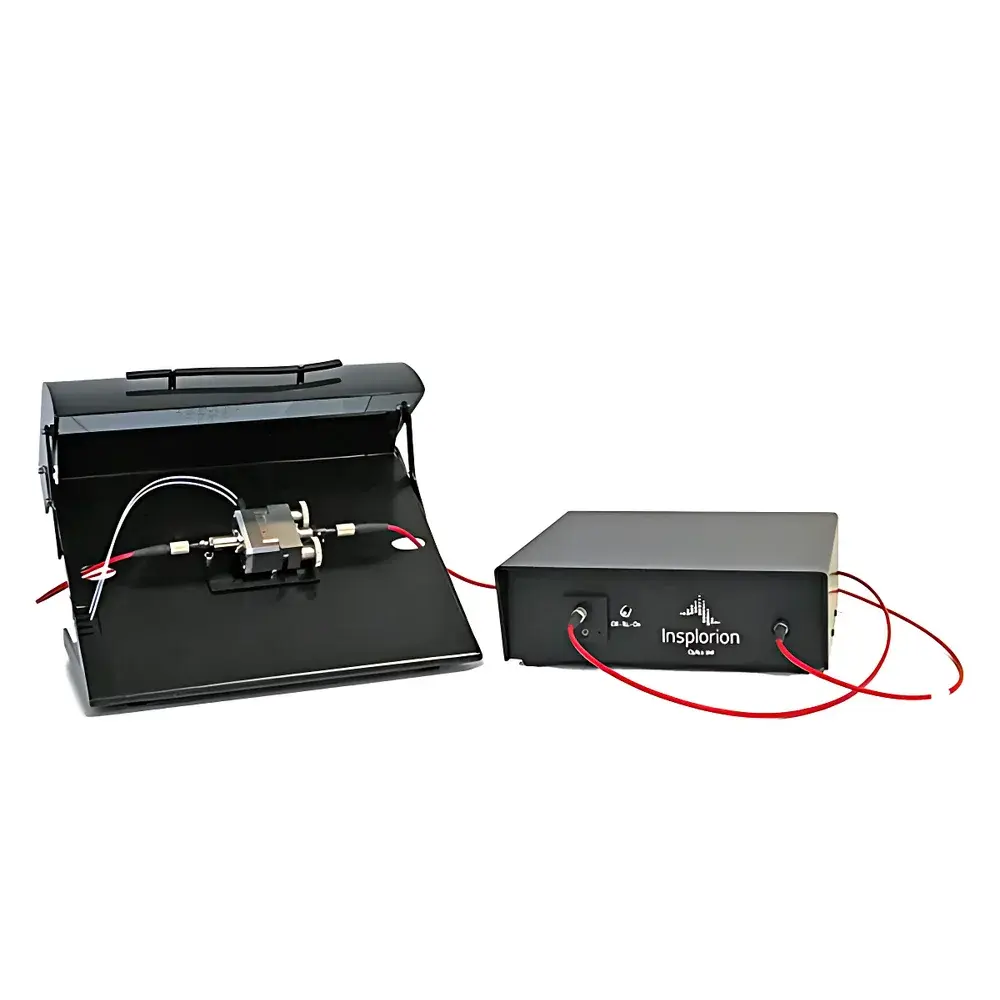
Insplorion XNano Nanoplasmonic Sensing Analyzer
| Brand | Insplorion AB |
|---|---|
| Origin | Sweden |
| Model | XNano |
| Measurement Principle | Nanoplasmonic Resonance Spectroscopy (NPS) |
| Sample Environment | Liquid or Gas Flow |
| Temperature Range | 25–80 °C (optional up to 250 °C) |
| Chip Substrate | Fused Silica (9.5 × 9.5 × 1 mm) |
| Sensing Surface | Nanostructured Gold |
| Coating Options | Au, SiO₂, Si₃N₄, TiO₂, Al₂O₃ |
| Optical Source | Tungsten-Halogen Lamp (≥2000 h lifetime) |
| Wavelength Range | 450–1000 nm |
| Spot Size | ~2 mm diameter |
| Time Resolution | 10 Hz (10 samples/sec) |
| Noise Level | < 0.01 nm (in liquid, 1 Hz sampling) |
| Flow Cell Volume | ~4 μL |
| Minimum Sample Volume | ~100 μL |
| Typical Flow Rate | 20–100 μL/min |
| Materials | Titanium & Perfluoroelastomer® |
| Dimensions (Measurement Unit) | 31 × 25 × 25 cm |
| Software | Windows-compatible, ASCII output, multi-parameter real-time export (resonance wavelength, linewidth, extinction) |
Overview
The Insplorion XNano Nanoplasmonic Sensing Analyzer is an advanced, label-free optical biosensor platform engineered for real-time, in situ monitoring of nanoscale interfacial phenomena. It operates on the principle of Nanoplasmonic Resonance Spectroscopy (NPS), leveraging localized surface plasmon resonance (LSPR) shifts induced by minute changes in the local refractive index within ~100 nm of a nanostructured gold transducer surface. Unlike conventional SPR systems requiring prism coupling and large footprints, the XNano employs a compact, chip-based optical architecture with high spatial and temporal fidelity—enabling quantitative detection of molecular adsorption, thin-film swelling, nanoparticle binding, and phase transitions at solid–liquid or solid–gas interfaces. Its design emphasizes experimental flexibility: measurements are compatible with microfluidic flow cells, static cuvettes, or gas-phase exposure; temperature is actively controlled from ambient to 80 °C (optionally up to 250 °C); and sensor chips support customizable substrate materials and surface chemistries. The system delivers sub-nanometer optical resolution (< 0.01 nm noise floor at 1 Hz in aqueous media) and 10 Hz time resolution—critical for capturing fast kinetic events such as hydrogen absorption in Pd nanoparticles or dye diffusion in mesoporous TiO₂.
Key Features
- Label-free, real-time detection of refractive index changes within the evanescent field (~100 nm depth) of a nanostructured gold sensor surface
- Integrated microfluidic flow cell with minimal dead volume (~4 μL) and low sample consumption (~100 μL per assay)
- Thermally stabilized measurement environment (25–80 °C standard; optional high-temp module supports up to 250 °C)
- Modular sensor chip platform: fused silica substrates (9.5 × 9.5 × 1 mm) with customizable surface coatings (Au, SiO₂, Si₃N₄, TiO₂, Al₂O₃)
- Stable tungsten-halogen light source (≥2000 h lifetime) covering 450–1000 nm spectral range with 2 mm circular measurement spot
- Multi-parameter real-time data acquisition: resonance wavelength shift (Δλ), full width at half maximum (FWHM), and extinction intensity
- Rugged mechanical construction using titanium and perfluoroelastomer® seals for chemical compatibility across organic solvents, buffers, and corrosive gases
Sample Compatibility & Compliance
The XNano accommodates diverse sample formats—including proteins, lipids, polymers, metal oxides, and small molecules—in both liquid-phase (aqueous buffers, organic solvents, ionic liquids) and gas-phase (H₂, CO₂, NH₃, O₂) environments. Its open-flow architecture supports integration with standard HPLC tubing, syringe pumps, and custom gas manifolds. Sensor surfaces can be functionalized via thiol-, silane-, or phosphonic acid-based chemistries to immobilize ligands (e.g., antibodies, DNA aptamers, His-tagged proteins) under controlled conditions. While the instrument itself does not carry regulatory certification, its data output structure and software audit trail capabilities align with GLP and GMP-aligned workflows. Raw ASCII data files (tab-delimited) are fully compatible with third-party analysis tools used in regulated environments, and timestamped parameter logs support traceability per FDA 21 CFR Part 11 requirements when deployed with validated laboratory IT infrastructure.
Software & Data Management
The XNano Control Software runs natively on Windows 10/11 and provides intuitive configuration of acquisition parameters (integration time, averaging, flow rate triggers), real-time visualization of all three optical parameters (λ₀, FWHM, extinction), and synchronized logging of temperature, pressure, and fluidic status. All data are exported in plain-text ASCII format—readable by Origin, MATLAB, Python (pandas), or Excel—without proprietary binary dependencies. The software supports batch processing of time-series datasets, baseline correction algorithms, and user-defined kinetic fitting models (e.g., 1:1 Langmuir, two-state conformational change). Exported files include metadata headers specifying instrument ID, chip lot number, coating type, and environmental conditions—enabling reproducible cross-laboratory comparison. No cloud connectivity or remote telemetry is enabled by default; data residency remains fully under user control.
Applications
- Molecular Interaction Analysis: Quantification of binding kinetics (kon, koff, KD) for protein–protein, protein–small molecule, and antibody–antigen interactions without labeling—validated in studies with membrane proteins reconstituted in tethered bilayer lipid membranes (tBLMs).
- Hydrogen Storage Research: Real-time monitoring of hydride formation/decomposition in sub-5 nm Pd and Mg nanoparticles under controlled H₂ partial pressure and elevated temperature—enabling size-dependent thermodynamic and kinetic modeling.
- Thin-Film Phase Transitions: Thickness- and size-resolved measurement of glass transition temperature (Tg) in PMMA films and PS nanoparticles, revealing interfacial mobility gradients inaccessible to bulk DSC.
- Diffusion & Release Kinetics: Tracking dye infiltration into mesoporous TiO₂ photoanodes for DSSCs, yielding position-resolved diffusion coefficients and saturation times—correlated with photovoltaic performance metrics published in Nano Letters.
- Hidden Interface Characterization: Probing interfacial hydration, swelling, or degradation at buried polymer–porous substrate interfaces—critical for controlled drug delivery matrices and protective coatings.
FAQ
What physical quantity does the XNano measure?
It measures wavelength-shift-induced changes in localized surface plasmon resonance (LSPR) arising from refractive index variations within ~100 nm of the nanostructured gold surface.
Can the XNano operate under anaerobic or high-pressure gas conditions?
Yes—the flow cell and sealing materials (titanium, perfluoroelastomer®) are rated for inert gas environments and moderate pressures (up to 5 bar); custom high-pressure configurations are available upon request.
Is surface regeneration supported between cycles?
Regeneration depends on surface chemistry: mild acidic/basic or chaotropic washes are effective for many immobilized ligands; covalent monolayers may require UV-ozone or piranha treatment—chip reusability is demonstrated for >50 cycles with proper handling.
How is temperature uniformity ensured across the sensing area?
A Peltier-based thermal stage with embedded Pt100 sensor and closed-loop feedback maintains ±0.1 °C stability over the 9.5 × 9.5 mm chip area during dynamic ramping or isothermal operation.
Are reference channels or dual-wavelength compensation available?
No internal reference channel is included; however, ratiometric referencing can be implemented externally using a second identical chip in parallel flow or via post-acquisition background subtraction from pre-binding baselines.
Related Products




