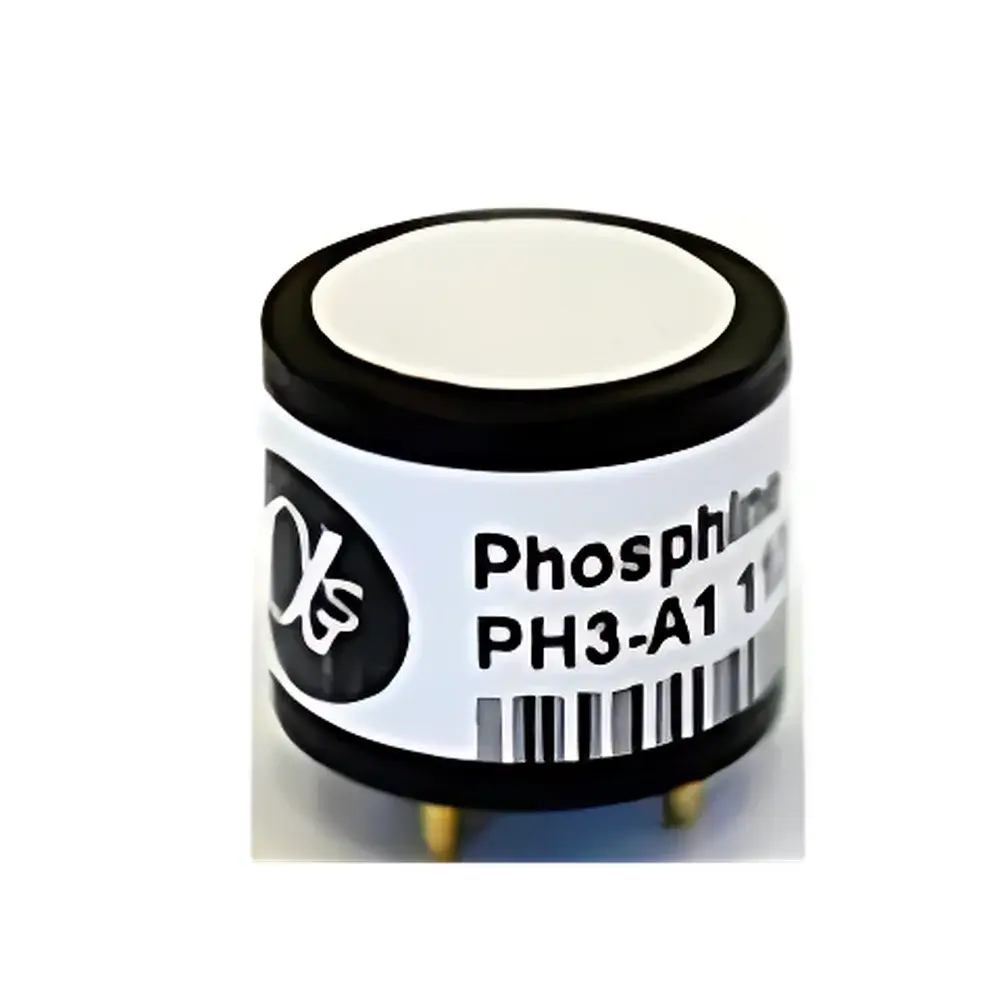
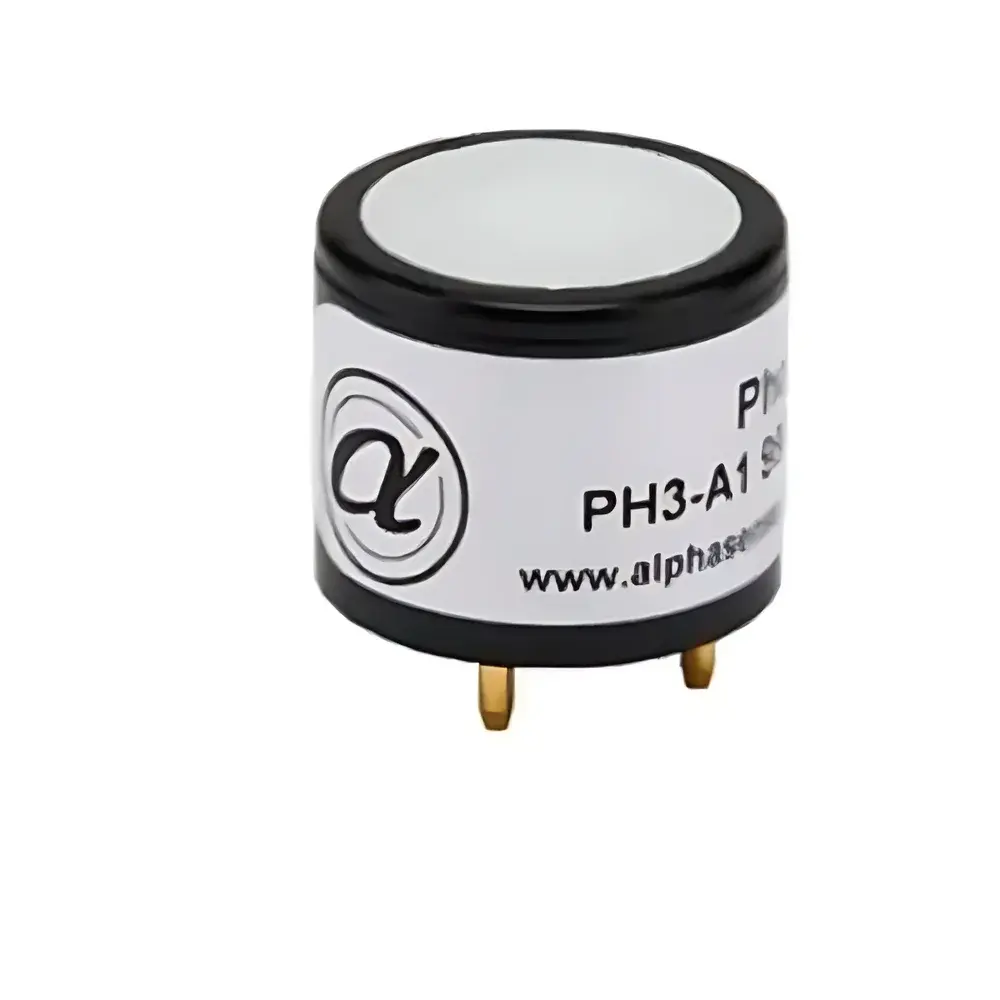
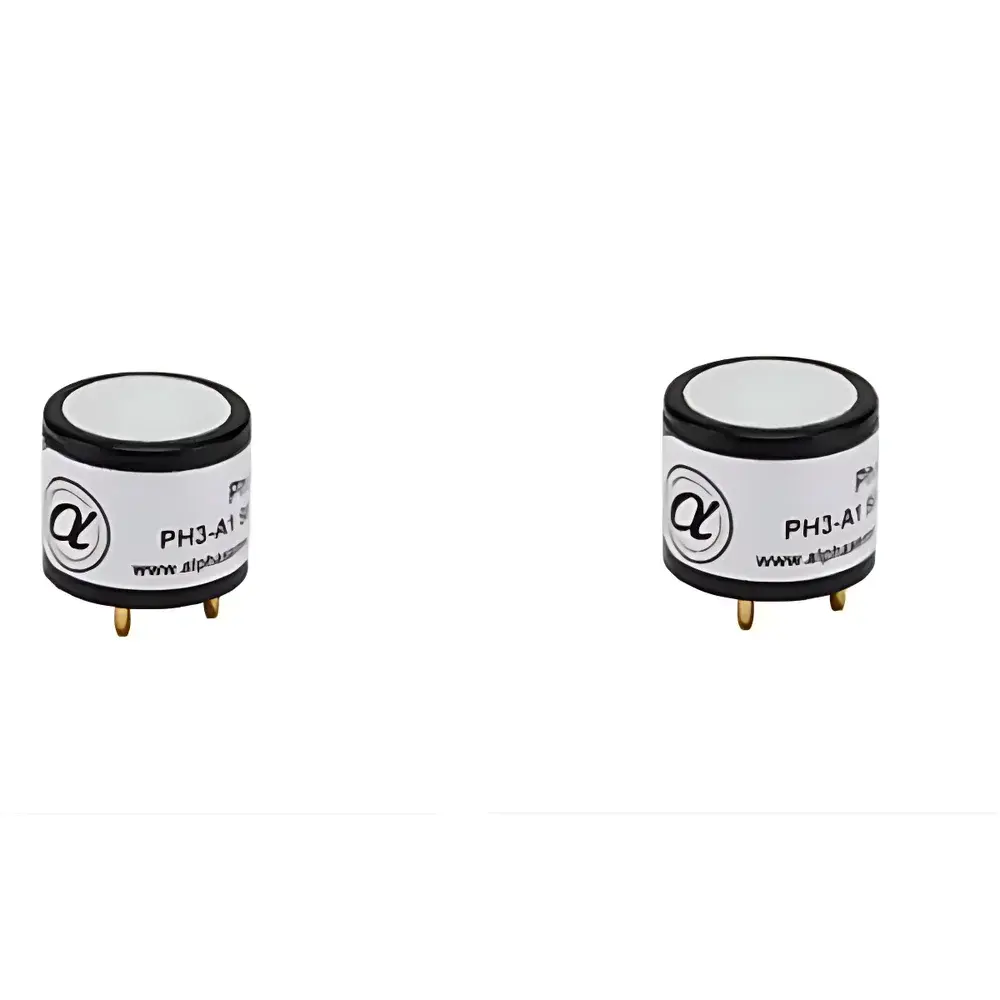
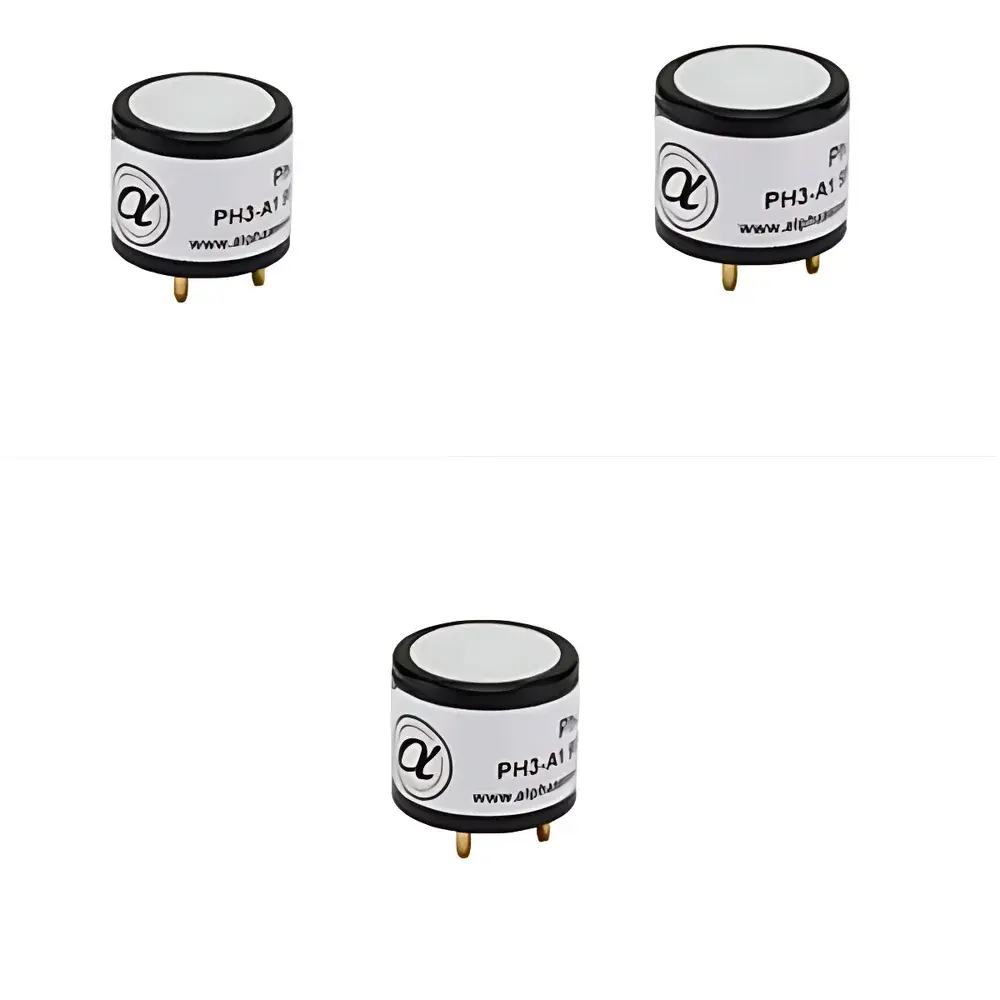
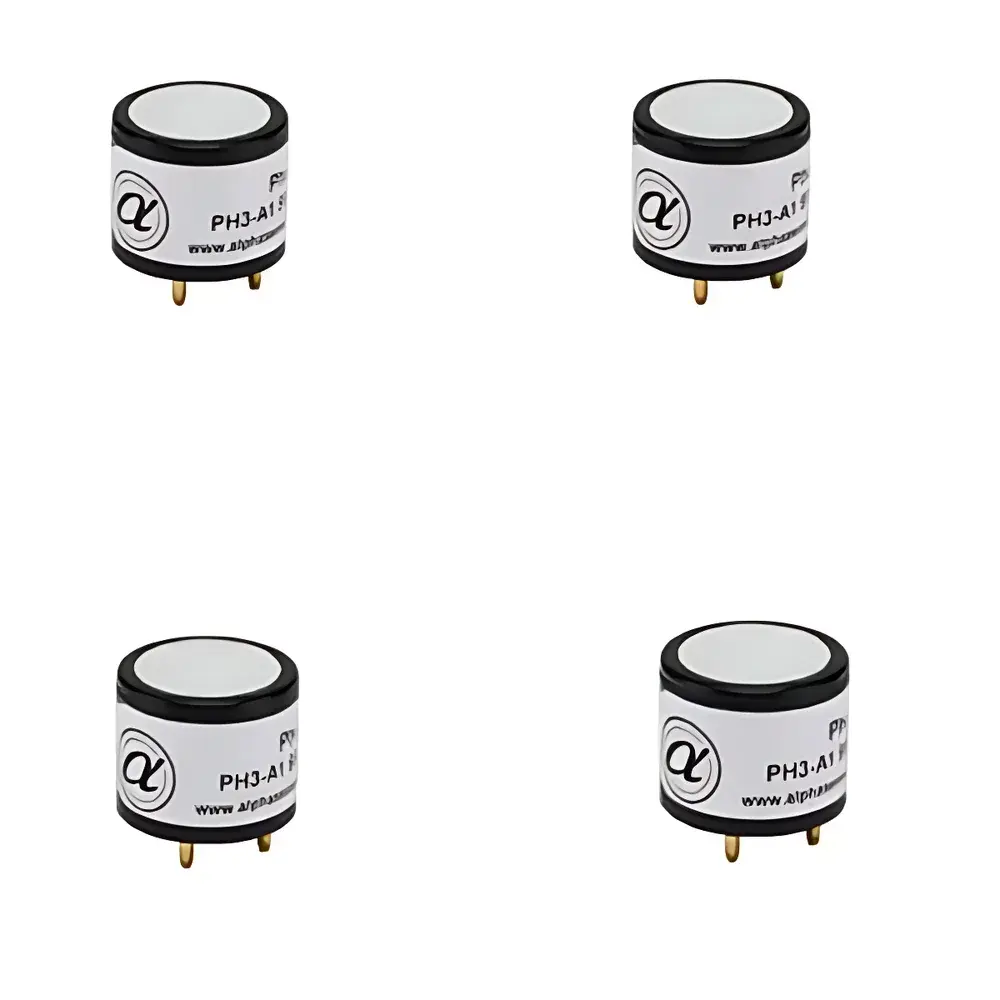
Alphasense PH3-A1 Phosphine (PH₃) Electrochemical Gas Sensor
| Brand | Alphasense (UK) |
|---|---|
| Origin | United Kingdom |
| Model | PH3-A1 |
| Measurement Range | 0–10 ppm |
| Sensitivity | 550–900 nA/ppm |
| Response Time (t₉₀) | <25 s |
| Linearity Error | ±0.6 ppm (0–20 ppm full scale) |
| Overload Limit | 75 ppm |
| Resolution | <0.1 ppm |
| Dimensions | Ø20.2 × 16.5 mm |
| Operating Temperature | −30 to +50 °C |
| Operating Humidity | 20–90 %RH (non-condensing) |
| Load Resistance | 10–33 Ω |
| Expected Service Life | 24 months |
| Storage Stability | 6 months (unpowered, sealed, 20 °C) |
Overview
The Alphasense PH3-A1 is a high-performance, three-electrode electrochemical gas sensor engineered for the selective and stable detection of phosphine (PH₃) in ambient air. Designed and manufactured in the United Kingdom, it operates on the principle of amperometric electrochemical transduction: PH₃ diffuses through a hydrophobic membrane into an aqueous electrolyte, where it undergoes oxidation at the working electrode, generating a current proportional to gas concentration. This sensor is optimized for fixed- and portable gas detection systems deployed in grain storage facilities, fumigation monitoring, semiconductor fabrication environments, and industrial hygiene applications—where reliable, low-range phosphine measurement is critical for safety compliance and process control.
Key Features
- Stable, factory-calibrated output with traceable calibration certificates available upon request
- Three-electrode architecture (working, counter, reference) minimizes drift and improves long-term baseline stability
- Integrated hydrophobic PTFE diffusion barrier ensures consistent response across variable humidity conditions (20–90 %RH, non-condensing)
- Compact cylindrical form factor (Ø20.2 × 16.5 mm) enables integration into space-constrained OEM instruments and multi-gas detectors
- Low-power operation compatible with battery-powered portable devices and continuous emission monitoring systems (CEMS)
- Specified operating temperature range of −30 to +50 °C supports deployment in unheated silos, outdoor enclosures, and tropical climates
- Robust construction with gold-plated contacts and laser-welded stainless-steel housing enhances mechanical durability and corrosion resistance
Sample Compatibility & Compliance
The PH3-A1 exhibits high selectivity for phosphine with minimal cross-sensitivity to common interferents including CO, H₂S, SO₂, NO₂, Cl₂, and NH₃—verified per Alphasense’s internal interference testing protocol (documented in datasheet Rev. D). It complies with the essential design and performance requirements of IEC 60079-29-1 (Explosive atmospheres — Gas detectors — Performance requirements for detectors for flammable and toxic gases) and meets the functional safety guidance outlined in ISO 20471:2018 for occupational exposure monitoring. While not intrinsically safe as a standalone component, the sensor is routinely integrated into certified ATEX/IECEx Zone 1 and UL Class I, Div. 1 systems by qualified OEMs. Its 24-month service life and 6-month shelf life (when stored sealed at 20 °C) align with GLP-aligned quality management practices for sensor inventory control.
Software & Data Management
The PH3-A1 delivers analog current output (nA range), requiring external signal conditioning via a precision transimpedance amplifier and ADC. When integrated into compliant instrumentation platforms, its output supports linearization algorithms embedded in firmware per manufacturer-provided calibration coefficients. For regulatory-grade deployments—including those subject to OSHA PEL or EU Directive 2017/164/EU—the sensor’s performance data (zero drift, span stability, temperature compensation coefficients) can be logged with timestamped audit trails meeting FDA 21 CFR Part 11 requirements when paired with validated data acquisition software. Alphasense provides comprehensive technical documentation, including sensitivity vs. temperature curves, humidity correction tables, and recommended zero/span calibration intervals (typically every 3–6 months depending on exposure history).
Applications
- Real-time phosphine monitoring during structural fumigation of grain elevators, flour mills, and tobacco warehouses
- Continuous leak detection in phosphine-based semiconductor doping processes (e.g., Si:P epitaxy)
- Occupational exposure assessment for pest control operators under EU Directive 2004/37/EC (Carcinogens and Mutagens Directive)
- Environmental monitoring near landfill sites and wastewater treatment plants where anaerobic decomposition may generate PH₃
- OEM integration into multi-gas personal monitors (PGMs), fixed-point area monitors, and automated fumigation control systems
FAQ
What is the recommended calibration frequency for the PH3-A1 in continuous monitoring applications?
Calibration should be performed at installation and repeated at intervals no greater than 3 months under typical field conditions; more frequent verification (e.g., daily bump tests) is advised in high-exposure or mission-critical environments.
Can the PH3-A1 be used in oxygen-deficient atmospheres?
Yes—it operates independently of ambient O₂ concentration due to its internal electrolyte and auxiliary electrode configuration, making it suitable for confined-space monitoring where O₂ levels may fall below 19.5 %.
Is temperature compensation mandatory for accurate readings?
While the sensor includes built-in temperature compensation circuitry in most OEM modules, raw output requires application-specific compensation using the published sensitivity vs. temperature curve to maintain ±5 % reading accuracy across the full −30 to +50 °C range.
Does Alphasense provide NIST-traceable calibration standards for the PH3-A1?
Alphasense does not supply gas standards directly but certifies compatibility with ISO 17025-accredited phosphine calibration gases (e.g., 1 ppm PH₃ in N₂) and provides detailed calibration protocols for third-party traceability.
How should unused PH3-A1 sensors be stored to maximize shelf life?
Store in original sealed packaging at 20 ± 3 °C and 30 °C) or ambient PH₃ concentrations above 0.1 ppm.