
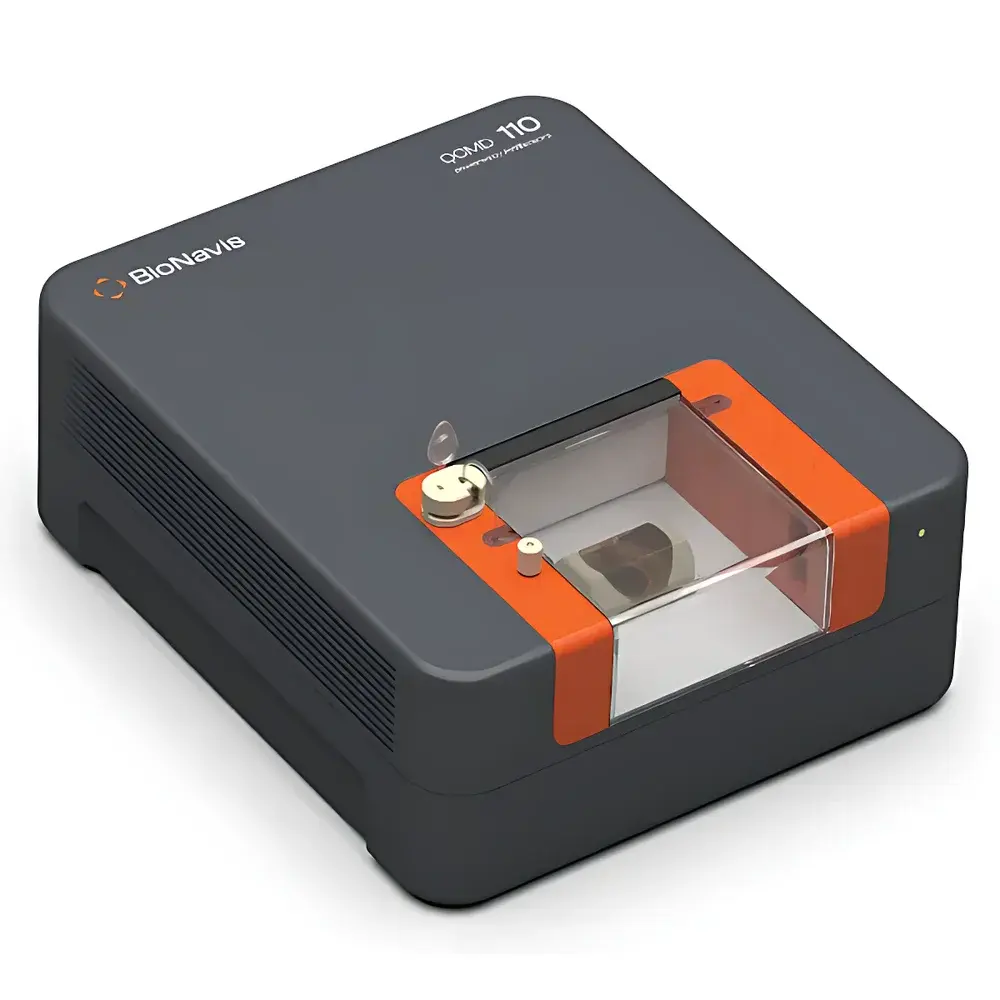
BioNavis QCMD 110 Quartz Crystal Microbalance with Dissipation Monitoring
| Brand | BioNavis |
|---|---|
| Origin | Finland |
| Model | QCMD 110 |
| Temperature Range | 15–45 °C |
| Frequency Range | 4–160 MHz |
Overview
The BioNavis QCMD 110 is a single-channel Quartz Crystal Microbalance with Dissipation monitoring (QCM-D) system engineered for high-precision, real-time analysis of interfacial mass changes and viscoelastic properties at solid–liquid, solid–gas, or electrochemical interfaces. Based on the piezoelectric resonance principle, the instrument measures shifts in the resonant frequency (Δf) and energy dissipation (ΔD) of AT-cut quartz crystals upon mass loading or structural changes in adsorbed layers. Unlike conventional QCM, QCM-D captures both inertial mass (via frequency shift) and coupled mechanical compliance (via dissipation), enabling quantitative differentiation between rigidly bound, hydrated, or soft viscoelastic films—critical for accurate interpretation in biomolecular interactions, thin-film deposition, corrosion studies, and battery interface characterization.
Key Features
- High-frequency operation range (4–160 MHz): Enables detection of sub-monolayer mass changes with enhanced signal-to-noise ratio and improved resolution for low-mass adsorption events.
- Integrated temperature control (15–45 °C, ±0.1 °C stability): Ensures thermal reproducibility across kinetic and thermodynamic experiments, supporting ISO/IEC 17025-compliant method validation.
- QuickLock flow cell design: Facilitates rapid sensor exchange and minimizes dead volume, reducing sample consumption and improving response time during liquid-phase measurements.
- Modular architecture: Supports interchangeable fluidic modules for gas-phase, liquid-phase, and electrochemical configurations—including potentiostat-integrated setups compliant with ASTM E2938 for electrochemical QCM-D applications.
- Precision syringe pump integration: Delivers programmable, pulse-free flow rates (0.01–1 mL/min) with traceable calibration records, aligning with GLP data integrity requirements.
Sample Compatibility & Compliance
The QCMD 110 accommodates standard 5 MHz, 10 MHz, and high-overtone quartz sensors (e.g., Q-Sense™-compatible formats), including gold-coated, silicon oxide, and custom-functionalized surfaces (e.g., COOH-, NH₂-, or thiol-terminated). It supports aqueous buffers, organic solvents, corrosive electrolytes, and humidified gas streams. Instrument firmware and data acquisition comply with FDA 21 CFR Part 11 for electronic records and signatures when used with validated software configurations. Measurement protocols adhere to ISO 14442 (QCM for surface adsorption), ASTM D7500 (coating thickness via QCM), and USP guidelines for analytical instrument qualification.
Software & Data Management
Acquisition and analysis are performed using BioNavis QCMD Control Software (v4.2+), which provides real-time Δf/ΔD plotting, multi-harmonic fitting (n = 1–13), Voigt-based viscoelastic modeling, and export of raw time-series data in HDF5 and CSV formats. Audit trails log user actions, parameter changes, and calibration events with timestamps and operator IDs. Data files include embedded metadata (sensor ID, temperature setpoint, flow rate, timestamp), supporting traceability per ALCOA+ principles. Exported datasets integrate seamlessly with MATLAB, Python (via qcmdio libraries), and industry-standard LIMS platforms.
Applications
- Biomedical Materials: Quantifies protein adsorption kinetics, hydrogel swelling/deswelling, and cell adhesion mechanics under physiological conditions—supporting ISO 10993-5 cytocompatibility screening workflows.
- Electrochemical Interfaces: Tracks in situ electrode mass changes during Li-ion intercalation, SEI formation, or catalyst degradation, correlating Δf/ΔD with charge transfer resistance from EIS.
- Corrosion & Inhibitor Screening: Monitors real-time metal dissolution and inhibitor film formation on steel or aluminum substrates in simulated oilfield brines per NACE TM0169 protocols.
- Biosensor Development: Characterizes antigen–antibody binding affinity (KD), DNA hybridization efficiency, and aptamer conformational switching—validating performance against CLSI EP25-A2 reference methods.
- Coating & Thin-Film Engineering: Evaluates layer-by-layer polyelectrolyte assembly, CVD/PVD film uniformity, and anti-fouling polymer brush hydration dynamics.
- Energy Fluids Analysis: Measures hydrocarbon adsorption isotherms on reservoir rock analogues and quantifies wettability reversal kinetics relevant to EOR process optimization.
FAQ
What sensor harmonics does the QCMD 110 support for simultaneous measurement?
The system acquires up to 13 overtones (n = 1, 3, 5…25) in parallel, enabling robust thickness and viscoelastic modeling using the full harmonic spectrum.
Is the instrument compatible with third-party electrochemical workstations?
Yes—via analog voltage input/output ports and TTL synchronization signals, enabling synchronized potentiostatic control and QCM-D data acquisition with Gamry, BioLogic, or Metrohm systems.
Can temperature be ramped during an experiment?
Yes—the integrated Peltier module supports linear or stepwise temperature ramps (0.1–5 °C/min) with closed-loop feedback, logged alongside Δf/ΔD data.
Does the software support automated batch processing of multiple sensor runs?
Yes—scriptable analysis pipelines allow batch fitting of kinetic models (e.g., Langmuir, two-state, or conformational change) across datasets, generating summary reports in PDF/Excel.
What calibration standards are recommended for mass sensitivity verification?
Certified polystyrene nanoparticle dispersions (NIST SRM 1963) and gravimetrically prepared poly-L-lysine films are routinely used for Δf-to-mass calibration; dissipation calibration follows Sauerbrey–Voigt cross-validation protocols.



