RKD Elite Etch Cu Chemical Decapsulation System
| Brand | RKD |
|---|---|
| Origin | USA |
| Model | Elite Etch Cu Chemical Decapsulation System |
| Fluid Delivery Precision | Micro-dosed HNO₃ / H₂SO₄ / mixed acid |
| Maximum Acid Flow Rate | 8 mL/min |
| Acid Temperature Control Range | 10–250 °C |
| Minimum Wire Diameter Compatible | 0.8 mil (20.3 µm) Cu |
| Safety Features | Dual-sealed fluid interfaces, real-time leak detection, N₂ pressure interlock, fiber-optic lid sealing verification, cooled waste acid collection (<90 °C) |
| Control Interface | External handheld keypad |
| Compliance | Designed for ISO/IEC 17025 lab environments |
Overview
The RKD Elite Etch Cu Chemical Decapsulation System is an engineered solution for controlled, non-mechanical removal of epoxy mold compounds (EMCs) and other polymer-based encapsulants from integrated circuits containing fine-pitch copper bond wires. Unlike mechanical grinding or plasma etching, this system employs precisely metered chemical dissolution using nitric acid (HNO₃), sulfuric acid (H₂SO₄), or custom acid blends—delivered via a high-reproducibility micro-dosing pump. The process leverages turbulent flow dynamics generated under regulated pressure to accelerate material removal while maintaining thermal stability critical for preserving sub-20 µm Cu interconnects. Engineered for semiconductor failure analysis (FA) laboratories, the Elite Etch Cu enables repeatable decapsulation of leadframe and QFN packages without inducing wire pull, pad lifting, or metallization corrosion—key requirements for root-cause analysis in reliability testing, counterfeit detection, and design verification workflows.
Key Features
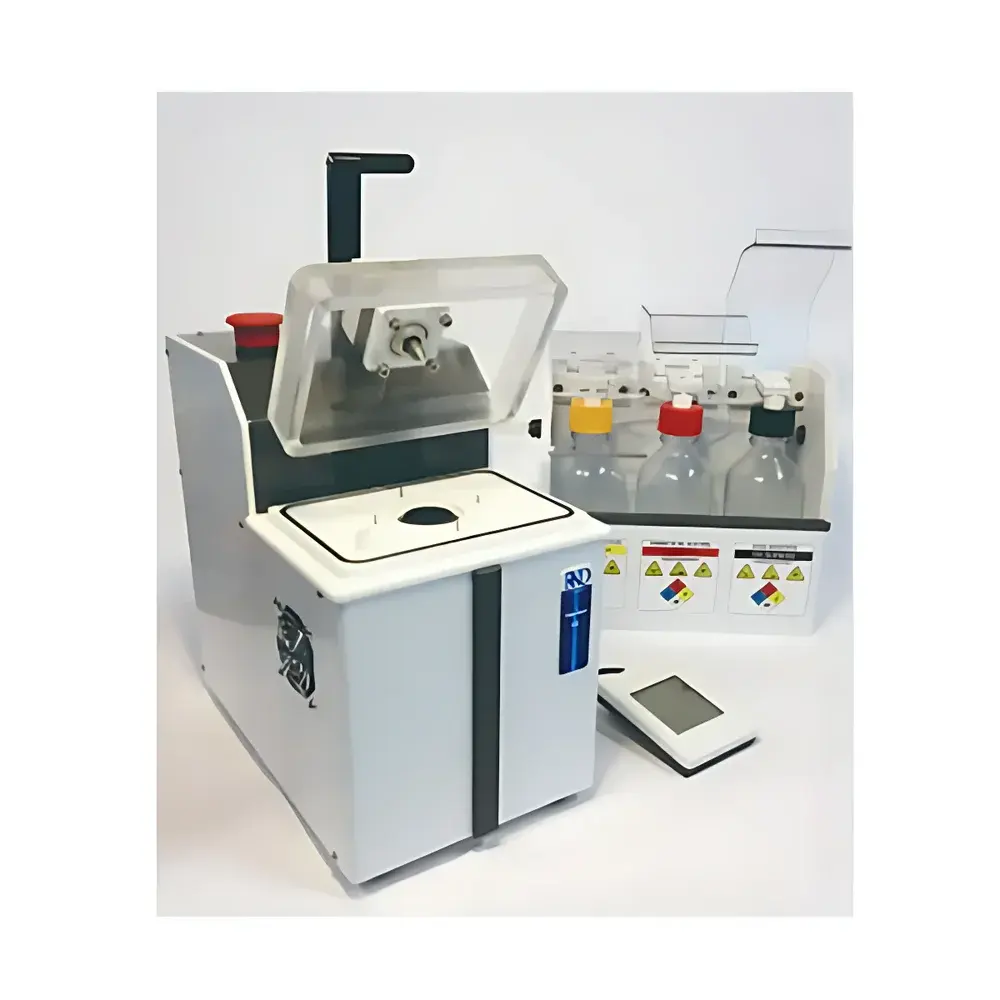
- Carbon-silicon carbide (SiC) etch head with optimized geometry to minimize post-process acid fuming and simplify cleaning—enhancing operator safety and reducing maintenance downtime.
- Pneumatically actuated sample compression assembly: The plunger retracts automatically when the safety hood is open; upon full closure, it extends vertically to apply uniform axial force, eliminating lateral movement of devices or fixtures during etching.
- Dual-sealed fluid path architecture between acid reservoirs and etch chamber—combined with embedded fluid sensors in both bottle modules and internal manifolds—to trigger immediate audible/visual alarms upon any leakage event.
- Integrated thermal exchange system enabling precise acid temperature regulation from 10 °C to 250 °C at flow rates up to 8 mL/min—critical for balancing etch rate and Cu wire integrity.
- Automated high/low-pressure nitrogen switching with internal pressure compensation ensures consistent chamber inerting while minimizing N₂ consumption by >40% versus fixed-pressure systems.
- Fiber-optic proximity sensor confirms hermetic seal integrity of the etch hood prior to acid delivery initiation—preventing uncontrolled vapor exposure.
- Cooled waste acid recovery system maintains effluent temperature ≤90 °C, eliminating need for dual-waste bottles or acid-type switching valves—reducing consumables and cross-contamination risk.
- Externally mounted, chemically resistant handheld keypad allows full parameter control (flow rate, temperature setpoint, pulse duration, dwell time) from outside the fume hood—protecting electronics from corrosive vapors.
Sample Compatibility & Compliance
The Elite Etch Cu accommodates standard JEDEC-compliant package formats including SOIC, QFP, QFN, BGA, and leaded plastic DIPs—up to 32 mm × 32 mm footprint. It is validated for decapsulation of EMCs such as Hitachi HTRB-100, Sumitomo EME-G700, and Dow Corning ECC-4100 series. The system meets OSHA 29 CFR 1910.1200 (Hazard Communication Standard) requirements for acid handling equipment and supports integration into ISO/IEC 17025-accredited FA labs. Optional data logging firmware enables compliance with FDA 21 CFR Part 11 for electronic records and signatures, including user authentication, audit trail generation, and immutable session logs—essential for GMP-regulated semiconductor qualification testing.
Software & Data Management
While the base configuration operates via tactile keypad interface, optional PC-based control software provides extended functionality: method library management, real-time temperature/flow monitoring with graphing, automated protocol sequencing, and CSV export of process parameters per sample ID. All logged data includes timestamp, operator ID, acid lot number, and environmental conditions—facilitating traceability across FA reports. The system architecture supports secure network connectivity for centralized lab management platforms compliant with IEEE 1394 or Ethernet/IP protocols.
Applications
- Failure analysis of thermally stressed or electrically overstressed ICs where delamination or wire bond degradation must be visually confirmed.
- Counterfeit detection through die surface inspection, marking verification, and metallization layer analysis.
- Package reliability qualification per JESD22-A108 (highly accelerated temperature and humidity stress test) and JESD22-A110 (highly accelerated stress test).
- Design validation of new EMC formulations targeting improved thermal conductivity and moisture resistance.
- Process development for advanced packaging technologies including fan-out wafer-level packaging (FOWLP) and 2.5D/3D IC stacking.
FAQ
What acid types are compatible with the Elite Etch Cu system?
Nitric acid (HNO₃), sulfuric acid (H₂SO₄), and pre-mixed HNO₃/H₂SO₄ solutions—formulated per IPC-TM-650 2.3.25 standards—are supported. Custom blends require compatibility validation prior to use.
Can the system handle gold or aluminum wire-bonded devices?
The Elite Etch Cu is specifically calibrated for copper wire preservation. For Au or Al wire packages, alternative etch chemistries and parameters must be qualified separately—contact RKD Applications Engineering for protocol guidance.
Is remote diagnostics supported?
Yes—optional Ethernet-enabled diagnostic port allows secure remote access for firmware updates, error log retrieval, and calibration status verification under ITAR-controlled environments.
How often does the SiC etch head require replacement?
Under typical usage (≤500 cycles/year with proper post-cycle rinse), the SiC etch head demonstrates service life exceeding 3,000 operational hours—verified via RKD’s accelerated wear testing per ASTM F2012.
Does the system comply with CE or UL safety directives?
The Elite Etch Cu carries UL 61010-1 certification for laboratory electrical equipment and conforms to IEC 61000-6-4 (EMC emissions) and IEC 61000-6-2 (immunity). CE marking is available upon request for EU shipment configurations.