
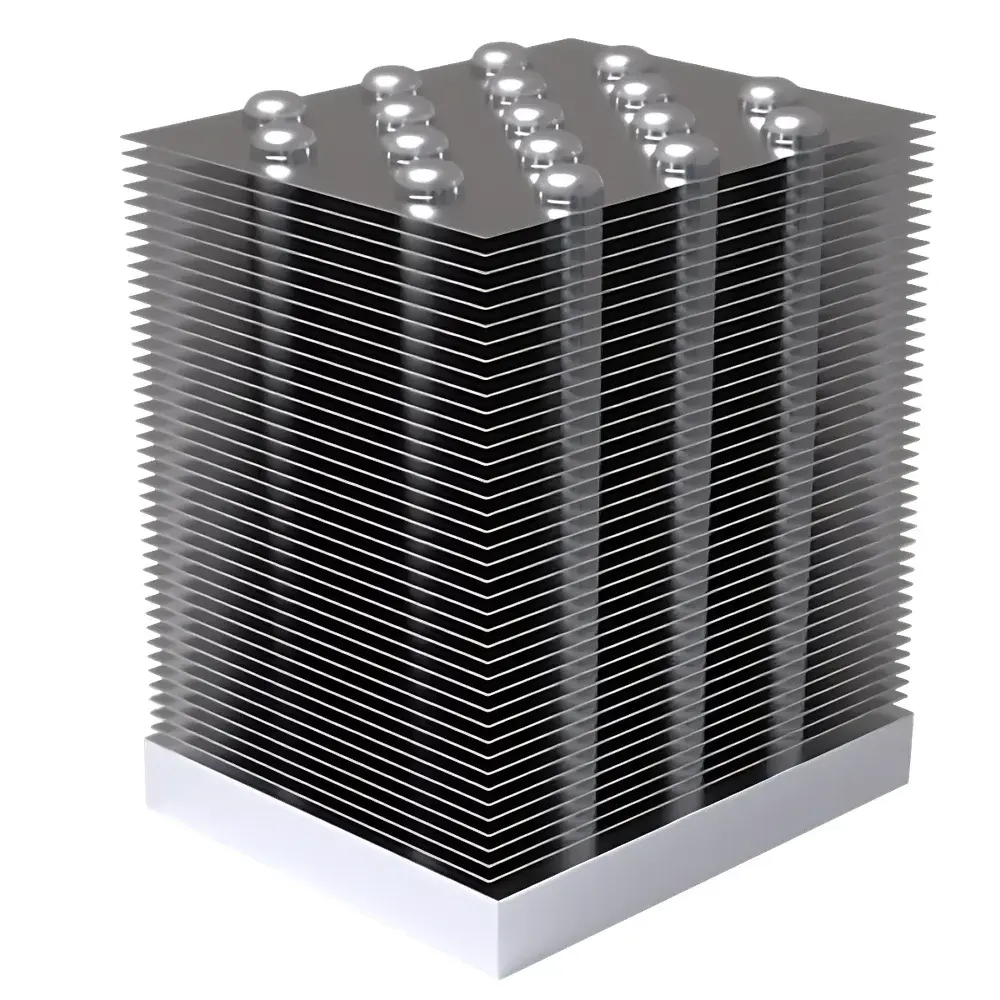
CooliBlade ULTIMA Advanced Forced-Convection Thermal Channel Heat Sink
| Brand | CooliBlade |
|---|---|
| Origin | Finland |
| Model | ULTIMA |
| Heat Sink Material | Aluminum |
| Working Fluid | Hydrocarbon-based Phase-Change Medium |
| Weight | 2.7 kg |
| Mounting Angle | 0° ±5° |
| Thermal Resistance | 0.028 K/W |
| Max Operating Temperature | 150 °C |
| Operating Temperature Range | −20 °C to +150 °C |
| Ambient Temperature Range | −20 °C to +60 °C |
| Storage Temperature Range | −50 °C to +90 °C |
Overview
The CooliBlade ULTIMA is an advanced, high-power forced-convection thermal management solution engineered for standard IGBT power modules in demanding industrial and infrastructure applications. Unlike conventional aluminum finned heat sinks relying solely on conductive and convective heat transfer, the ULTIMA integrates CooliBlade’s proprietary NEOcore thermal channel technology—a monolithic, all-aluminum, phase-change-enhanced architecture. At its core, the NEOcore design eliminates interfacial thermal resistance by embedding a sealed, capillary-driven evaporation–condensation loop directly within the solid aluminum matrix. This enables near-instantaneous lateral heat spreading across the entire structural mass, transforming the entire heatsink into an active thermal conductor rather than a passive dissipator. The system operates without external pumps or moving parts, leveraging latent heat absorption at the evaporator zone (thermally coupled to the IGBT baseplate) and efficient sensible/latent rejection via optimized fin geometry in the condenser region. Its physics-based operation ensures stable performance under transient thermal loads and variable airflow conditions—critical for mission-critical deployments in 5G infrastructure, EV charging systems, and grid-scale power electronics.
Key Features
- Monolithic NEOcore Thermal Channel: Fully integrated, hermetically sealed aluminum structure with internal wickless phase-change pathway—no thermal interface materials (TIMs), no solder joints, no mechanical fasteners between functional layers.
- Ultra-Low Thermal Resistance: Achieves 0.028 K/W (tested per ASTM D5470 under standardized 25 mm² contact area, 50 LFM airflow, ΔT = 60 K), enabling reliable thermal management for modules dissipating >3 kW per unit.
- Lightweight Structural Design: Total mass of 2.7 kg maintains structural rigidity while minimizing system-level weight impact—particularly advantageous for airborne, mobile, or height-constrained installations.
- Mounting Flexibility: Supports both horizontal and vertical orientations within ±5° tolerance; compatible with standard IGBT footprints (e.g., SEMIKRON SKiiP®, Infineon EconoDUAL™) via M5 threaded inserts and optional isolation kits.
- Passive-Ready Operation: Delivers sufficient cooling capacity for many high-power applications without forced-air augmentation—reducing fan count, acoustic noise, and single-point failure risk in redundant systems.
- Environmental Resilience: Rated for continuous operation from −20 °C to +150 °C case temperature; non-corrosive hydrocarbon working fluid ensures long-term stability under thermal cycling and humidity exposure.
Sample Compatibility & Compliance
The ULTIMA is mechanically and thermally qualified for direct mounting on industry-standard 62 mm and 130 mm IGBT module packages used in inverters, motor drives, and medium-voltage converters. It complies with RoHS 2011/65/EU and REACH (EC) No. 1907/2006 requirements. While not a medical or aerospace-certified component, its construction meets IPC-STD-001 Class 2 process controls for thermal interface reliability. For applications subject to IEC 61800-5-1 (adjustable speed electrical power drive systems) or UL 1558 (low-voltage power circuit breakers), thermal validation must be performed at system level per manufacturer-specific derating curves. No hazardous substances are employed in the working fluid or structural alloy (EN AW-6063 T6 equivalent).
Software & Data Management
The ULTIMA is a hardware-only thermal solution and does not incorporate embedded sensors, firmware, or communication interfaces. Thermal performance data—including transient response curves, pressure drop vs. airflow characteristics, and derating tables across ambient temperature bands—are provided in downloadable PDF and CSV formats through CooliBlade’s Engineering Support Portal. These datasets are compatible with mainstream thermal simulation tools (ANSYS Icepak, Mentor FloTHERM, Siemens Simcenter FloEFD) via native .STEP geometry files and validated boundary condition templates. All thermal test reports adhere to ISO/IEC 17025-accredited laboratory practices (per CooliBlade’s third-party testing partner in Espoo, Finland). Traceability documentation—including material certifications (EN 573-3), batch-specific thermal resistance verification, and environmental compliance declarations—is available upon request for GMP/GLP-regulated projects.
Applications
- High-Density LED Lighting Systems: Enables compact, fanless luminaires for street, stadium, and horticultural lighting where junction temperature control directly governs lumen maintenance and lifetime (per IES LM-80/LM-84 protocols).
- 5G Massive MIMO Radio Units: Reduces cooling subsystem mass by up to 70% versus conventional heat sinks, addressing critical weight constraints in rooftop and pole-mounted active antenna units (AAUs) operating under ASHRAE TC 90.4 ambient envelopes.
- EV Onboard Chargers & DC Fast Charging Stations: Maintains SiC MOSFET and GaN HEMT junction temperatures below 125 °C during sustained 22 kW+ operation, even at 45 °C ambient—supporting IEC 61851-23 compliance for liquid-cooling-free architectures.
- Industrial Variable Frequency Drives: Replaces bulky fin-stack assemblies in HVAC and pump inverters, improving power density while meeting UL 508A short-circuit withstand requirements through enhanced thermal margin.
- Renewable Energy Inverters: Withstands solar irradiance-induced cabinet temperatures exceeding 60 °C in outdoor enclosures (per IEC 62109-1), sustaining conversion efficiency >98.5% across full load range in utility-scale PV plants.
FAQ
Does the ULTIMA require refilling or maintenance of its working fluid?
No. The hydrocarbon-based phase-change medium is permanently sealed within the NEOcore structure during manufacturing. No servicing, replenishment, or periodic replacement is required over the product’s operational lifetime.
Can ULTIMA be used in vacuum or high-altitude environments?
The unit is not rated for vacuum operation due to internal vapor pressure equilibrium constraints. Performance degradation begins above 2,500 m altitude (75 kPa ambient); derating guidance is provided in Application Note AN-ULTIMA-ALT.
Is thermal interface material (TIM) necessary between the IGBT and ULTIMA baseplate?
Yes. A high-reliability, low-thickness (<0.1 mm) phase-change TIM (e.g., Henkel ECCOBOND® G310 or Parker Chomerics THERM-A-GAP® GEL 30) is mandatory to ensure optimal interfacial conduction and mitigate micro-gap effects.
What is the expected service life under continuous thermal cycling?
Accelerated life testing (per JEDEC JESD22-A104E) demonstrates >100,000 cycles between −40 °C and +125 °C with 15 years of field operation in typical industrial environments.
Are custom variants available for non-standard IGBT footprints or voltage isolation requirements?
Yes. CooliBlade offers engineering collaboration for mechanical adaptation (e.g., extended baseplates, integrated busbar cutouts, ceramic isolation layers) under NDA; lead time and MOQ apply.



