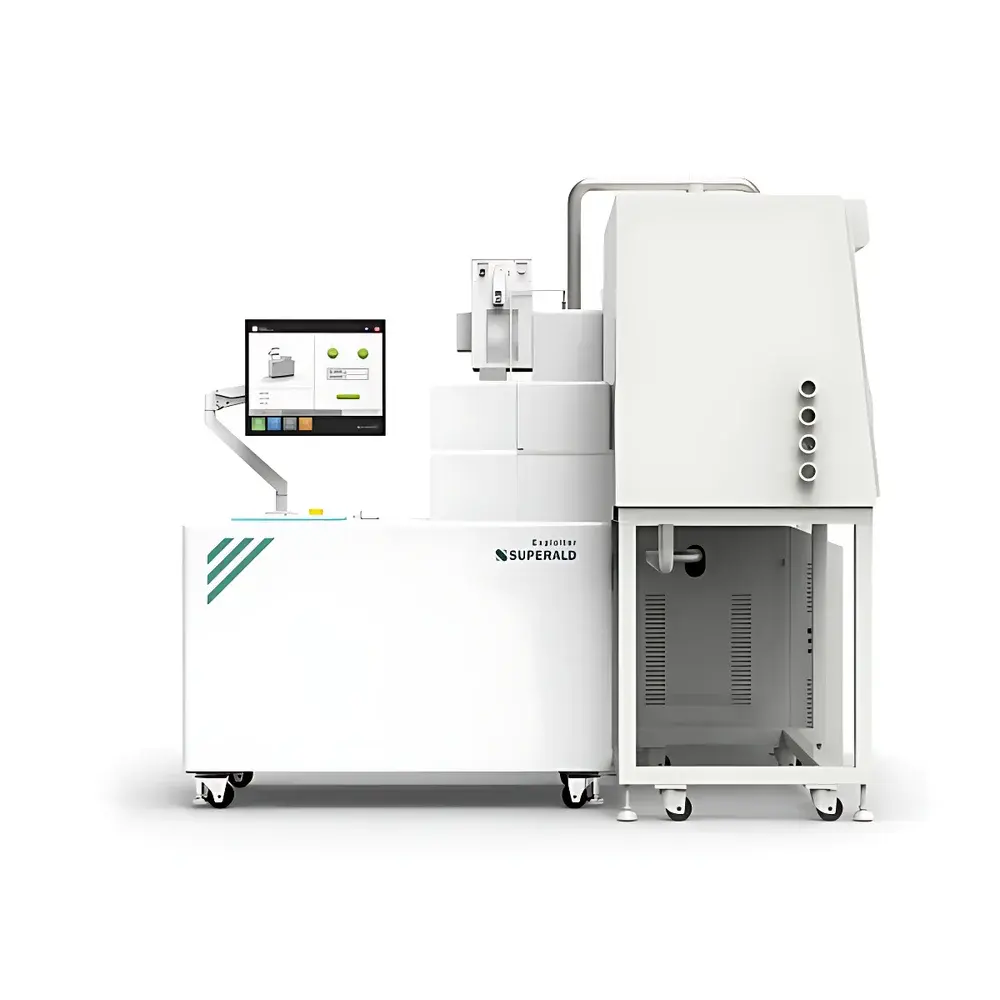
SUPERALD Glove Box Integrated Atomic Layer Deposition System
| Brand | SUPERALD |
|---|---|
| Origin | Guangdong, China |
| Model | Glove Box Integrated |
| Substrate Size | 200 mm (8 inch) diameter (customizable) |
| Process Temperature Range | RT to 500 °C (customizable) |
| Precursor Channels | Up to 6 (solid & liquid sources supported, customizable) |
| Reactant Gas Channels | 2 (customizable) |
| Carrier Gas | N₂ with MFC flow control (customizable) |
| Plasma Gas Channels | 4 (customizable) |
| RF Power | 0–1000 W |
| Pressure Measurement | Dual corrosion-resistant capacitance manometers (0.005–1000 Torr) |
| Base Vacuum | <5×10⁻³ Torr |
| Vacuum Pump | Standard oil-sealed rotary vane pump |
| Control System | 19″ industrial touch display, embedded IPC running Windows 7, PLC-based real-time control with fieldbus support |
| Source Bottle Heater | RT–200 °C |
| Glove Box Integration | Dual-glove, single-station configuration (customizable) |
Overview
The SUPERALD Glove Box Integrated Atomic Layer Deposition System is an engineered platform for ultra-high-purity, atomic-scale thin film synthesis under inert or controlled-atmosphere conditions. Combining a Class 100–1000 glove box environment with a fully integrated ALD reactor, the system enables reproducible, self-limiting surface reactions without exposure to ambient oxygen or moisture—critical for processing air-sensitive precursors (e.g., metal alkyls, amides, and pyrophoric hydrides) and oxygen/moisture-sensitive substrates (e.g., Li-metal anodes, perovskite films, or freshly cleaved 2D materials). The system operates on the fundamental principle of sequential, saturated surface chemisorption: each precursor pulse reacts exclusively with available surface sites until saturation, followed by inert purge to remove physisorbed species and reaction byproducts—ensuring sub-nanometer thickness control, exceptional conformality (>95% step coverage in aspect ratios >50:1), and layer-by-layer stoichiometric precision. Designed for semiconductor process development, advanced battery R&D, and functional nanomaterial synthesis, it supports both thermal and plasma-enhanced ALD (PE-ALD) modes via configurable RF-excited plasma sources.
Key Features
- Glove box integration with dual stainless-steel gloves and solvent-resistant EPDM liners, maintaining O₂/H₂O levels <0.1 ppm during operation
- Modular precursor delivery architecture supporting up to six independently heated and temperature-controlled sources (RT–150 °C), accommodating solid, liquid, and volatile precursors—including corrosive or high-vapor-pressure compounds
- Dual-capacitance vacuum measurement system (0.005–1000 Torr) with chemical resistance, enabling accurate pressure profiling across ALD cycles and plasma ignition thresholds
- Programmable RF plasma subsystem (0–1000 W, 13.56 MHz) with four dedicated gas inlets for reactive species generation (e.g., O₂, N₂, H₂, NH₃), enabling low-temperature PE-ALD of oxides, nitrides, and carbides
- High-reliability PLC + industrial PC control architecture compliant with IEC 61131-3 standards; real-time multi-task scheduling ensures deterministic timing of valve actuation (<10 ms resolution)
- “One-Touch Deposition” workflow automation: vacuum pumping → substrate heating → precursor dosing → purge → plasma activation (if enabled) → cooldown—all executed from a single command with full audit trail logging
- Comprehensive interlock logic including vacuum/pressure safety thresholds, temperature over-limit shutdown, glove integrity monitoring, and hardware-enforced mutual exclusion of incompatible gas valves
Sample Compatibility & Compliance
The system accommodates wafers up to 200 mm (8 inch) diameter, with optional customization for larger substrates or non-planar samples (e.g., MEMS devices, fiber optics, porous scaffolds). It meets core requirements for ISO/IEC 17025-accredited laboratories and supports GLP/GMP-aligned documentation practices: all process parameters (temperature setpoints, pulse durations, MFC flows, pressure logs, plasma power profiles) are timestamped and stored with user ID, session ID, and digital signature metadata. Software includes FDA 21 CFR Part 11-compliant electronic signature modules, role-based access control (admin/operator/engineer tiers), and immutable audit trails for recipe execution, parameter changes, and alarm events. Hardware design conforms to CE machinery directive (2006/42/EC), EMC directive (2014/30/EU), and RoHS 2011/65/EU.
Software & Data Management
The proprietary SUPERALD Control Suite runs on Windows 7 Embedded (long-term support validated) and provides a unified interface for recipe creation, real-time monitoring, and post-run analysis. Recipes define not only deposition sequences but also environmental constraints (e.g., maximum glove box humidity before chamber transfer), hardware pre-checks (e.g., source bottle temperature verification), and fail-safe recovery actions. All data—including sensor time-series, valve state logs, and plasma impedance spectra—are stored in standardized HDF5 format with embedded metadata (CF-conventions compliant). Export options include CSV, MATLAB .mat, and direct SQL database push to enterprise LIMS systems. Remote diagnostics and firmware updates are supported via TLS-secured Ethernet connection, with optional OPC UA server integration for factory-wide MES interoperability.
Applications
- Semiconductor manufacturing: High-κ gate dielectrics (Al₂O₃, HfO₂, ZrO₂), metal gate electrodes (TiN, TaN, Ru), diffusion barriers (WNₓ), and EUV mask capping layers
- Energy storage: Atomic-scale coatings on LiCoO₂ cathodes (Al₂O₃, Li₃PO₄), Si anodes (carbon/TiO₂ hybrids), separator membranes (Al₂O₃ on PP/PE), and solid-state electrolyte interfaces (LiPON, LATP)
- Optoelectronics: Hermetic encapsulation of OLED/QLED emitters (Al₂O₃/HfO₂ nanolaminates), anti-reflective stacks on photovoltaic cells, and plasmonic nanostructure functionalization
- Catalysis & sensing: Single-atom catalysts (Pt₁/FeOₓ, Ir₁/TiO₂), core–shell nanoparticles (Pt@SiO₂), and MOF-derived hybrid catalysts with controlled metal loading and spatial distribution
- Biomedical devices: Bioinert TiN/TiAlN coatings on orthopedic implants, antimicrobial ZnO layers on surgical tools, and drug-eluting polymer film priming layers
- Quantum & MEMS: Low-stress AlN piezoelectric films for resonators, superconducting NbN/AlN heterostructures, and hermetic sealing of microfluidic sensor cavities
FAQ
What glove box atmosphere specifications does the integrated system maintain?
Standard configuration achieves and sustains O₂ and H₂O concentrations below 0.1 ppm inside the work chamber during ALD operation, verified by integrated residual gas analyzer (RGA) port and continuous electrochemical sensor feedback.
Can the system perform both thermal and plasma-enhanced ALD in the same run?
Yes—software-defined process steps allow alternating thermal precursor pulses with subsequent plasma-activated reactant exposures within a single recipe, enabling hybrid ALD/PE-ALD bilayer or gradient film synthesis.
Is remote monitoring and troubleshooting supported?
The system includes embedded Ethernet connectivity with secure TLS/SSH tunneling, enabling real-time remote viewing of chamber status, sensor trends, and alarm history—subject to customer-configured firewall policies and authentication protocols.
How is precursor cross-contamination prevented during multi-source operation?
Each precursor line features isolated stainless-steel tubing, dedicated high-purity diaphragm valves with metal-seated seals, and programmable purge sequences using inert carrier gas; physical layout enforces unidirectional flow paths with zero shared manifolds.
Does the software support integration with external metrology tools (e.g., ellipsometers or XRD)?
Yes—the control suite exposes RESTful API endpoints and TCP/IP socket interfaces for bidirectional communication with in-situ characterization tools, enabling closed-loop thickness control based on real-time optical measurements.