
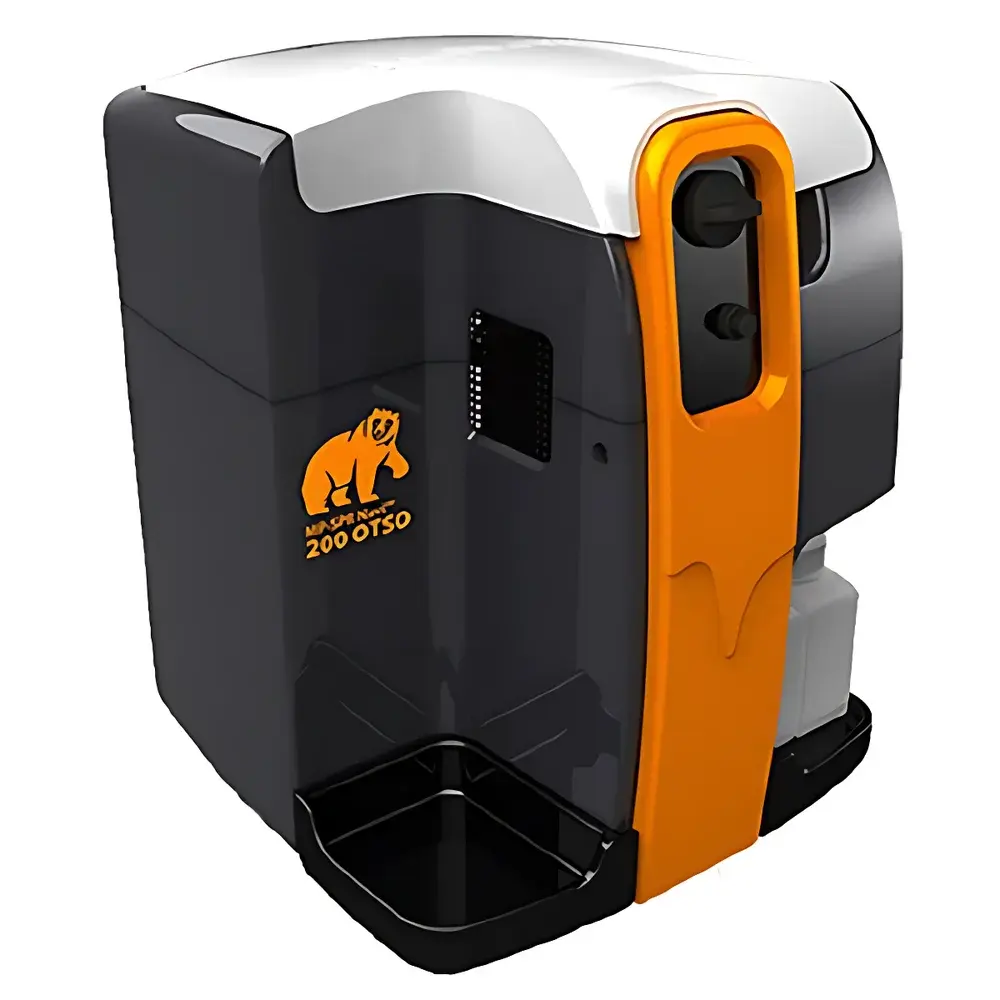
Bionavis MP-SPR Navi 200 OTSO Multi-Parameter Surface Plasmon Resonance Analyzer
| Brand | Bionavis |
|---|---|
| Origin | Finland |
| Model | MP-SPR Navi 200 OTSO |
| Sample Volume | 250 µL |
| Injection Volume | 50 µL |
| Analysis Time | 5–10 min |
| Temperature Control Range | 15–45 °C (ambient ±7 °C / +20 °C) |
Overview
The Bionavis MP-SPR Navi 200 OTSO is a semi-automated, open-architecture multi-parameter surface plasmon resonance (MP-SPR) analyzer engineered for label-free, real-time molecular interaction analysis. Unlike conventional angular-interrogation SPR systems limited to single-wavelength, fixed-angle operation, the MP-SPR Navi 200 OTSO employs true angular scanning (40°–78°) with rotating laser and detector assembly, enabling simultaneous extraction of multiple optical parameters—including resonance angle, full-width-at-half-maximum (FWHM), and intensity—across a broad spectral and refractive index (RI) range. Its core measurement principle leverages Kretschmann configuration coupling without index-matching oil, using prism-mounted sensors with proprietary adhesive coupling gel. This design eliminates sample contamination risks associated with liquid-index oils and enables post-measurement sensor reuse or complementary ex situ characterization (e.g., AFM, XPS). The system supports dual-channel fluidics with independent flow control via peristaltic pumps (10–400 µL/min), accommodating both aqueous and organic solvents (e.g., ethanol, acetonitrile) as well as gas-phase measurements—making it uniquely suited for cross-phase biomolecular interaction studies, thin-film metrology, and functional material characterization.
Key Features
- True angular scanning range: 40°–78° with 0.001° angular resolution, delivering full SPR curves for multi-parameter fitting and robust baseline stability.
- Dual-wavelength capability (standard 670 nm; optional L-option adds 785 nm per channel) enables simultaneous determination of layer thickness and bulk RI—critical for anisotropic or multilayered films (e.g., diamond-like carbon, TiO₂, SiO₂).
- Refractive index measurement range: 1.00–1.40 in bulk media; extended capability for high-RI materials (up to ~2.7) and complex media including 100% serum, urine, saliva, and DMSO-containing buffers (up to 5% v/v) via PureKinetics™ correction algorithm.
- Two independent microfluidic channels with 1 µL PDMS flow cells (standard); interchangeable with chemically resistant PEEK (SPR305-MS), electrochemical (SPR321-EC), gas-phase (SPR310-GS), or fast-kinetics (SPR302-LS) configurations via one-button cell replacement.
- Flexible sensor compatibility: Au, Ag, Cu, Pt, SiO₂, Al₂O₃, TiO₂, CMD, Ni²⁺-NTA, and custom functionalized surfaces; non-in-situ deposition enabled by chip holder for spin-coating, dip-coating, or vapor deposition.
- High temporal resolution: 1 ms sampling rate in fixed-angle mode for rapid kinetic profiling (ka: 10³–10⁸ M⁻¹s⁻¹; kd: 10⁻⁷–0.1 s⁻¹; KD: 10⁻¹²–10⁻³ M); sub-second full-curve acquisition in MP-SPR mode.
Sample Compatibility & Compliance
The MP-SPR Navi 200 OTSO operates across heterogeneous sample matrices without labeling or amplification. It is validated for direct analysis in undiluted biological fluids (serum, plasma, urine, saliva), organic solvents, and gaseous environments—enabling physiologically relevant binding assays under native conditions. Its hardware and software architecture support compliance with GLP/GMP-aligned workflows: raw data files are timestamped, immutable, and include full audit trails (user actions, instrument parameters, environmental logs). While not FDA 21 CFR Part 11–certified out-of-the-box, the system’s deterministic data structure, exportable .csv/.xlsx outputs, and optional TraceDrawer™ (for kinetic modeling) and LayerSolver™ (for optical layer fitting) facilitate integration into regulated environments requiring analytical method validation per ICH Q5B, USP , or ISO/IEC 17025 guidelines.
Software & Data Management
Control and analysis are performed using the vendor-provided MP-SPR Navi™ Control and DataViewer software suite (Windows 7/8.1/10 compatible; ≥4 GB RAM, ≥10 GB HDD). All software licenses are perpetual and unrestricted—no subscription or dongle required. Data acquisition includes real-time visualization of SPR curves, sensorgrams, and derived parameters (angle shift, FWHM, intensity). Export options include Excel-native formats, MATLAB-compatible .mat files, and ASCII text. Advanced analysis modules—TraceDrawer™ (global fitting of association/dissociation phases with mass-transport correction) and LayerSolver™ (ellipsometric-grade optical modeling of multilayer stacks)—are available as optional add-ons. Instrument firmware updates are delivered via secure web portal with version-controlled changelogs and release notes.
Applications
- Therapeutic Biologics Characterization: Quantitative affinity and kinetics of antibody–antigen, FcγR–IgG, and bispecific interactions in complex matrices; epitope binning; conformational stability assessment under thermal or chemical stress.
- Drug Delivery & Nanomedicine: Real-time monitoring of nanoparticle–cell membrane interactions, polymer–drug loading/release kinetics, and stealth coating performance (e.g., PEG density, protein corona formation).
- Biosensor Development: Optimization of immobilization chemistry, signal-to-noise ratio, and limit-of-detection for SPR-based diagnostics on glass, polymer, or nanomaterial transducers.
- Biomaterials & Surface Science: In situ quantification of protein adsorption, cell adhesion, hydrogel swelling, and corrosion-resistant coating integrity—down to monolayer-level sensitivity (1 pg/mm² for proteins; sub-100 Da analytes in liquid phase).
- Electrochemical & Hybrid Sensing: Integration with SPR321-EC flow cell for simultaneous electrochemical impedance spectroscopy (EIS) and SPR readout during redox-triggered binding events.
FAQ
What distinguishes MP-SPR from conventional SPR?
MP-SPR measures the full angular SPR curve rather than a single angle, enabling simultaneous extraction of multiple optical parameters and eliminating angle-drift artifacts. Its oil-free prism coupling and dual-wavelength capability allow broader RI coverage and quantitative thickness/RI decoupling—unachievable with standard SPR.
Can the system analyze small molecules (<500 Da) in serum?
Yes. PureKinetics™ compensates for bulk RI shifts caused by serum matrix effects, and the system’s 1 µRIU sensitivity and low noise floor (<0.3 µRIU short-term) enable reliable detection of low-MW ligands even at sub-µM concentrations in undiluted biological fluids.
Is HPLC-grade tubing used in the fluidic path?
Yes. All wetted components—including pump tubing, connectors, and flow cells—are chemically inert (PEEK, fused silica, or fluoropolymer) and compatible with HPLC maintenance protocols. Replacement parts are field-serviceable without tools.
Does the system support temperature-controlled kinetic experiments?
Yes. The integrated Peltier-based thermostat maintains ±0.1 °C stability across 15–45 °C, enabling Arrhenius analysis of binding thermodynamics and temperature-dependent conformational transitions.
Are sensor chips reusable?
Most metal and oxide sensors (e.g., Au, SiO₂) can be regenerated and reused after mild cleaning (e.g., piranha solution for organics, UV-ozone for organics, or low-pH glycine for antibodies), provided surface integrity is preserved. Functionalized chips (e.g., CMD, Ni-NTA) may require recharging depending on ligand stability.





